

Maintenance and servicing
Augmented reality in maintenance
To ensure smooth production processes, the maintenance and servicing of machines and systems is essential. At the same time, these are becoming increasingly complex, meaning that technicians and engineers without specialist knowledge quickly reach their limits. A new solution trains specialists and drastically reduces downtime and maintenance times.
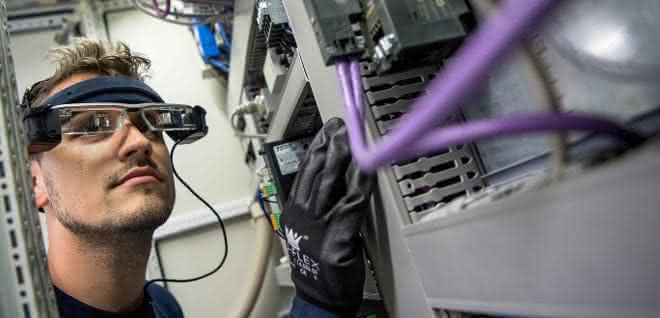
According to a 2015 study by the German Academy of Science and Engineering, maintenance generates an annual equivalent value of around one trillion euros for German industry through plant availability and productivity alone. The potential for fast and conscientious maintenance work is therefore a decisive factor for a cost-efficient production process. A new solution from Fieldbit and Actemium, Vinci Energies' industry-focused brand, uses augmented reality (AR) to make the availability of machines and systems even more reliable and therefore more profitable.
Supporting the maintenance technician with AR
"Modern systems are so complex that even exceptional engineers can be overwhelmed and it would take too much time to familiarize themselves with system plans," explains Edwin Bastings, Account Manager at Actemium. "We wanted to use modern digital technology to provide employees with a particularly comprehensive set of tools so that they can complete even highly specialized tasks straight away."
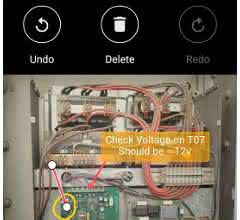
The combination of augmented reality with image and sound transmission creates this additional performance. Via smartphone, tablet or smartglasses, users can access a range of digital tools in real time that help them to carry out analog applications faster and more efficiently.
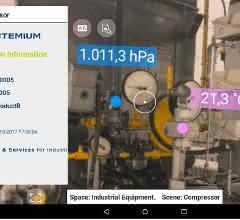
The so-called Fieldbit suite consists of a total of four modules: Hero (interactive AR collaboration, "out-of-the-box"), Cosmic (data access and display), Logic (digital step program) and Knowledge (cloud/server database). Depending on customer requirements, data is stored and transferred either via the cloud (public, private or hybrid) or as an on-premises model via local servers. The Fieldbit app runs on mobile devices (Apple iOS or Android operating system) and receives, processes and forwards the data via WLAN. The helpdesk works via a web application based on HTML5. Optical image recognition or QR codes are used to uniquely identify machines and systems. All system data is read out in Cosmic via the existing SCADA or PLC systems. Actemium provides the necessary framework for this.
In practice, the components of the four modules interact with each other: if a spare part needs to be replaced on a machine, for example, an expert accompanies the technician on site via mobile communications (3G or 4G). Once the technician has scanned the system, the Fieldbit app recognizes it and uses AR technology to digitally superimpose information graphics, circuit diagrams or entire system parts onto the real camera image of the mobile device. All upcoming work steps can even be displayed virtually and explained simultaneously by radio. The increased efficiency results in time savings of 20 to 30 percent.
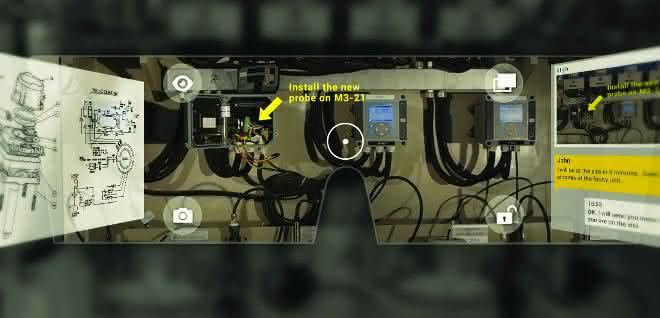
The solution is already running successfully as a pilot project for very different customers: for example, a European railroad company is currently using the application for its train drivers so that they can independently switch their locomotive's voltage transformers to the national power grid when crossing borders. A pharmaceutical customer uses the AR solution to calibrate its systems. Even the military is showing interest in using the solution to maintain their technology, for example during missions abroad.
These examples underline the wide range of applications across several sectors and industries. With the help of the solution, the problems were solved at the first attempt in around half of all use cases. This reduced the customer's costs by around 30 percent.
Michiel Kaelen, Business Unit Manager Industrial Services Veghel (NL), Actemium / ag


You might also be interested in
ebm-papst is growing again thanks to AI and data centers
ebm-papst returned to a growth trajectory in fiscal year 2025/26. Air Technology, data center applications, and artificial intelligence are driving revenue and investment.
 read more...
SPE on the Verge of a Market Breakthrough
Single Pair Ethernet (SPE) has moved beyond the conceptual phase and is increasingly being implemented in industrial settings. The focus here is not only on higher data rates and simplified cabling, but above all on the issue of system integration...
read more...More than 900 exhibitors already registered
Around six months before the start of the trade fair, more than 900 companies have registered for SPS 2026 in Nuremberg. The trade fair focuses on industrial AI, cyber security and digital transformation.
read more...Virtual PLCs in practice: How vPLCs make production systems more flexible and scalable
The increasing networking of IT and OT is fundamentally changing industrial automation. The IT/OT Integration Summit shows how modern technologies can make production environments more efficient, flexible and future-proof. The event will focus on...
read more...Sales growth in a turbulent market environment
Thanks to innovations and a focus on strategic industrial markets, Sick was able to moderately increase its sales in the 2025 financial year. In a turbulent market environment, the company was able to maintain its position and gain market share with...
read more...Siemens presents new AI agent
Siemens is launching 'Eigen Engineering Agent', an AI for automation technology. The solution is integrated into the TIA Portal, has been tested with over 100 companies and is designed to significantly accelerate engineering processes.
read more...Schaeffler keeps sales almost stable
Schaeffler generated revenue of EUR 23.5 billion in 2025 and increased EBIT before special items to EUR 936 million. At 266 million euros, free cash flow was significantly above the prior year and forecast. Net income remained negative due to high...
read more...Advancing artificial intelligence together
Helukabel is stepping up its activities in the field of artificial intelligence and is now a member of the IPAI. The innovation and collaboration platform for companies, research facilities, institutions and administration has set itself the goal of...
read more...New impetus for ifm sales
Two new positions were filled at ifm at the start of 2026: Markus Wolf becomes Managing Director Sales Germany, Sven Quant takes over the position of Central Managing Director in the Process Sensors division within the ifm Group.
read more...