
Shock absorber
Versatile use: dampers in linear modules
Good brakes are needed when riding fast. Here, hydraulic damping elements such as mini shock absorbers are ideal for more demanding solutions, but also structural dampers for simpler tasks. Two practical examples from ACE illustrate this.
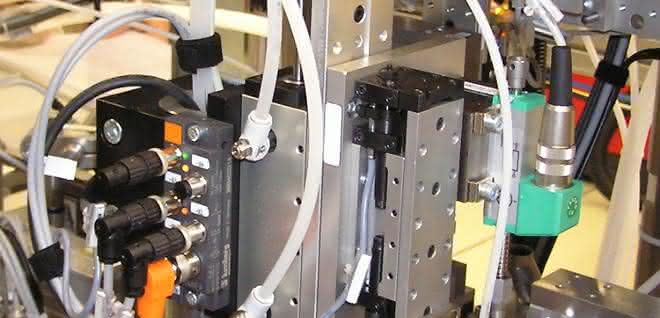
Despite their small size, miniature shock absorbers are technically sophisticated products. They optimize machines reliably and effectively by braking moving masses quickly and non-destructively. When the mass hits the shock absorber, oil is set in motion by the piston in the pressure sleeve and pressed through throttle holes, converting the energy introduced into heat. Depending on the application, the holes are arranged over the stroke in such a way that the mass is decelerated with a constant damping force, i.e. the kinetic energy is dissipated evenly over the entire stroke. The constant linear characteristic curve is associated with the lowest load on the machine. Rapid, gentle stopping without rebound effects enables faster machine cycles with correspondingly higher productivity. It is also pleasing that a considerable reduction in noise is achieved.
One example of this is the pneumatic modules from Zipatec Montagetechnik, Kalchreuth, in which such machine elements are responsible for braking. In consultation with the user, Zipatec determines how the mass to be accelerated and decelerated should behave in a defined unit of time, after which the linear units are adapted accordingly. This means that their mounting surfaces are variable and compressed air feeds can be planned in several options. The use of pre-tensioned cross roller guides in hardened prismatic guide rails ensures 100% freedom from play and a long service life. By combining the guide rail, carriage section and end plates into a single unit, high rigidity is guaranteed over strokes of up to 100 millimetres and with a maximum load capacity of 700 newtons.
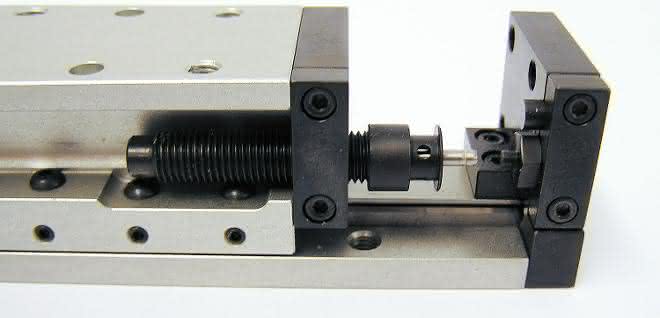
For these tasks in particular, Zipatec provides customers with the LM35 linear unit, a compact but complete solution consisting of a guide rail, carriage section, end plates and damping. The modules can be easily integrated into constructions and the stroke adjustment is so simple that many customers carry it out themselves directly on site.
Savings thanks to miniature shock absorbers
The braking process for handling tasks in comparable modules is often managed using pneumatics. In this case, however, small hydraulic shock absorbers are integrated to make the braking of the modules more cost-efficient and more predictable in the long term. This is because the one-off investment costs for the purchase of shock absorbers are often offset by savings of several thousand euros in operating costs compared to the case where pneumatics would take over braking in the long term.
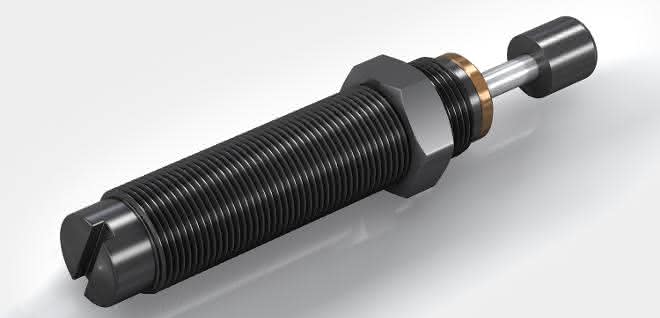
The savings result, among other things, from the fact that, thanks to shock absorbers, the masses can be moved with the smallest possible pneumatic cylinder, allowing the use of smaller valves and maintenance units. In addition, compressed air and the electricity required for distribution are permanently saved. For example, pneumatic end-position cushioning requires around three to four cubic centimetres of air, which is often compressed to up to 70 bar. This is not necessary with mini shock absorbers, as they slow down the movements safely and quickly when the end position is reached, with the added benefit of significantly lower machine loads.
In the case described, miniature shock absorbers of the type MC30EUM from ACE perform this task. Supported by the constantly available online calculation options on the ACE homepage, a proprietary CAD program and additional test series carried out together with ACE, Zipatec opted for the self-adjusting and maintenance-free damping elements. With a stroke of eight millimetres and an energy absorption of 3.5 Newton meters per stroke, these are able to achieve the desired high repeat accuracy of the LM35 in its linear movements, given the high repetition rates of the linear modules and the 5,600 Newton meters of force that must be dissipated per hour. Just 54 millimetres long and ten grams light when extended, the tiny ACE modules can be integrated into almost any design, thanks to a continuous M8x1 thread.
Little helpers for emergency stops
An interesting alternative for reliable protection and also for hard work in the end positions of linear modules are the structural dampers from ACE, known as tube dampers due to their tube-like shape. A total of eight product families with more than 150 standardized individual products have one thing in common: The elements made of co-polyester elastomer are a more cost-effective alternative to hydraulic dampers when precise, i.e. immediate stopping is not required.
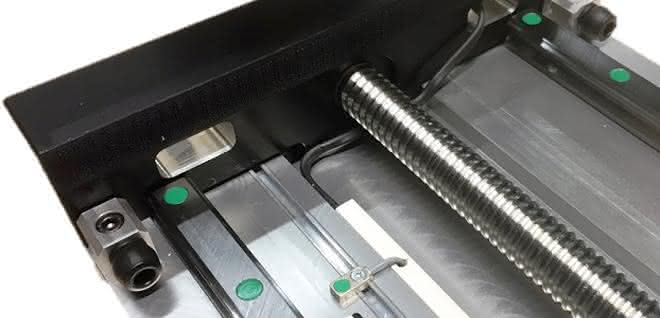
At Lisco, Bargteheide, the tubes are used for the following task: As powerful machine elements in various linear axes, in handling and other motion systems, they ensure that in the event of an operating or software error, there is no uncontrolled impact of the masses in the end positions. The same would theoretically be possible in the event of a power failure. Each of these scenarios would lead to cost-intensive repairs and downtime. As the linear axes at the Schleswig-Holstein-based company Lisco are generally supplied with profile rails or roller guides, it made sense to find a solution that could be fitted to the left and right of the respective rail or guide. The requirement profile also included a compact design and simple installation.
Together with ACE, the TA17-7 tube was identified as the damping element of choice as an alternative to the aforementioned dampers. This is characterized by a degressive damping characteristic, which results in high energy absorption at the start of the stroke. Despite their compact design and low weight of just 40 grams, these tubes are capable of dissipating up to nine Newton meters per stroke at ambient temperatures of minus 40 to 90 degrees Celsius. This specification applies in an emergency.
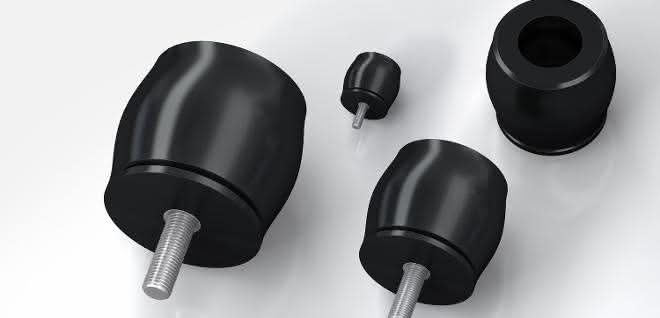
If designs stipulate approaching the end positions as a rule, six Newton meters per stroke are still permissible. In comparison to alternative solutions such as other solid dampers or springs, their long service life of up to one million load changes then comes into its own. This means they last up to 20 times longer than dampers with solutions made of urethane, up to ten times longer than rubber dampers and up to five times longer than steel springs. They can be attached very quickly and without complications using the screw provided.
One advantage that applies to both Tubus and small shock absorbers is that they are easy to integrate. But it is not the only one: both product ranges are available on request with special strokes, characteristics, spring rates, sizes and materials. This makes the designer's work much easier. In addition, both product variants can be used in a variety of ways, for simple tasks on the one hand and for sophisticated solutions on the other, so that designers at ACE have all the options they need to optimize their linear technology. as
Hall 5, Stand 5223


You might also be interested in
Free online tools from ACE in practice
In many companies, digitalization and the lean management approach are seen as a welcome slimming cure. How digital progress is simplifying design processes is demonstrated above all by solutions designed from the user's perspective. Configuration...
 read more...
ACE small shock absorbers secure wheelchair test bench
The demands on the quality and functional safety of wheelchairs are high. This also applies to the test series carried out by manufacturers during the development or further development of models. As part of their training, three mechanical...
read more...E-scooter with customizable damping
The startup Scuddy has significantly improved the flexibility, performance, customizability and ergonomics of its second-generation foldable e-scooter of the same name - thanks in part to damping technology from ACE.
read more...ACE vibration dampers: protected against vibrations step by step
Autonomous driving - what is still being perfected for road traffic is already part of everyday life when it comes to transporting materials from the warehouse to assembly. In fact, manufacturer-independent special kits for converting commercially...
read more...Key factor: energy efficiency
Sumitomo Drive Technologies, together with Invertek Drives and the Lafert Group, will be presenting its complete drive solutions for automation and Industry 4.0. Visitors to the stand will learn how they can achieve their sustainability goals and...
read more...ACE structural and crash dampers: Safety on the road 7
The seventh axis is used in manufacturing and production systems to make robots more agile and increase their reach. As an additional traversing axis, this linear axis brings robots quickly into the workspace or guides them precisely to parallel...
read more...Mechanical and plant engineering
Incoming orders in November: economic dampener takes effect
In the final months of 2022, the various economic downturns were also reflected in the order books of the mechanical and plant engineering sector.
read more...Safe protection for handling systems
Small shock absorbers protect linear axes in the semiconductor industry.
read more...ACE TUBUS structural dampers protect compact sliders
The requirements in automotive manufacturing in terms of product quality, precision and durability are high. Design engineers at voestalpine Camtec GmbH have therefore opted for structural dampers from ACE to protect compact slides.
read more...