
Spring and preload technology
Spring force in button cell format
Smalley wave springs require up to 50 percent less axial installation space for the same spring travel and load capacity. The smallest wave springs in the range have a diameter of just four millimetres.
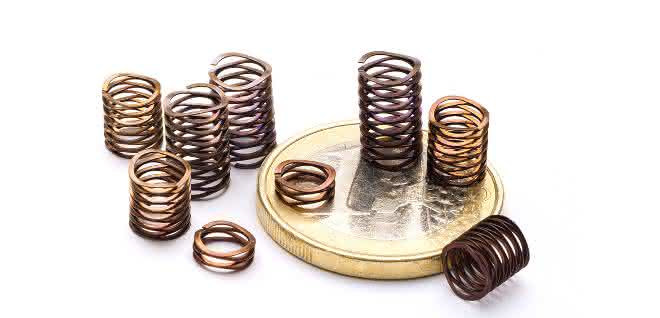
TFC is one of the suppliers of C-parts from the portfolio of the US manufacturer Smalley. The highlights in the current TFC range include the flat wire wave springs from the Crest-to-Crest product line, which are available in many sizes in both metric and inch dimensions and, thanks to their geometry, require up to 50 percent less axial installation space than conventional round wire springs for the same spring travel and load capacity.
They have been used in the design of space-optimized lightweight kinematics for some time now. Since Smalley has been offering crest-to-crest wave springs with tiny diameters of five millimetres or less, they have also been making inroads into the market segment of small-format and miniature assemblies. They are therefore conquering more and more applications in electrical engineering, electronics, optics, robotics, measurement technology as well as medical, laboratory and dental technology, where they are replacing the classic round wire spring.
TFC can currently supply crest-to-crest wave springs in small diameters of six and five millimetres as standard parts. As a customer-specific special solution, flat wire wave springs with a diameter of just four millimetres have also been produced. This was made possible by the further development of edge winding technology, also known as the no-tooling-cost or circular-grain process. With the aim of achieving an almost perfect circle, a pre-hardened flat wire is wound over a high edge.
Axial and radial reduction
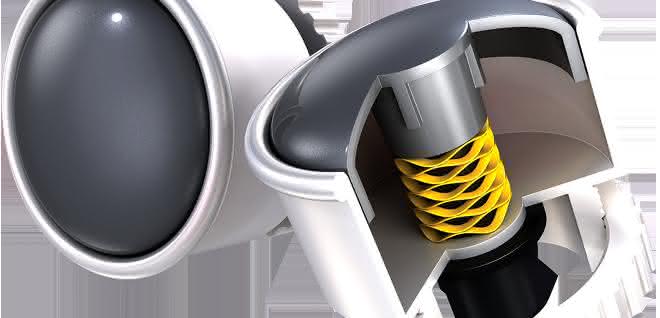
With the small crest-to-crest wave springs, Smalley sales partner TFC is opening up new possibilities for developers and designers in many industries for the axial (and radial) reduction of installation spaces and the innovative miniaturization of their functional modules and components. In addition, many design-related collision problems in small-format assemblies can be eliminated. Pressure valves, switching knobs, plug connectors, movable connecting elements (joints) and many other kinematic assemblies that cannot do without a spring travel, preload or return can be made significantly slimmer in their outer dimensions by using the small Crest-to-Crest wave springs.
At the same time, the springs support the design of modern lightweight solutions. This is because wherever the installation space is reduced, the amount of material required for the peripheral construction is also reduced. This benefits not only equipment and apparatus manufacturers in medical, laboratory, measurement and fluid technology, but also manufacturers of small-format components for automation, automotive engineering and many other branches of industry.
Open gap, overlapping ends
TFC offers the small wave springs in single-layer versions with an open gap or overlapping ends. Other distinguishing criteria include the number of coils and waves and the so-called free height. In terms of materials, the customer can choose between spring steel, stainless steel (17-7 PH) and special grades. as


You might also be interested in
Fraunhofer IOSB Opens Humanoid Robots Lab
The Fraunhofer IOSB is opening a Humanoid Robots Experience Lab in Karlsruhe, Lemgo, and Ilmenau. Companies and organizations can use these facilities to test potential applications for humanoid robots and develop pilot projects.
 read more...
Artificial Intelligence in Manufacturing
Trumpf and IPAI Are Expanding a European AI Network for Industry
The high-tech company Trumpf is an official partner of the IPAI AI network in Heilbronn. Together, the partners aim to exchange experiences, develop new AI applications for industrial use, and advance the development of artificial intelligence in...
read more...Case Study: Networked Manufacturing Platform for Toolmaking
Using a networked manufacturing platform, Escha GmbH & Co. KG, a manufacturer of industrial fastening technology, has comprehensively modernized its toolmaking operations.
read more...Barcelona Declaration on Robotics and...
Robotics Associations Adopt Global Automation Strategy
The global robotics industry is stepping up its collaboration. The associations AER Automation, A3, IFR, and VDMA Robotics + Automation have formed a long-term alliance by signing the “Barcelona Declaration on Robotics and Automation 2026.” The...
read more...Jane Heffner is the new president of the International Federation of Robotics
Jane Heffner is the new president of the International Federation of Robotics. Adrien Brouillard has been appointed vice president of the global federation.
read more...Greater Transparency in the Robotics Market
RoboFinder Launches as an Independent Comparison Platform
Launch at Gitex Europe: 'RoboFinder' aims to bring more transparency to the professional service robotics market. In this interview, founder and CEO Brian Engels discusses market potential, challenges, and the goals of the new platform.
read more...Artificial Intelligence for the Physical Space
Alibaba Expands Qwen Model Family with a Robotics Suite for Physical AI
Alibaba is expanding its Qwen model family with a robotics suite for Physical AI. The three models—for manipulation, navigation, and simulation—are designed to assist autonomous robots with complex tasks in real-world environments.
read more...International Federation of Robotics
U.S. Robotics Industry Sees Double-Digit Growth
In the U.S., sales of industrial robots rose by 11% compared to the previous year: 38,000 units were newly installed in 2025. This significant recovery is driven by robust growth in the food industry and other non-manufacturing sectors. However, the...
read more...Development Collaboration for Humanoid Robotic Hands Launched
Schunk is entering into a new development partnership with Robert Bosch Robotics. Their shared goal is to develop an industrial-grade robotic hand that can be integrated into various humanoid robot systems.
read more...