
Plastic ball bearing vs. metal bearing
Saltwater showdown in the test lab
Igus tested Xiros flanged ball bearings and metal bearings in salt water in its test laboratory. Thanks to the use of lubrication-free and maintenance-free tribo-plastics, the Xiros bearing was able to impress in the test.
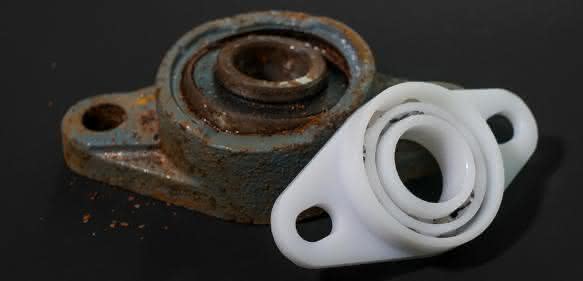
Igus operates the world's largest test laboratory for plastics in moving applications in Cologne. Over 12,000 tribological tests alone are carried out by the motion plastics specialist every year. These include tests that examine the use of a wide variety of materials in the most diverse environments in real-life tests. This time: Xiros flanged ball bearings and metal bearings in salt water.
The engineers at the test laboratory filled a container with sea salt water and heated it to 80 degrees Celsius. Two bearings were then placed in it for 120 hours: A classic two-hole flange bearing made of metal and a Xiros flange bearing made of Xirodur B180 - a high-performance plastic that Igus has optimized over the years in terms of wear and media resistance. Both bearings were not completely covered in the test, but were in contact with air to trigger the corrosion effect.
Clear winner
After just a few hours, the metal bearing began to corrode. At the end of the test, clear traces of rust were visible on all bearing components. The plastic bearing was different. Even after 120 hours, the Xiros flanged ball bearing was unimpressed by the aggressive salt water and high temperatures. No change in color, no trace of rust. A clear advantage, especially for clean room applications and applications in food and medical technology, where rust poses a hygiene risk.
Xiros ball bearings generally consist of four components: the inner and outer rings, the plastic cages and the stainless steel or glass balls. Unlike metal bearings, the wear-resistant polymer bearings enable particularly smooth and hygienic dry running without a single drop of lubricating oil and are maintenance-free. Their long service life can be easily calculated online. The plastic bearings are also electrically insulating, temperature-resistant from minus 40 to plus 80 degrees Celsius, non-magnetic, 60 percent lighter and up to 40 percent cheaper than comparable metal bearings. They are suitable for supporting medium loads and have been used reliably by users all over the world for years - including in conveyor belts, labeling, conveying and packaging machines as well as in filling systems. as


You might also be interested in
Handling and storage solution from Viastore
Hardware and software for the fully automated warehouse
As part of the restructuring of its plant in Curitiba, Brazil, household appliance manufacturer Electrolux has switched to a fully automated warehouse. The literal verticalization of stocks increased productivity, reduced costs and standardized the...
 read more...
Drives for autonomous mobile robots
Fast delivery thanks to powerful drives
Knapp's Open Shuttles, autonomous mobile robots (AMR), enable the automation of in-house transportation without having to adapt the existing infrastructure. The installed drive solutions from Dunkermotoren and gearbox manufacturer Framo Morat enable...
read more...Radio networks for the flow of information
How do you integrate moving components and load carriers into the internal information flow? A radio-supported automatic material retrieval system (AMS) is available for this task, which also precisely records the stocks of goods in the (material)...
read more...Flexibility in the warehouse
Autonomous mobile robots make it possible to automate in-house transportation without having to adapt the existing infrastructure. The built-in drive solutions allow even bulky and heavy loads to be transported safely.
read more...Measure, report, optimize
Trouble-free system control is the basis for efficient production - and this in turn requires seamless, precise monitoring of important parameters.
read more...Modular storage concept
Gebhardt will be presenting the new Gebhardt Upstream at its LogiMat trade fair stand. The proven software solutions, warehouse technology solutions and conveyor technologies such as Galileo IoT, StoreWare and SpeedSorter can also be seen there.
read more...Four automation tips for SMEs
Cobots and mobile robots support automation projects in SMEs. What to look out for when taking the first steps.
read more...Scara robots change the profitability of automation
The introduction of low-cost robots to supplement human capabilities can increase the speed and quality of production. Yamaha uses the example of automated quality control of injection molded parts to show how this can be achieved.
read more...Energy supply, motors and drives
Customized drive technology for intralogistics
ABM Greiffenberger will be presenting complete drive solutions at LogiMAT (April 25 to 27). The system provider adapts these to specific applications and customers - always in close and cooperative partnership with the customer.
read more...