
Rotation module
Getting the hang of EMC testing
XXL rotation module. Frankonia specializes in EMC test laboratories. The company has designed a system for testing components weighing up to 20 tons for a Chinese test laboratory. The turntable on which the components are tested is supplied via an Igus rotation module.
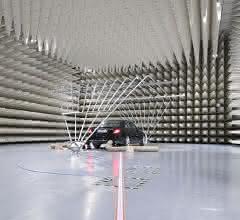
Electromagnetic compatibility, or EMC for short, is important wherever electrical currents flow. An EMC test of all components is then part of the standard tests. Both the emitted interference from the device and - in the opposite direction - its interference immunity are tested. Once the individual components have been tested, they are installed in the overall system - for example a car or an airplane - and tested again in interaction with the other components.
These test laboratories are used by all manufacturers of electrical products and service providers such as TÜV. With the increasing technological progress of electric vehicles or autonomous driving, for example, anechoic chambers are naturally also an essential development component in the automotive industry. In addition, EMC testing is always part of the CE marking of electrical appliances. Frankonia researched a special type of absorbent material back in the early 1990s in collaboration with the University of Cologne and developed the absorber technology under the name Frankosorb. Thanks to its special properties, such as extreme durability and non-flammability, Frankonia became a dominant and unique international solution provider and was able to establish itself in this niche industry of EMC test laboratories. Today, Frankonia develops, researches and produces around 95 percent of all components and products in its own factories in Germany, Poland and China using proven modular and prefabricated designs.
Testing on the turntable
Larger test laboratories for cars are often equipped with a turntable. Andreas Heindl, Product Development Manager at Frankonia: "The measurement during the rotary movement allows a precise scan of the entire test object and shows critical hotspots." In the current project, Frankonia has developed an EMC test laboratory that covers all conditions for testing customer-specific test specimens. This also includes a turntable that is designed for a load of 20 tons and has connections for generators, transformers and electric motors.
One of the special features of the project was that the components had to be supplied with medium voltage during the tests - ten kilovolts of voltage at 700 amps to be precise. The designers were therefore faced with the challenge of routing several cables with a considerable cross-section (and corresponding weight) through the turntable.
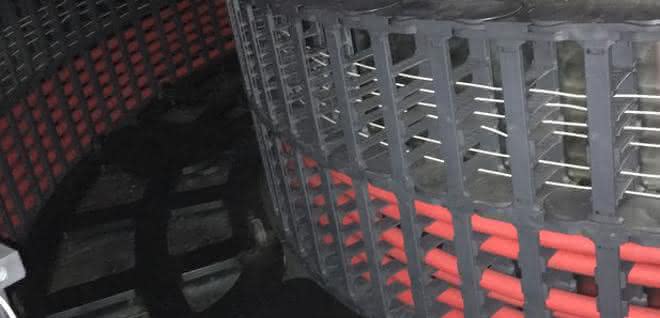
How do you solve this problem? With energy chains from Igus and a corresponding rotation module. Energy chains protect the cables and hoses they carry from failure and wear. They enable a reliable supply of energy, data and media to systems and machines and are constantly in motion. The rotation module consists of such an energy chain in RBR design, i.e. with a reverse bending radius. The chain is tilted by 90 degrees to the usual installation method, i.e. it is positioned on edge, so to speak, and guided in a specially developed trough. The result is a compact and robust cable carrier system that performs rotating movements - the rotation module.
However, the application at Frankonia posed additional requirements resulting from the test environment. Andreas Heindl: "All components must be completely neutral as far as electromagnetic waves are concerned." Conventional energy chains are therefore out of the question, as static charges can occur if the adjacent chain runs touch each other or are in contact with the trough during movement. This would affect the EMC test result.
Rotation module with a diameter of 5.90 meters
This is why ESD-compatible chains from the E4 range from Igus are used here. They differ from conventional materials in that they contain a graphite admixture for hazardous areas. Frankonia uses this type of chain more frequently. In this case, the designers opted for a very large chain with an internal height (or, in this case, internal width) of 80 millimetres. Central bars ensure optimum guidance of the six Chainflex cables, which were specially developed for moving applications and each have a cross-section of 120 square millimetres. Igus supplied a total of several hundred meters of these cables for this project. Various low-voltage and control cables are also routed through the chain and the rotation module.
The turntable has a diameter of seven meters and can hold test specimens weighing up to 20 tons. During a test cycle, which usually lasts several hours, it performs a rotation of 400 degrees: 200 degrees in one direction, then back to the starting position and 220 degrees in the opposite direction. The overlap ensures that the test object is completely covered.
Filling the cable carrier system with medium-voltage cables involves considerable weight. This puts a strain on the chain, whose design is optimally prepared for this and is characterized by very high stability and torsional rigidity - even in the version with a bending radius on both sides. This is due in part to the design feature of the rear grip, which connects the individual chain elements. The rotation module has an outer diameter of almost six meters. So-called floating islands are used as special guide elements in this project to ensure safe and low-friction guidance of the energy chain. The EMC test facility with the XXL rotation module, the ESD energy chain and the Chainflex cables is currently being assembled in China - by Frankonia personnel on site and with the support of Igus fitters in China. as


You might also be interested in
Hebotec at the Hannover Messe 2025
Connecting consumers without tools
Additional robots, control cabinets, control panels or other consumers can be easily integrated into the EMC concept of an existing production line using the PAK 25 equipotential bonding terminal from Hebotec.
 read more...
Motion controller for small drives
Medium power range covered
Faulhaber has another housing-less and compact motion controller in its range, which is particularly suitable for integration in device construction and medical technology applications.
read more...Safe solutions for cable installations
From thick power cables to thin sensor lines, cables and lines must be routed safely through systems and machines. A challenge that should not be underestimated, explains Jörg Sokat, Head of Product Management at Pflitsch.
read more...Displacement measuring systems
Economic positioning
The integrated position measuring system IMS from Bosch Rexroth is now also available as IMS-compact for absolute measurement. The non-contact solution with magnetic measuring principle enables robust and economical position detection for linear...
read more...Economic positioning
The integrated position measuring system IMS from Bosch Rexroth is now also available as IMS-compact for absolute measurement. The non-contact solution with magnetic measuring principle enables robust and economical position detection for linear...
read more...Sensors with IO-Link for extruders
The melting pressure always in view
Macchi, a manufacturer of blown film extrusion lines, optimized its extruders for Industry 4.0 by integrating melt pressure transmitters with digital IO-Link output for precise recording of the melt pressure and magnetostrictive displacement...
read more...Vision with good visitor response
6505 visitors and 378 exhibitors attended the machine vision trade fair in Stuttgart.
read more...Würth Elektronik at the embedded world
Würth Elektronik, manufacturer of electronic and electromechanical components, is presenting itself as a partner to developers at embedded world. At stand 110 in hall 2, the company will be presenting its portfolio and the associated services.
read more...Die-cast electronics housing
CTX Thermal Solutions manufactures cost-effective die-cast housings in application-specific geometries.
read more...