
Slim, strong, quick to fill
Opening the e-chain without tools
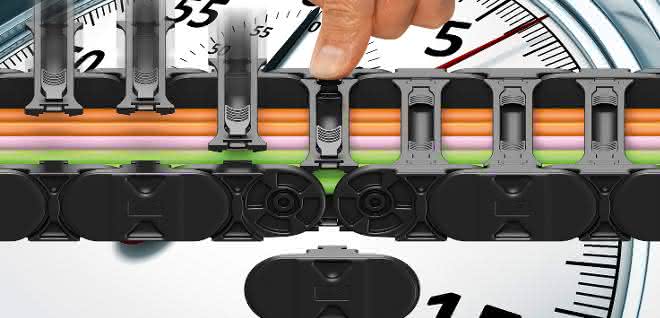
The chain links of the new E4Q energy chain from Igus have a "creek pebble" design to reduce weight and a new opening bar concept with locking tabs. These ensure that the series can be opened and closed in seconds without tools.
Long unsupported lengths and long travel distances with high filling weights are extreme loads for energy chains. The Igus developers have therefore designed the E4Q E-Chain precisely for such application scenarios. Based on the robust E4.1 energy chain standard, the new series offers a long service life and a high degree of modularity.
Naturalistic-inspired shapes are used to optimize the material and therefore the weight of the energy chain. The creek pebble-shaped design can be found on the outside of the chain links and on the stops. Despite the material cut-outs, the new development has a high level of strength and stability, comparable to the E4.1 series.
Assembly with new opening bars
Another special feature of the E4Q is its opening bars, explains the manufacturer. These can be opened and closed completely without tools. There are two recesses on the top of the bar for the fingers, with which the locking hooks can be easily pulled open. Unlocked on both sides, the opening bar can be removed upwards with little effort. This makes it easy to open and close the chain, even in a guide trough, and speeds up the filling of the e-chain by up to 40 percent. Another advantage: thanks to its innovative design, the new opening bar has significantly higher pull-out forces when locked than comparable e-chains.
Additional noise damping
The design also makes the chain very quiet in motion. However, if the user requires additional noise damping, Igus has integrated an optional system in the inner horizontal stop for the E4Q. This consists of two connected balls that dampen the impact during the radius and stretch stop. The balls are made of a new noise-optimized and soft material that further reduces the noise level without limiting the stability of the stops. as


You might also be interested in
Lifting oven grates
Bharat Forge CDP is a supplier of forged chassis and engine components as well as non-automotive systems. Since 2020, the company has been working with Kito-ER2 electric chain hoists to lift furnace grates in the production hall.
 read more...
Mobile and intelligent handling solutions
Scaglia Indeva has been developing and producing industrial manipulators and handling solutions for more than half a century. The company will be presenting its latest products for logistics at LogiMat.
read more...Mink at the Hannover Messe 2023
Transportation on brushes
Technical brushes from Mink are suitable for the gentle transportation of sensitive workpieces. According to the manufacturer, the adaptability of the brushes to different surfaces ensures part quality and avoids rejects.
read more...Partial automation in wood processing
Rescue from the staff shortage
The Schnurr company in Nordrach in the Black Forest has been processing wood for almost 170 years. Today, the company is a sought-after partner when it comes to individual wooden packaging or sawn and planed wood.
read more...Products for better ergonomics
At Intec, Scaglia Indeva will be presenting innovative ergonomic products for intralogistics. The focus is on products for better ergonomics, smoother work processes and protection of employees against overload.
read more...New pallet roller for the warehouse
Conveyor technology specialist Rulmeca is expanding its range of conveyor rollers for pallets and other heavy goods with the XPS series.
read more...Individual energy management
When a Festoon cable carrier system for a crane system with a travel distance of 30 meters was to be replaced, Tsubaki Kabelschlepp designed a complete package consisting of chain and cables, guide channel including substructure and an individual...
read more...Plan and manage maintenance
The health and safety regulations and statutory inspection guidelines for operating equipment in companies are strict and extensive. As a result, it is not easy to keep track of all inspection regulations and periods in day-to-day operations.
read more...Fully automated conveyor system for battery systems
With a fully automated and flexibly expandable conveyor system for truck loading, a manufacturer of battery systems in the electric automotive industry is meeting the increasing demand.
read more...