
Online tools support designers
Digital assistant for synchronized movement
Online support for design engineers. Online tools simplify the entire process from design to commissioning - even for synchronized linear units. With the right software, viable automation solutions for multi-axis gantries and pick-and-place tasks can be implemented quickly and easily.
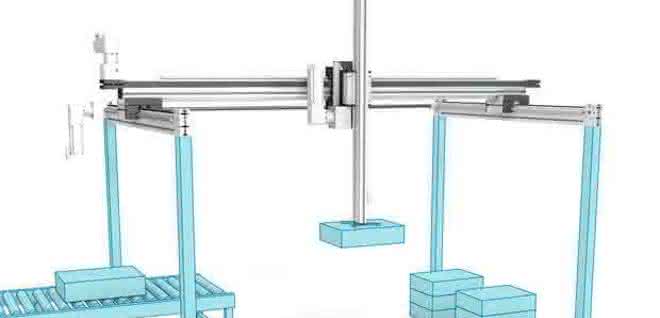
Different requirements are placed on linear units in process automation. Aspects such as speed, payload, accuracy, stroke length, reliability and robustness as well as area of application and duty cycle determine the selection and design. Online tools offer support in the complex selection, design and configuration of mechanical components and systems. For some applications, a parallel arrangement of linear units is necessary if, for example, synchronous movement of both units in one plane is required. To implement this technically, it would be possible to equip each linear unit with its own drive and install a PLC to control the entire synchronization. However, it is simpler to connect the linear units to each other via a shaft and use a single motor. However, the design is then complex. "Automation is easy with the Item Motion Designer," says Uwe Schmitz, Team Leader Product Management item linear motion units at Item. "A single online tool covers various automation tasks, perfectly tailored to individual mechanical and electrical requirements."
Mechanically synchronized linear units can be designed with the Motion Designer to match the transport task. The intelligent program determines the combination of two linear units and a synchronous shaft, which enables two slides or two linear units to run in parallel. "The modular system offers ready-made solutions for a large number of linear units," explains Uwe Schmitz. "These consist of couplings that are mounted between two linear units and connected to a synchronous shaft." The couplings are matched to the linear units. Two metal claws enclose a plastic coupling ring gear, which compensates for axial and radial misalignment.
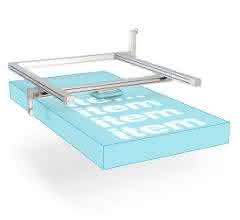
Various gantry solutions are available for the automation of production processes with parallel linear units. These are combinations of linear units with which numerous tasks can be realized, for example the control of different points in a plane by a tool. Two axes then run in parallel and are connected by a synchronous shaft. These 2D surface gantries are used, for example, in systems for printing or inspecting surfaces. Here, probes, sensors or print heads move precisely over a large area. Ideal combinations of linear axes are also available for 3D spatial gantries. Demanding positioning tasks can thus be performed in three dimensions. Synchronized linear axes can be used to design pick-and-place systems, for example, in which grippers and tools for processing tasks are attached to slides and carrier profiles.
Complex task
When designing synchronized linear axes, designers have to take many influencing factors into account. The installation position, dynamic parameters, occurring loads and forces play a major role. The length of the synchronous shaft must be determined depending on the maximum possible speed. Torques can be calculated and suitable couplings selected on the basis of data sheets. In order to achieve an optimally functioning system, the selected components must also be mechanically combinable. "The linear unit is often designed based on corresponding corner points and tends to be oversized for safety reasons," explains Uwe Schmitz. "However, a generous design goes hand in hand with additional costs." If, on the other hand, the system is not sufficiently dimensioned, defects, downtimes and inefficient processes are the result.
With the design of the linear units, speed, precision and load capacity are optimized and the system can be operated efficiently in the long term. Item's online tool makes it easier to dimension and select components. "The Motion Designer calculates the maximum torques, for example, and recommends the solution with the right coupling," says Uwe Schmitz. The software's comparison function shows both the technical requirements defined by the input and the technical specification of the system that Item recommends. The designer can choose between the system that exactly meets his requirements and alternatives that offer more performance reserves. Item thus automates and simplifies the specification of systems and provides an optimally dimensioned overall solution including synchronization set, motor, gearbox and control system. The designer automatically creates complete documentation with all technical specifications and CAD data. In addition, the designer can access numerous application examples including design data. as


You might also be interested in
ebm-papst is growing again thanks to AI and data centers
ebm-papst returned to a growth trajectory in fiscal year 2025/26. Air Technology, data center applications, and artificial intelligence are driving revenue and investment.
 read more...
SPE on the Verge of a Market Breakthrough
Single Pair Ethernet (SPE) has moved beyond the conceptual phase and is increasingly being implemented in industrial settings. The focus here is not only on higher data rates and simplified cabling, but above all on the issue of system integration...
read more...More than 900 exhibitors already registered
Around six months before the start of the trade fair, more than 900 companies have registered for SPS 2026 in Nuremberg. The trade fair focuses on industrial AI, cyber security and digital transformation.
read more...Virtual PLCs in practice: How vPLCs make production systems more flexible and scalable
The increasing networking of IT and OT is fundamentally changing industrial automation. The IT/OT Integration Summit shows how modern technologies can make production environments more efficient, flexible and future-proof. The event will focus on...
read more...Sales growth in a turbulent market environment
Thanks to innovations and a focus on strategic industrial markets, Sick was able to moderately increase its sales in the 2025 financial year. In a turbulent market environment, the company was able to maintain its position and gain market share with...
read more...Siemens presents new AI agent
Siemens is launching 'Eigen Engineering Agent', an AI for automation technology. The solution is integrated into the TIA Portal, has been tested with over 100 companies and is designed to significantly accelerate engineering processes.
read more...Schaeffler keeps sales almost stable
Schaeffler generated revenue of EUR 23.5 billion in 2025 and increased EBIT before special items to EUR 936 million. At 266 million euros, free cash flow was significantly above the prior year and forecast. Net income remained negative due to high...
read more...Advancing artificial intelligence together
Helukabel is stepping up its activities in the field of artificial intelligence and is now a member of the IPAI. The innovation and collaboration platform for companies, research facilities, institutions and administration has set itself the goal of...
read more...New impetus for ifm sales
Two new positions were filled at ifm at the start of 2026: Markus Wolf becomes Managing Director Sales Germany, Sven Quant takes over the position of Central Managing Director in the Process Sensors division within the ifm Group.
read more...