

Vibration measurement
Measure vibrations and order dampers via app
VibroChecker, the free vibration measurement app, and four vibration isolators from ACE shock absorbers have helped a homeowner to eliminate unpleasant vibrations from an air conditioning unit in a short space of time.
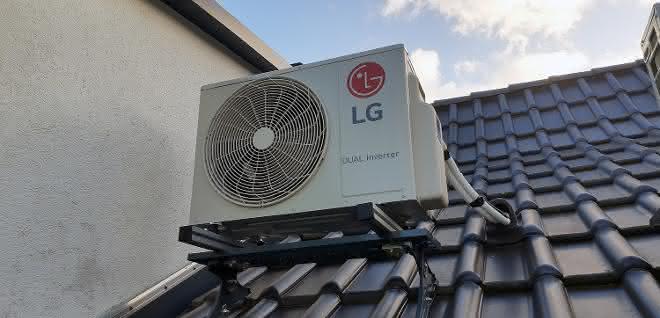
When temperatures no longer fall below 20 degrees Celsius at night, we talk about so-called tropical nights. Such nights have increased noticeably in recent years. Ventilation alone is no longer enough to cool living rooms and bedrooms down to acceptable temperatures. The high Celsius values coupled with high humidity make sleep restless.
In principle, homeowners have three options to remedy the situation in existing properties. Firstly, they can invest a five-figure sum in façade insulation. Secondly, they can purchase a monobloc air conditioning system or, thirdly, they can install an air conditioning split system on the roof. All three options are not really ideal at first glance. Façade insulation is not only expensive, but also involves a high consumption of resources during production and must be viewed critically in terms of thecarbon footprint. For example, a climate split unit would cause fewer emissions even if it were used continuously around the clock for 20 years. Furthermore, even the best façade insulation cannot permanently banish the heat in hot summers.
Disadvantages of split air conditioning units
Monobloc air conditioning systems, on the other hand, require an exhaust air hose to the outside. This is not attractive and certainly not efficient. After all, the same amount of warm air is sucked into the room as is discharged. An air conditioning split unit, on the other hand, has the heat exchanger outside the room to be cooled, just like a refrigerator, and is therefore about three times better positioned in terms of energy balance. However, these devices have the major disadvantage that some of them may not be installed on houses. And even if this is the case, there can be a problem, as this report shows. But ACE shock absorbers found a solution.
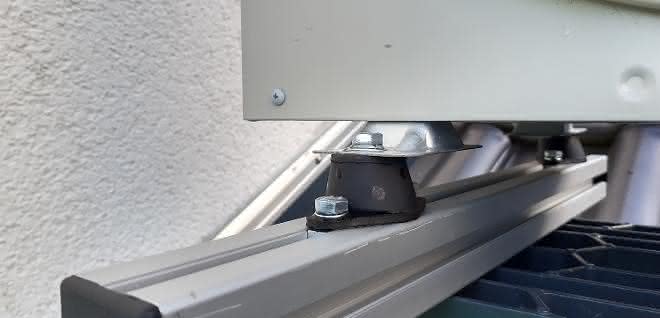
When installed on the roof, it can happen in individual cases that air conditioning splitters vibrate quite strongly and make themselves felt through the vibrations they cause. The vibrations can also be transmitted into the building structure and thus possibly also into the living rooms and bedrooms. In this case, however, a homeowner with the latter condition only struggled briefly with the vibrations caused by his new air conditioning split unit installed on the outside of the house.
He was familiar with ACE through his work as a technician and knew that the company specialized in damping solutions. After a quick phone call, the specialists from Langenfeld recommended that he download the company's own VibroChecker app. This free tool allows the iPhone or iPad to measure vibrations and shocks. Even better: after determining the values that cause the vibrations, the app also shows the ACE solutions that can remedy them. After just a few entries, swipes and confirmations online, four vibration dampers or so-called compression mounts of the type COM-52511 were found to efficiently and permanently isolate the disruptive vibrations later on site.
Suitable damper via app
The family of compression mounts includes vibration dampers that cover a load range of 6.3 to 2,053 kilograms at a natural frequency of 4.5 to 17.3 hertz. The high bandwidths are typical of ACE's standard solutions, as the company aims to provide users with as many models as possible from stock so that the most common designs can be handled as quickly as possible. This was also the case here.
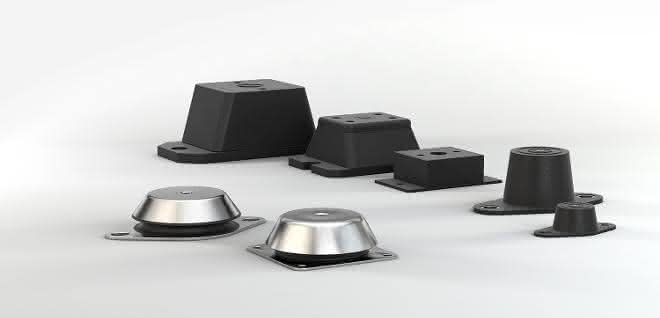
The four small high-performance bearings, which were indicated by the app for an even load distribution of the total mass of the air conditioning unit of 34.4 kilograms and which operate at a natural frequency of seven to eleven hertz, reached the homeowner the day after the order was placed. The machine elements are maintenance-free and are suitable for low-frequency applications from around 15 Hertz. At 25 Hertz, the degree of insulation is 90 percent. Designed for temperatures from minus 30 to 80 degrees Celsius, they are ideally suited for mounting on the fronts of houses in our latitudes, even if they are usually used for vertical loads in industrial machines, small motors, pumps or compressors.
The conclusion in this case is that all the advantages of a climate split device over the much more expensive competitors of monoblocks and façade insulation can now be fully exploited, because thanks to the VibroChecker app and with a material cost of 31 euros, a reassuring solution has been found. as


You might also be interested in
Atlas Copco takes over long-standing sales partner
Atlas Copco has taken over Heide-Pumpen. The specialist for mobile pumps has been working closely with Atlas Copco in sales and service for a long time, especially for surface pumps for construction site dewatering and wastewater detour or in the...
 read more...
Lutz Pumpen at the Achema 2024
New mobile drum pump with battery drive
The new B3 Battery from Lutz Pumpen promises mobile and safe working with aggressive liquids without having to compromise on pumping performance compared to wired versions. The battery-powered drum pump will be on display at Achema, the world's...
read more...Maintenance and Pumps&Valves in February
Final preparations are underway in Dortmund: On February 21, 2024, maintenance will start as the leading trade fair for industrial maintenance and with it Pumps&Valves as the trade fair for industrial pumps, fittings and valves.
read more...Liquid separator keeps pumps dry
Vacuum clamping minimizes distortion and enables five sides to be machined in one clamping operation. The use of cooling lubricants poses a challenge: If they get into the vacuum generator, they can cause serious damage.
read more...Spring clutches for construction machinery
Spring clutches from Torsion Control Products (TCP) are ideal for use in construction machinery where modern diesel engines are used.
read more...Protection against cooling lubricant
Liquid separator from Schmalz keeps pumps dry
Anyone clamping with a vacuum during CNC machining must protect the pump from cooling lubricant. The NLS liquid separator from Schmalz separates the cooling lubricant and returns it to the running process - without interrupting the vacuum.
read more...Which clutch for what?
Mechanical engineering and its applications are multifaceted. Every application is special and requires a perfect machine design. Individual components in the system must also be optimally designed.
read more...Energy efficiency needs electrical engineering and IT
The energy crisis makes one thing clear: it is not enough to simply screw a photovoltaic system onto your roof or purchase green electricity. Industry is faced with the challenge of reducing consumption in order to counter the rise in energy prices,...
read more...Solutions for a networked and climate-neutral industry
At the world's leading trade fair for industry, around 4,000 companies from the mechanical engineering, electrical and digital industries as well as the energy sector will be showcasing solutions for the production and energy supply of the future.
read more...