
Networked linear technology
Linear technology goes on a digital journey
While some design engineers are still amazed at the vehemence with which IT technologies are pushing their way into factories, basic technologies are also changing. Take linear technology, for example: while many still regard it as a purely mechanical matter, more recent developments paint a different picture.
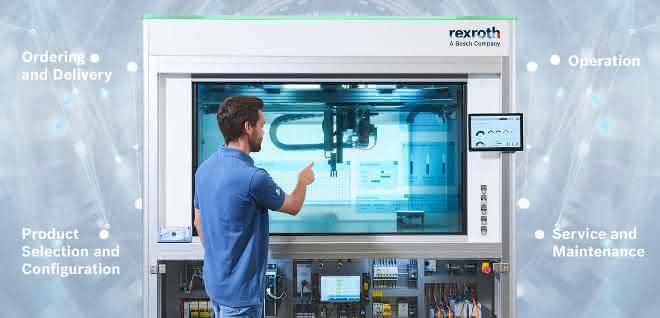
Matthias Rommel, Head of the Linear Technology Division at Bosch Rexroth, explains the opportunities offered by digitalization in linear technology: "What can networked linear technology achieve in the future that it can't yet? We at Bosch Rexroth are certain that much more is already possible today than most people can imagine. We already have a clear idea of how Rexroth linear technology will be intelligently integrated into the factory of the future. Production changeovers will be carried out by software command and sensors will monitor all operating states in order to significantly increase the availability of machines by means of predictive maintenance.
Engineering with online tools
Online tools already support the selection, design and configuration of mechanical components. Design engineers can find their application-specific solution within minutes. In the near future, the software assistants - also supported by artificial intelligence - will reach such a level of maturity that they will be able to map even complex multi-axis systems. In addition to mechanics, they will also include sensors and drive technology, including pre-programmed motion sequences.
The data generated during design and configuration is used right from the start to provide meaningful virtual images for end-to-end digital engineering. Machine manufacturers work with them from the initial idea through simulation and design to electronic ordering and documentation.
This data is then still available and simplifies engineering in the next steps. The individual components are automatically identified during commissioning by digital type plates. Software wizards derive optimum parameters from this individual data and the process requirements. Electrical commissioning is largely automatic and error-free.
Condition monitoring
At the same time, sensors integrated into the linear technology form the basis for comprehensive condition monitoring. No technology is closer to the physical interface between machine and workpiece than linear technology. Nowhere else does the process data come together so unfiltered. The control system knows what the machine is doing, but the linear technology "senses" how it feels. This means that linear technology will soon be able to use condition monitoring to automate the entire process, from wear detection to ordering spare parts.
This forward integration of mechanics for the factory of the future is already in full swing. It is important that machine manufacturers, service providers and users do not have to do their own programming and integration work, but simply use the encapsulated measurement functions of linear technology for their evaluations.
Digital design, configuration, construction, commissioning, retrofitting and predictive maintenance, including service functions: The digital journey of linear technology has long since begun - and it will open up very important horizons for higher productivity over the entire life cycle. as
Hall 4, Stand 4305


You might also be interested in
Predictive maintenance in retrofit
Predictive maintenance pays off. This is because early detection of impending failures means that systems can be serviced in a targeted manner before production downtime occurs. But how complex is it to integrate such a maintenance concept into an...
 read more...
Maintenance instead of replacement
The circular economy starts with the machinery
Sustainability in industry starts with machines, says our guest author from Deguma: How maintenance, modernization and the 5R strategy save resources, energy and CO₂.
read more...3D printing for unplanned requirements
The material fails and the machine suddenly stops? Then you need to take the right measures to be able to resume production quickly. Material failure in the form of faulty components or material wear in the frame are a risk for any production.
read more...High demands in terms of safety, application and robustness
Demanding work in the electrical trade and energy supply as well as smooth processes in production require innovative and customized measurement technology that scores points for safety, ease of use and resilience.
read more...Car meets e-bike: riding with lubrication-free polymer bearings
Studies show that the proportion of pedestrian and bicycle traffic is increasing in urban areas. With the JetBike, JetBike GmbH from Braunschweig presents a mixture of e-bike and car and relies on lubrication-free polymer bearings from Igus.
read more...Hydraulic hub for more efficient servicing
Bosch Rexroth presents a digital toolbox for service and maintenance. With a comprehensive range of digital services, the Hydraulic Hub simplifies and accelerates the service and maintenance of hydraulic products and increases machine availability.
read more...Arnold Umformtechnik expands after-sales...
Faster help with VR glasses
Arnold Umformtechnik is expanding the after-sales service for its machines to include digital remote services. The focus is on data security, simple operation and clear processes.
read more...147,000 euros per hour: high costs for German companies due to unplanned downtime
According to the "Value of Reliability" study, 67% of industrial companies in Germany experience unplanned downtime at least once a month. This costs the German economy 147,000 euros per hour. Nevertheless, reactive maintenance concepts are not...
read more...Maintenance starts with a maintenance planner
Legal requirements stipulate that machines and systems must be serviced regularly. The maintenance work serves to ensure occupational safety and economic efficiency.
read more...