
Loading and unloading machine tools
Linear axis robot compact
The shortage of skilled workers is not a future scenario, but has long been a reality. Many manufacturers therefore want to automate their operations - for example for the unmanned loading and unloading of machine tools. Indunorm Bewegungstechnik offers linear technology and handling systems through to complete cells.
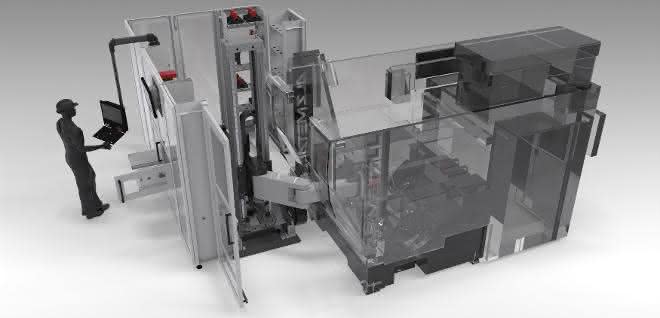
When companies use a linear axis robot with a robot arm, they can save a lot of space compared to a classic articulated arm robot - and therefore also energy and costs, and space plays a particularly important role when retrofitting existing machines. For example, manufacturers are increasingly relying on automated handling to load components for milling in machining centers and then pick them up again for further process steps. "Particularly in times when companies are struggling with a massive shortage of skilled workers, this allows them to run their ghost shifts and use non-productive hours profitably," says Klaus-Dieter Matthes, Managing Director of Indunorm Bewegungstechnik in Duisburg. Manufacturers often use articulated robots for parts handling. "These pick up the workpieces, which are stored in racks in the cells," explains Matthes. "The components can vary considerably in weight and size. At Indunorm, components measuring 630 x 630 x 300 mm or pallets weighing up to 600 kg are possible - but they can also be much smaller and lighter."
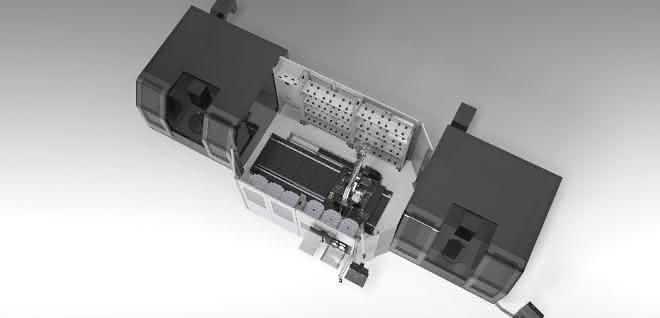
A typical application: The robot is positioned between two machine tools. It takes a pallet from the rack, moves it to the first machine and places it there for processing. It then moves back, picks up another pallet and moves to the second machine. The process starts all over again. As the robot arm is usually too short to operate both machines, the company offers floor trolleys for a large operating range. "The robot can move freely programmable on these. Indunorm supplies these in different sizes. The compact solutions consist of a stable substructure on which recirculating ball bearing guides are mounted. They are driven by a gear rack with permanently installed permanent lubrication. This enables the units to achieve travel speeds of up to 90 m per minute. The trolleys can be attached using floor anchors and leveling devices and covered with a metal sheet. All surfaces are easy to clean and the units are easily accessible for servicing. "Thanks to the simple and robust design, we can extend the length of the floor trolleys at any time - either to the millimetre or with standardized module lengths," says the Indunorm Managing Director. Four sizes from 500 to 1,400 mm wide are available.
Space is in short supply
The problem with articulated robots in this application: Due to their design, there is an axial projection of around 500 mm over the floor trolley when the arm moves. The distance to the shelves or components must be correspondingly large. "If users want to retrofit their systems, they usually don't have the space for automation," Matthes knows from his customers. Renting or buying space is expensive, and for many companies this is not financially feasible. Moving other machines is also time-consuming and expensive. A compact design is therefore of fundamental importance.
How can this be implemented? Indunorm develops linear axis robots. To provide customers with even better support, the engineers have equipped them with a new swing arm or robot arm - similar to a SCARA robot. This offers a clear advantage in terms of space requirements. "We attach it to a tower that is located on the ground chassis," explains Matthes. Compared to a classic robot arm, this does not protrude during movement. This means that the solution can be pushed all the way up to the shelf. "We can build up to 50 % more compactly," explains Matthes. For many manufacturers, this solution is what makes automation possible in the first place.
Smaller footprint, less energy consumption
Because these solutions are more compact, energy costs are also reduced. This is an aspect that is currently becoming increasingly important for manufacturing companies, as rising prices are putting them under considerable pressure. A smaller footprint and more compact design also reduce the ecological footprint - fewer waste products are produced.
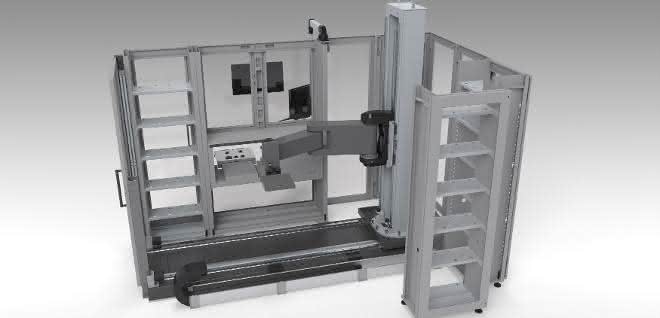
But what if the unmanned running times have to be extended? The operation should not only run until 3 a.m., but until 6 a.m., until the start of the early shift. One idea: build the shelves higher. If they are 1 m or even 1.50 m higher, they offer space for more pallets and components. An articulated robot would have to be larger in order to operate the racks. However, this increases its interference circle diameter: no shelves could be placed within this circle. The system would take up considerably more space. This costs space and therefore money. "With our solution, we only have to build the tower higher and possibly mount it on an optional rotary axis," explains Managing Director Matthes. "We have standard assemblies and modules in our range for this."
Demand in all sectors
Customers who rely on the linear axis robot from Indunorm come from a wide range of industries, including machine tool manufacturing, as described above, for loading and unloading machining centers. "The use in intralogistics is also exciting," reports Matthes. One user uses this solution in an automated high-bay warehouse, for example: The linear axis robot acts as a storage and retrieval unit and automatically picks up the pallet for storage and retrieval.
Another practical example: in order to temper components in large quantities, the linear axis robot places them in different ovens one after the other. The possible applications are diverse - the goal is always the same: to enable the most efficient automation possible. When automating the machining center, Indunorm supplies the complete cell if required, even when retrofitting the machine at the production plant on site. This then has its own drive technology and control system, including the software.
In the other examples listed above, customers mainly buy the mechanical components, including drive technology, from Indunorm. The system is then integrated into the customer's own control system and software. In this case, the customer is not dependent on any other control system. He therefore saves on the additional robot controller and uses his own controller, which is required anyway. Another great advantage for the entire team: only one controller for commissioning and servicing - and there is no need for complex interfaces between the robot controller and the customer's own controller.


You might also be interested in
"We are clearly different from the competition"
The IT company 21unity offers a range of hardware and software services, as well as traditional services. Andreas Mühlbauer spoke to Managing Director Anja I. Gondolf about the company's appearance at the Hannover Messe, its services and future...
 read more...
Think digital, act local
When it comes to industrial damping technology, on-site advice is often very valuable for engineers and designers.
read more...Plagiarius 2024 negative prize
On January 26, 2024, the Plagiarius campaign awarded its dreaded "Plagiarius" negative prize for the 48th time to manufacturers and retailers of particularly brazen counterfeits and fakes.
read more...Spindel Full Service records second-best...
Maintenance as an economic success factor
Spindel Full Service, the spindle repair specialist from Baden-Württemberg, can look back on its second-best financial year in its history - with 15% growth compared to the previous year. And the further forecast also looks good.
read more...Thyssenkrupp and Novelis cooperate
Platform for the circular economy
With a platform for the circular economy in the automotive industry, the two companies Thyssenkrupp Materials Services and Novelis want to set new standards for the recycling of used materials. The open platform will enable access to larger...
read more...How production can benefit from AI
Together with AI technology, IIoT networking makes it possible to better control machine parameters and optimize quality with predictive quality. Downtimes and set-up times can also be further minimized. Cloud platforms also make these technologies...
read more...Marco Ghirardello takes the lead
Fanuc has appointed Marco Ghirardello (48) as the new President and CEO of Fanuc Europe. Ghirardello succeeds Shinichi Tanzawa, who has led the company since 2016 and will take on a new role at Fanuc's headquarters in Japan.
read more...Efficient robot monitoring
Microchips are installed almost everywhere - whether in smartphones, washing machines or cars. With increasing digitalization, the demand for semiconductors has been growing rapidly in all areas of the economy for years.
read more...Everything on one platform
Functional and powerful tools are essential for professional work on the construction site, in the workshop or when carrying out repairs.
read more...