
Chain circulation system
Maintaining the right distance
New at Maschinenbau Kitz is a chain circulation system that feeds and removes workpieces to and from the machining center in a synchronized and position-oriented manner. In order to be able to transport components of different sizes, the distance between the two profile strands on which the components lie can be changed via an adjustment unit. Torque ball bushings and shafts from Dr. Tretter are installed for this purpose.
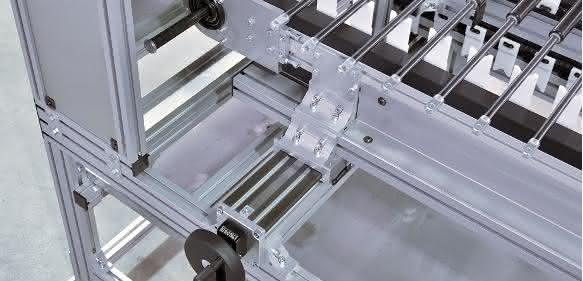
Maschinenbau Kitz in Troisdorf, North Rhine-Westphalia, is one of the leading suppliers of mechanical modules and components for factory automation - including belt conveyors for in-plant transportation. The company acts as the parent company of the mk Technology Group, which includes subsidiaries in Gera near Leipzig, Spain, the Netherlands, Austria, Switzerland and the USA. Of the group's 460 employees, 264 work in Troisdorf alone. The conveyor systems are used, for example, for internal transportation in automotive manufacturing, mechanical engineering, electrical engineering and in the food, pharmaceutical and packaging industries.
The systems are assembled and commissioned at the Troisdorf site. In addition to in-house production, suppliers play an important role for the machine manufacturer. "We attach great importance to reliability, price, adherence to deadlines and rapid delivery when it comes to our partners," explains Sabine Eßer, Group Manager at Maschinenbau Kitz. One of the selected suppliers is Dr. Tretter from the Swabian town of Rechberghausen. "We are particularly impressed by the high quality of the components. This includes the high-performance torque ball bushings and shafts," says the group manager.
Suitable solutions from the modular system
"With our proven and extensive modular system of profile and conveyor technology, we can customize our standard solutions," explains Eßer. The machine manufacturer produces around 4,000 to 6,000 functional modules a year, with an export quota of just under 20 percent. One of the latest developments is the TKU 2040 recirculating chain system: the chain conveyor is ideal for the machine tool and plastics industries as well as for the automotive sector. In use, for example, a handling unit, a robot or an employee supplies the recirculating chain system with the workpieces. The conveyor feeds them to and from the machining center in a defined and position-oriented manner. "The cycle is based on a fixed cycle that the user can configure individually," explains Eßer. "We also supply the fixed interlinking to the various machining stations for this solution."
Different workpieces, different widths
The belt body consists of two chain conveyors - the profile strands. In addition, there are sliding guides for the double roller chain as the transport medium. Plastic prisms, brass prisms or workpiece carriers are attached to the conveyor chain as workpiece holders. These are guided securely by wheels in the deflection. "The important thing about this system is that the user can convey workpieces of different sizes," explains Eßer. To achieve this, the designers have screwed the conveyor body onto an adjustment unit.
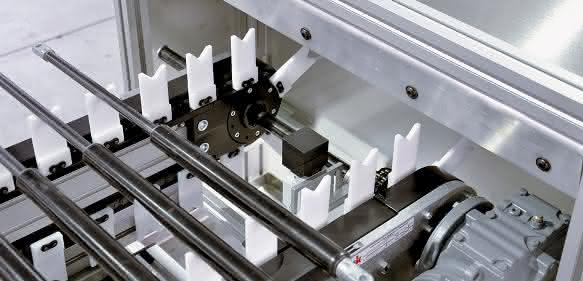
If a component change is required, an employee can move the profile strand both manually and automatically and change the distance accordingly using a handwheel. The design challenge here is that because both profile sections are coupled together, the motor not only drives one section, but also the other. "This means that parallel adjustment on the shaft is absolutely essential," explains Eßer. "If the strand to be moved is tilted, smooth operation can no longer be guaranteed and there is also considerable wear."
In the past, splined shafts or shafts with long keyways were used for the adjustment movement in comparable systems. "Before delivery, we had of course adjusted each system accordingly and tested its function," says Eßer. "However, the settings could become loose during transportation on the loading areas of the trucks, and the adjustment units often no longer functioned when used by the customer. There were always complaints."
Compact and high-quality machine elements
In their search for a solution for the new chain recirculation systems, the mechanical engineers came across the torque ball bushings from Dr. Tretter. They are installed in the deflection rollers and transfer the drive torque to the profile strand. "These high-precision longitudinal guidance systems for torque transmission enable smooth, parallel adjustment of the profile sections in any position - without them tilting. This is ensured by the rolling element ball," explains Detlef Stracke. He is a sales representative for Dr. Tretter and also supported Maschinenbau Kitz with this project.
The torque ball bushing only experiences a transverse force. During transmission, the bushings fulfill the function of a splined shaft. The special feature is that no stick-slip effect occurs due to the rolling element. The translation movement is almost jerk-free. In torque ball bushings, the ball runs in ground grooves. This means that these machine elements are significantly less prone to wear than splined shafts. This is due to the geometry of the contacting bodies: the concave circular arc groove fits snugly against the convex ball. The engineers at Maschinenbau Kitz also have the advantage of being able to realize very compact designs with the torque ball bushings.
"Even if the machine elements are a little more expensive, in the end we get the cheaper solution," summarizes Eßer. "If we need components such as the torque ball bushings, we simply send the drawing with the relevant dimensions to Dr. Tretter. We then receive the complete component with the matching shaft and just have to install it." as


You might also be interested in
BS Rollen Strengthens Its Presence in North Rhine-Westphalia
With the groundbreaking ceremony, BS Rollen is launching the construction of a new company facility in Hückeswagen. The new building will house administrative offices, an assembly line, and a high-bay warehouse, and is intended to facilitate further...
 read more...
Micro motors as the driving force behind intralogistics
Suitable transport structures in intralogistics are a prerequisite in all industries in order to withstand competitive pressure in the future. The basis for this is comprehensive automation, which would be inconceivable without an armada of powerful...
read more...E-scooter with customizable damping
The startup Scuddy has significantly improved the flexibility, performance, customizability and ergonomics of its second-generation foldable e-scooter of the same name - thanks in part to damping technology from ACE.
read more...Electric multidirectional counterbalanced...
360-degree steering on three wheels
Hubtex has given its FluX electric multidirectional counterbalanced truck an update: The new generation for the three-ton capacity class.
read more...New FLUX: 360-degree steering on 3 wheels
HUBTEX presents the new generation of the FLUX 30 electric multidirectional counterbalanced truck (load capacity 3 t). The innovative 2-in-1 stacker is both a front and sideloader. With its patented 360-degree HX steering, it transports both long...
read more...Norelem supports VDI Racing Camp
Mastering the challenges of e-mobility
Promoting young talent has been a priority at Norelem for many years: the company supports young talents with components and the necessary know-how and provides schools with illustrative material.
read more...igus:bike honored with German Design Award 2023
A wide, angular frame made of plastic, black wheels with Y-spokes: The futuristic look of the bicycle designed by Dutch bicycle developer mtrl with motion plastics from Igus can look forward to the prestigious German Design Award 2023.
read more...Floating garbage trap cleans up the Rhine
Every day, a ton of garbage flows down the Rhine. To catch some of it, the Cologne-based Krake association has now inaugurated a floating garbage trap. One of the sponsors of the so-called Rhine octopus is the plastics specialist Igus.
read more...Torwegge presents FlexO rollers
Visitors to the FMB - Supplier Fair for Mechanical Engineering can once again look forward to a new product at the Torwegge stand this year: the FlexO rollers.
read more...