
ACE safety damper
Soft landing during helicopter transport
Transporting helicopters as air freight undamaged to another country involves high demands. Special air transport safety devices from SMJ Sondermaschinenbau are therefore equipped with integrated damping elements from ACE.
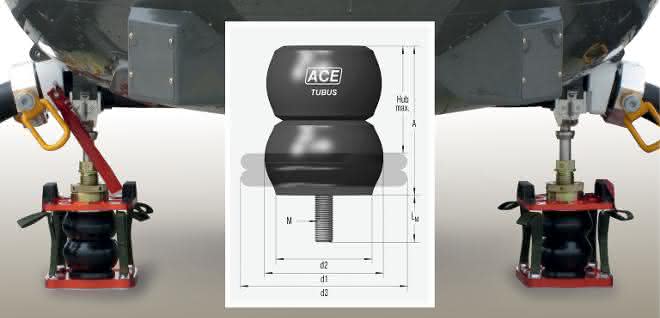
If high-quality equipment for rescue purposes has to be transported to crisis regions, the challenges are all the greater if there is only a small amount of space available for protection. This is the case with a transport aircraft for which SMJ Sondermaschinenbau has developed an ingenious fastening system. The object being transported is a helicopter, which has to be transported like raw eggs inside a cargo plane with the rotor blades removed. The interior dimensions are only a few centimetres more than the external dimensions of the helicopter body.
In order to efficiently protect the overall structure, a landing protection system for attaching the helicopter was developed to series maturity together with the client. This depends on special devices that transfer the occurring loads into the helicopter structure. Extensive calculations were necessary to ensure the load transfer to the individual structural points on the main rotor head and the cabin floor. In addition to secure attachment, the problem of overloading the structure also had to be avoided. Weather-related turbulence, rapid changes of direction and maneuvers during take-offs and landings lead to considerable force effects.
As helicopters are built to save a lot of weight and have a correspondingly fragile design, simply lashing them down with chains and tensioning straps is not enough. This is mainly because the forces acting on the body during flight can correspond to a load multiple of over 4.6 g, i.e. more than four times its own weight. Even without the rotor blades, this amounts to slightly more than three tons. Perfect protection is required to prevent structural damage, which is very difficult to detect during an inspection after air transportation. In this particular case, SMJ Sondermaschinenbau cooperated with ACE shock absorbers.
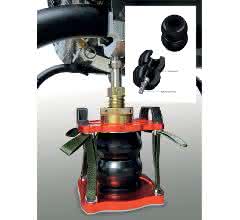
Tube dampers for safe transportation
A precise design was required to determine the exact type of structural damper. This involved determining the necessary energy absorption or force-displacement characteristic. It was taken into account that the helicopter skids allow a certain amount of deflection due to their design and can therefore absorb some of the energy in the event of a hard landing. However, this ability is not sufficient to prevent damage in the event of a rough landing or transportation.
For example, if a load of 10,000 newtons is applied vertically to the helicopter, the skids deform by 30 millimetres. The greater the load, the more serious the deformation. Based on these values, the two selected tube safety dampers had to have a special force-displacement characteristic. Accordingly, the dampers had to adopt a specific design, as they also had to fit into the design of the overall SMJ damping system.
In line with these requirements, ACE manufactured customer-specific special models. Because the individual safety dampers had to be tested before delivery as proof of the characteristic curve, various loads were applied during development. The tube safety dampers specially modified for the application in the course of this process enable the additionally required energy absorption of 124 kilonewtons and thus prevent damage to the helicopter structure in the event of an extreme landing or other shocks during flight.
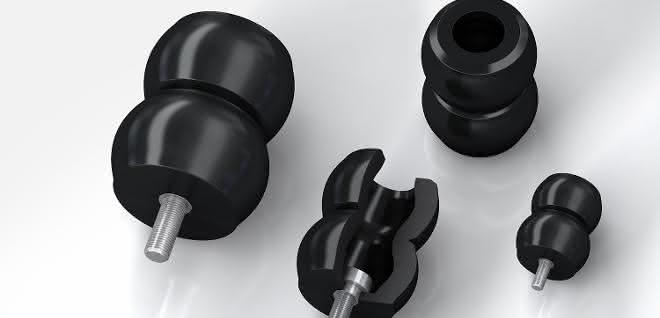
The specially modified TC-S series tubes for this application were originally developed for use in crane systems and meet the international industry standards of the Occupational Safety and Health Administration (OSHA) and the Crane Manufacturers Association of America. (CMAA). The TC-S models are characterized by the so-called dual concept of two damping structural bodies connected in a single machine element, which achieves the required spring rate for crane systems.
ACE adapted the diameter especially for the case described here and provided each custom-made tube with an extra-long stroke of 146 millimetres. As a result, the first air loading operations went to the satisfaction of everyone involved. as


You might also be interested in
Lifting oven grates
Bharat Forge CDP is a supplier of forged chassis and engine components as well as non-automotive systems. Since 2020, the company has been working with Kito-ER2 electric chain hoists to lift furnace grates in the production hall.
 read more...
Mobile and intelligent handling solutions
Scaglia Indeva has been developing and producing industrial manipulators and handling solutions for more than half a century. The company will be presenting its latest products for logistics at LogiMat.
read more...Mink at the Hannover Messe 2023
Transportation on brushes
Technical brushes from Mink are suitable for the gentle transportation of sensitive workpieces. According to the manufacturer, the adaptability of the brushes to different surfaces ensures part quality and avoids rejects.
read more...Partial automation in wood processing
Rescue from the staff shortage
The Schnurr company in Nordrach in the Black Forest has been processing wood for almost 170 years. Today, the company is a sought-after partner when it comes to individual wooden packaging or sawn and planed wood.
read more...Products for better ergonomics
At Intec, Scaglia Indeva will be presenting innovative ergonomic products for intralogistics. The focus is on products for better ergonomics, smoother work processes and protection of employees against overload.
read more...New pallet roller for the warehouse
Conveyor technology specialist Rulmeca is expanding its range of conveyor rollers for pallets and other heavy goods with the XPS series.
read more...Individual energy management
When a Festoon cable carrier system for a crane system with a travel distance of 30 meters was to be replaced, Tsubaki Kabelschlepp designed a complete package consisting of chain and cables, guide channel including substructure and an individual...
read more...Plan and manage maintenance
The health and safety regulations and statutory inspection guidelines for operating equipment in companies are strict and extensive. As a result, it is not easy to keep track of all inspection regulations and periods in day-to-day operations.
read more...Fully automated conveyor system for battery systems
With a fully automated and flexibly expandable conveyor system for truck loading, a manufacturer of battery systems in the electric automotive industry is meeting the increasing demand.
read more...