
Self-made automation
Worm farming with digital support
Self-developed robots and a driverless transport vehicle automate labor-intensive processes in worm farming. The robust components from Igus have become a reliable partner in this process.
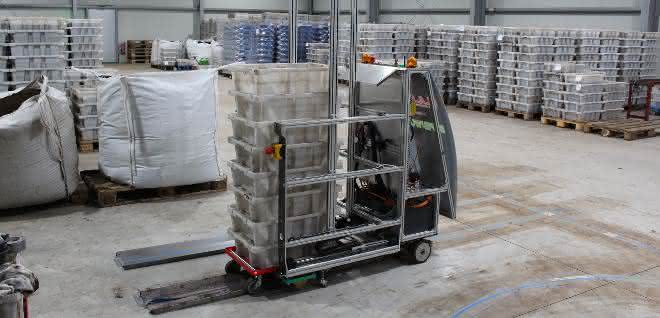
20 years ago, little Marvin stands curiously in front of his father and asks "Dad, how do earthworms actually reproduce?" Martin Langhoff does not hesitate for long and uses the internet to answer the question. This is the starting signal for an unusual family business: The Langhoff family runs a worm farm called "Superwurm" and is fully dedicated to breeding the giant redworm. The family relies on automation. Self-designed machines with Igus components take over work steps that were previously very time-consuming. There are also plans to sell the machines themselves soon.
Energy chains and linear guides without maintenance or cleaning for ten years
Martin Langhoff came across Igus products when he was looking for components for his first self-built machine. The worms' feeding and watering process was to be partially automated. Therefore, the components had to function reliably and permanently under difficult operating conditions with dirt, soil and moisture, as the machine was designed for 24-hour continuous operation. In addition, they should not require lubrication so that worms and soil remain undamaged. In the meantime, the drylin-R quattro slides with all-plastic bearings, which slide on two parallel shafts, and the E4 e-chains have been in continuous use for ten years and the machine runs flawlessly - without maintenance or cleaning.
Superwurm's warehouse is stacked full of Euro containers containing soil and worms. Each of these containers has to be watered once a week and feed is spread on the soil. Until now, the containers have been moved from the warehouse to Langhoff's first feeding and watering machine using a pallet truck. The machine picks up two containers at a time with a compressed air gripper and places them in the next station, where they are sprayed with water and sprinkled with feed. Drylin Quattro slides serve as bearing points for the moving gripper elements.
With this machine in particular, soil and moisture reach the bearing points. As the sliding elements of the linear guides are made of plastic with incorporated solid lubricants and therefore require no additional lubrication, no lubricant gets into the soil. Another advantage of the self-lubricating sliding elements is that dirt cannot adhere to grease or oil.
The e-chains are also unaffected by the harsh operating conditions. Despite dirt, moisture and constant loads, they guide the cables reliably and quietly. Unsupported lengths are no obstacle.
Robots and an AGV take over feeding and watering
Langhoff developed completely new machines to fully automate the feeding and watering process. These include two robots, a conveyor belt and an automated guided vehicle (AGV). The monotonous work steps involved in feeding and watering no longer have to be carried out by one person full-time, allowing them to concentrate on more demanding tasks. "With the new system, feeding and watering can be carried out around the clock, even when staff are absent. In addition, errors are reduced to an absolute minimum," says Martin Langhoff, owner of Superwurm.
The AGV collects the Euro containers in stacks from the warehouse to the new feeding and irrigation system. For this purpose, two parallel synchronously driven drylin ZLW toothed belt axes including portal center drive are installed in the AGV, which pull the stacks of containers on a trolley into the transport vehicle. This required toothed belt axles with stepper motors that can pull containers weighing 120 kg. This complete system is particularly light, requires only low power for operation and is insensitive to impact and dirt. To move the toothed belt axles, the cables are guided using an E6 e-chain. This increases their service life and protects them from external influences. Once the containers have been fully retracted into the AGV, a stepper motor closes a barrier to provide additional safety during transportation. This enables CE marking and approval for use in operation.
Once it arrives at the new feeding and watering system, the AGV moves the containers to the first robot, which places them one after the other from the trolley stack onto a conveyor belt. It works with an intelligent gripper that recognizes and corrects the position of the containers and only lifts them when a secure grip is guaranteed. "We needed cost-effective, compact and lightweight components for this," says Langhoff. Shafts are therefore mounted in Igubal ESTM pillow block bearings to open and close the gripper. Thanks to special tribopolymers, they can withstand high radial loads, are self-lubricating and therefore maintenance-free. Their vibration-damping material and low weight are also beneficial for the movement of the robot. An E4 series energy chain is used to guide the cables safely during the fast movements of the robot and to ensure long-lasting cables. In addition, Igus stepper motors with gears are used so that the gripper can move the containers onto the conveyor belt.
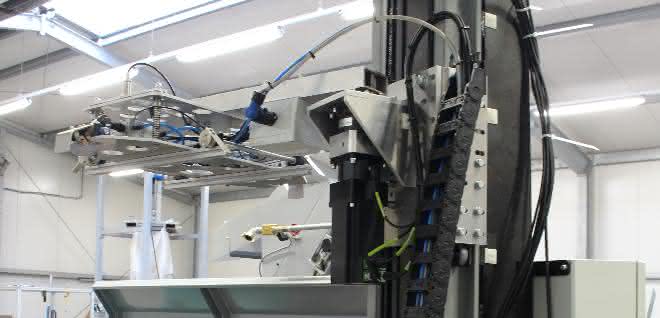
The containers are then automatically watered on the conveyor belt and feed is scattered on the ground. At the other end of the conveyor belt, a second robot lifts the watered and fed containers from the conveyor belt back onto a trolley, the AGV picks them up and drives them back to the warehouse. If the AGV battery is empty, the vehicle drives itself to the charging station and is ready for use again after 30 minutes. After the optimization phase, the family business plans to use a second identical AGV to speed up the process even further.
Even more automation in the future
There are already companies around the world that have recognized the same gap in the market as Langhoff. However, the labor-intensive worm farming is hardly automated at all. The Langhoffs want to change this in their company. The plan is to double the current level of automation in the worm farm. "Small companies need to use affordable and simple automation solutions for production and storage in order to keep up with the big players," says Martin Langhoff.
It is no coincidence that Igus products are used in the machines. The components are particularly wear-resistant and maintenance-free. The products are quickly available everywhere in an emergency. Numerous branches enable customers around the world to obtain components quickly. "We also appreciate the fast and uncomplicated service. You don't find that everywhere," adds Langhoff. For the future, he sees a need for further automation in his company with the help of Igus products and promises: "I already have the first ideas in mind.


You might also be interested in
Soft grippers for delicate foods
Irregularly shaped, fragile, and varying in size and weight: products such as potatoes, baked goods, and dairy products push mechanical grippers to their limits.
 read more...
Development Collaboration for Humanoid Robotic Hands Launched
Schunk is entering into a new development partnership with Robert Bosch Robotics. Their shared goal is to develop an industrial-grade robotic hand that can be integrated into various humanoid robot systems.
read more...Robot-controlled packaging of rolls
Koch Robotersysteme, a company specializing in the integration of robotic systems, has developed a complete, automated packaging line for packaging rolls based on Tentoma’s RoRo StretchPack packaging machine.
read more...Robotics and autonomous order picking
Locus Robotics acquires Nexera Robotics and expands autonomous warehouse logistics
Locus Robotics takes over Nexera Robotics and may have taken a decisive step towards truly universal warehouse automation. A new gripping technology should now make possible what was previously considered difficult to automate.
read more...Gentle wheel handling
The newly founded Eisenmann Robotics division develops new robotics concepts to increase the level of automation in modern production facilities.
read more...Gripping systems and vacuum generators
Schmalz is presenting new gripping systems and vacuum generators at Automatica. Exoskeletons, which allow employees to move heavy workpieces effortlessly, will also be on display.
read more...Smart universal gripper for power electronics
The power electronics manufacturer Semikron Danfoss uses the EGU 50 mechatronic parallel gripper from Schunk in a robotic cell. It handles different components and feeds them to a measuring line. With its functionalities, it meets all requirements...
read more...Schmalz takes over finger gripper from Soft Robotics
The vacuum specialist Schmalz is expanding its gripper portfolio and acquiring the mGrip product family from the US company Soft Robotics (SRI), including all finger gripper configurations, patents and the associated know-how.
read more...Soldering with special gripper
In order to make the mini wave soldering of large panels stable and reproducible, Eutect developed a special gripper that prevents the panel from bending, among other things.
read more...