
When Robots Learn to Understand Unknown Worlds
TUM and MIT Expand Partnership in AI and Robotics
Two of the world’s most renowned research centers for robotics and artificial intelligence are strengthening their ties: The Munich Institute of Robotics and Machine Intelligence at the Technical University of Munich (TUM MIRMI) and the Computer Science and Artificial Intelligence Laboratory at the Massachusetts Institute of Technology (MIT CSAIL) are expanding their strategic partnership. The Bavarian Ministry of Science is providing initial funding of 1.6 million euros to support the collaboration.
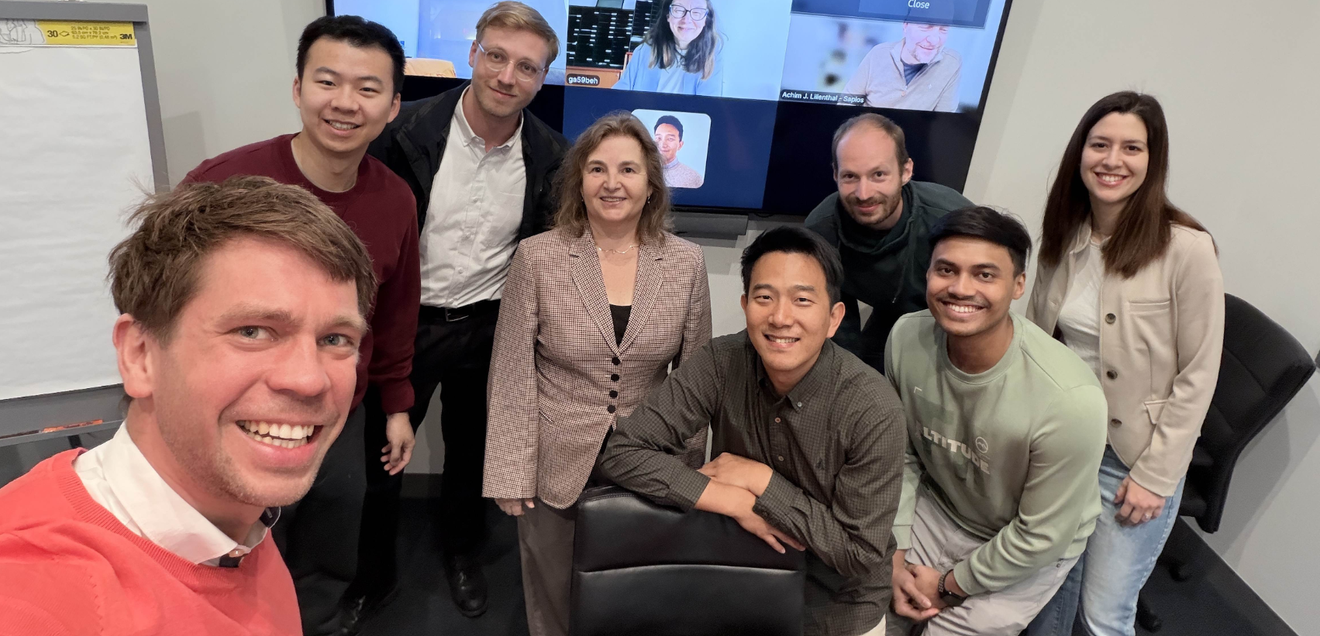
The idea behind the collaboration is simple in concept but technologically challenging: robots should better understand what is happening around them and be able to respond more flexibly to new situations. To this end, researchers from TUM MIRMI and MIT CSAIL are working in joint research tandems to develop applications for AI-based robotics. Once a year, scientists from both institutions will spend three months at the partner site to jointly design, test, and validate new technologies.
Two research centers, one common goal
MIT CSAIL is one of the world’s leading centers for computer science and artificial intelligence. Its director, Daniela Rus, is one of the most internationally renowned researchers in robotics. The scientist, who was recently awarded the Bavarian Minister-President’s High-Tech Prize, is regarded, among other things, as a pioneer in highly efficient neural networks—so-called liquid neural networks—as well as in robot collectives. Other focal points of her work include soft robotics, human-centered autonomous driving, and AI systems modeled after the human brain.
TUM MIRMI is also one of the major research centers in this field. With nearly 80 professors, it is one of the world’s largest institutes for robotics and AI. At the same time, the Munich region is considered one of Europe’s most important ecosystems for these technologies. The partnership with MIT is intended to further strengthen TUM’s international visibility, bring together researchers from both institutions, and increase the region’s appeal to young talent.
Robots are supposed to learn from data and experience
The first research collaboration focuses on the question of how robotic systems can learn from large amounts of unstructured sensor data. Led by Prof. Vincent Sitzmann of MIT, along with Prof. Achim Lilienthal and Dr. Daniel Dücker of TUM, the researchers are developing new AI models for robots designed to navigate even complex and previously unknown environments.
Among other things, generative AI and large video models are used in this process. They are designed to enable flexible path planning and help ensure that robots do not merely repeat familiar sequences but can better respond to new tasks and scenarios.
The second research partnership focuses on production. The team led by Prof. Mina Konaković Luković of MIT and Prof. Kathrin Dörfler of TUM is working on AI-supported methods for sustainable robotic manufacturing processes. The focus is on combining computer-aided design, digital twins, and robotic manufacturing.
Research Between the Lab and Practical Application
The scientific coordinator of the strategic partnership, Dr. Daniel Dücker of TUM, sees the collaboration as an important step toward further development: “a further boost for our research and an important impetus for stronger cooperation.” Even before the partnership began, the MIRMI scientist had been conducting research at MIT.
For Bavaria’s Minister of Science Markus Blume, this partnership represents international collaboration at the highest level: “MIT and TUM—a perfect match! MIT CSAIL stands for scientific excellence and boldly shaping the future. That’s a perfect fit for TUM. Our shared vision: to improve people’s lives through high-tech innovation. Our High-Tech Award winner, robotics pioneer, and CSAIL Director Daniela Rus embodies international networking. It’s wonderful that she embodies the connection between Boston and Bavaria, between MIT and TUM, through this partnership.”
TUM President Prof. Hofmann emphasizes the importance of the new alliance: “I am very pleased that, through the strategic partnership between TUM MIRMI and MIT CSAIL, we have now been able to secure one of the best and most experienced collaboration partners in the field of robotics and AI. In the first research tandems, we will now work together to develop sustainable solutions in the field of AI-based robotics.”
Prof. Lorenzo Masia, Executive Director of MIRMI and TUM spokesperson for the strategic partnership, also sees new opportunities, especially for early-career researchers: “In partnership with MIT and the associated research tandems, we have found a new form of collaboration that offers our young researchers, in particular, an optimal exchange at the highest scientific level.”
Daniela Rus describes the collaboration as a combination of complementary strengths: “MIT and TUM share a common commitment to advancing science that truly matters: science that is both visionary and closely tied to practical applications. Through this collaboration, we have the opportunity to combine the synergistic and complementary strengths of MIT and TUM: long-term scientific ambitions, world-class research talent, close collaboration with industry, and “living labs” where new ideas can be tested, refined, and put into practice. I have long admired the work of TUM MIRMI and am very much looking forward to working with Professor Lorenzo Masia and his team to expand this partnership and help shape the future of AI, robotics, and human-centered technology.”


You might also be interested in
Research at the Intersection of Fiber...
New Fiber-Optic Technology Reduces Energy Consumption in Photonic Computers
Frozen at -196 °C: A new liquid-core fiber combines light and sound with high efficiency, opening up new avenues for quantum computing and photonics.
 read more...
A quantum computer that performs calculations using oscillations
When it comes to storing information, quantum computers have so far run up against technical limitations. Instead of electromagnetic storage, researchers are now using mechanical vibrations. Their vibrating memory can store significantly more...
read more...Hydrogen Pipelines Put to the Test
New real-world lab tests safety and resilience
The Federal Institute for Materials Research and Testing (BAM) is opening a real-world laboratory to study pipelines and components for the safe operation of future hydrogen networks.
read more...Research Platform for the Energy Supply of the Future
For the first time, the Karlsruhe Institute of Technology (KIT) is bringing together key hydrogen technologies in a single research environment. The facility is intended to demonstrate how the production, storage, transport, and use of hydrogen can...
read more...When the quantum computer arrives
The Research Race to Ensure the Security of Critical Infrastructure
How can we protect our critical infrastructure from attacks by quantum computers in the future? As part of the QUEST project, Darmstadt University of Applied Sciences is researching new methods—post-quantum cryptography—designed to withstand even...
read more...VDE study on electrical engineering
More retirements than graduations
According to a VDE analysis, more than 30,000 electrical engineers will retire by 2029 without enough graduates to replace them. This is due to falling student numbers and high drop-out rates.
read more...Giving lightweight construction a profile
Pultrusion: A process that forms fibers under tension
Pultrusion is developing from a niche process into a key process for lightweight construction and sustainable fiber composite structures. The Fraunhofer IWU shows applications from energy to mobility.
read more...Green hydrogen directly from the sun and water
A start-up project at the Karlsruhe Institute of Technology (KIT) aims to fundamentally simplify the production of green hydrogen: Mass-produced photoreactor panels are to be used to produce hydrogen directly from sunlight and water - without...
read more...Fraunhofer shows industrial future between AI, data and new materials
At Hannover Messe 2026, the Fraunhofer-Gesellschaft will be presenting solutions for a resilient industry: from AI and data rooms to hydrogen technologies and material and recycling innovations.
read more...