
Lean management
Pull Consulting develops concepts for SMEs
Thanks to its close cooperation with Landshut University of Applied Sciences and the Puls Technology Center in Dingolfing, Pull Beratung has access to the latest methods of production and logistics planning, including a modern learning and model factory. With Lean Factory Design, the consultancy offers medium-sized manufacturing companies a holistic approach to making their production and logistics more competitive. Always in view: the value stream. By Dr. Markus Schneider

Selective improvement measures driven by individual specialist departments are a common phenomenon. However, they often prove to be a further shortcoming because they are approached without the necessary interdisciplinary understanding of the entire system. Methods are used in combination that lead to contradictory results, are not compatible with the lean concept and therefore create seemingly unsolvable conflicts of objectives, usually at departmental boundaries.
Many optimization projects are often carried out during ongoing series production, i.e. after the start of production. In these cases, a number of restrictions can have a negative impact on the expected result. Factors such as available space, tools and machines that have already been procured, customer approvals granted for processes, certifications, established processes and much more make changes difficult. Studies show that only around a fifth of the costs can be influenced during ongoing operations when change costs are high. The big lever for optimization therefore lies in the planning phase, before the start of production. However, this potential is insufficiently exploited, particularly in SMEs, due to a lack of planning capacity. Optimization measures are also often implemented too quickly without having identified the actual cause of the problem: It is sometimes difficult to identify where in the overall system optimization should be applied and which levers can be used to achieve the desired effects. As a result, only "symptoms" are cured.
Transferring standards to own production
These findings from two decades of practical experience and a decade of research activities in the optimization of production and logistics systems have prompted Prof. Dr. Markus Schneider, Managing Director of Pull Beratung and Head of the Puls Technology Centre, to develop his own optimization concept. It is called Lean Factory Design (LFD).
The core of this approach is the so-called Landshut Production System. In it, around 100 lean principles and the necessary methods are systematically and coherently built upon one another. This forms the basis for knowledge management and serves as a guide for planners in their actions. The Landshut Production System can serve as a model for medium-sized companies to derive their own lean production system.
LFD always considers a complete factory from goods receipt to goods issue with all value streams for customer products. These are examined holistically from the three dimensions of process, technology and people. The concept is deliberately designed to be interdisciplinary and often helps to resolve existing conflicts of objectives between production and logistics, but also purchasing, technical development, IT and, above all, controlling, and to develop the entire factory in a targeted manner in one direction.
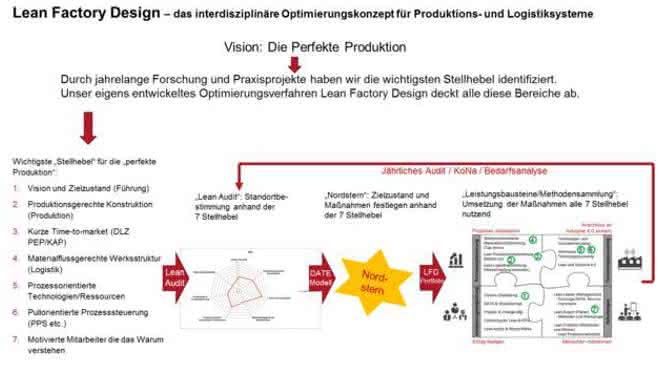
The term design means that LFD encompasses the entire life cycle of a factory and deliberately focuses on the design and planning phase before the start of production, as this is where 70-80 percent of subsequent costs can be influenced with comparatively little effort. However, design also means consciously shaping the system. This requires comprehensive knowledge of the right levers for optimizing production, which often only have an indirect effect on the overall system.
Lean Factory Design is an interdisciplinary optimization concept for manufacturing organizational units with 100-2,000 employees. Driven by the vision of perfect production, Prof. Dr. Schneider has been systematically collecting and developing organizational and technical solutions for over ten years in order to get closer to this goal. Through intensive research and numerous practical projects, he has been able to identify the seven most important levers for optimizing production systems. Interestingly, these levers are neither directly located in production nor do they have a direct effect on it. For this reason, but also due to the lack of interdisciplinary know-how, they are often overlooked and not used in practice. Used correctly, they nevertheless form a highly effective planning and optimization approach that combines key elements of many relevant disciplines.
The path from actual to target status
At the start of an optimization project, a specially developed "lean audit system" measures the lean maturity level of an organization in relation to these seven levers. In the form of a two-day inspection, it is determined how efficiently the processes in the company are currently running, whether and how the most important levers for optimizing production are being used and in which areas previously undiscovered potential lies dormant. A comparison is also made with other companies to determine the company's own position. In addition to determining the current level of lean maturity, this forms an ideal basis for planning further steps.
Involving management is essential for the success of the project. This takes place as part of a "North Star Workshop". The potential identified in the lean audit provides a target-oriented guide to what the company should focus on in the next planning period. The measures required to achieve these targets are then planned and implemented using the LFD method kit. This is designed in such a way that, on the one hand, it takes into account all seven levers of production optimization and, on the other hand, only contains methods and tools that have been tested for their lean compatibility and, if necessary, further developed. The basic structure is based on the three dimensions of a company as a socio-technical system: process, technology and people.
The starting point of an optimization project is usually value stream-oriented material flow planning. Here, lean methods such as value stream design are combined with selected approaches from classic factory planning and factory planning software. The customer thus receives a master plan for each location in the form of a 2D layout, value stream and action plan for several years into the future. A master plan helps to ensure that the high investments in buildings and infrastructure are properly aligned in the long term.
This top-down-oriented approach is combined with bottom-up-oriented "lean production optimization" in what is known as the counterflow method. It is optimized in an onion-slice fashion from the workplace outwards. While the master plan is intended to ensure long-term orientation, the bottom-up approach brings direct and tangible success in the short term.
Individual solution with specific training concept
The technology dimension is currently an important driver of innovation, particularly due to digitalization and Industry 4.0. The basis for process-oriented technology selection is provided by the "Intelligent Production Logistics" model factory at the Puls Technology Center in Dingolfing and a catalog containing a structured list of over 170 technologies for production logistics. The "technology scouting" workshop concept also provides a quick overview of the available options. Thanks to the methodical support, the technologies that are ultimately used in the companies are determined strictly on the basis of the process requirements of the respective environment. This ensures an individual, tailor-made solution instead of following certain industry trends or selecting technologies simply because they are already known in the company.
A particular challenge in any change project is the human dimension. After all, the best plan is useless if the employees do not accept the ideas, do not understand the why and do not live the processes. Lean Factory Design includes a target group-specific training concept that is coordinated both in terms of content and timing with the process optimization process and covers topics such as "on-site leadership", store floor management and Kata in addition to lean methods.
Dr. Markus Schneider, Professor of Logistics, Materials and Manufacturing Management at Landshut University of Applied Sciences, Scientific Director of the PULS Technology Centre and founder and Managing Director of Pull Beratung GmbH / ee


You might also be interested in
Plagiarius 2024 negative prize
On January 26, 2024, the Plagiarius campaign awarded its dreaded "Plagiarius" negative prize for the 48th time to manufacturers and retailers of particularly brazen counterfeits and fakes.
 read more...
Ivalua honors winners of the Generative AI...
AI-supported "add-ons" for buyers within 48 hours
Ivalua, provider of cloud-based spend management solutions, announced the winners and innovations of the first Generative AI Innovation Cup. The competition took place in December 2023. It was open to all Ivalua partners and employees - more than...
read more...Efaflex celebrates 50 years of high-speed...
The emphasis is on "fast"
Since day one, Efaflex has wanted to use new technologies as early as possible and drive progress in the industry. This year, the family business is celebrating its 50th anniversary under the motto "Fast Forward".
read more...Security of supply even during power outages
In the winter of 2022, Germany was worried about energy shortages. The drugstore retailer dm did not paint any horror scenarios, but nevertheless saw the possibility of controlled, temporary, regional power cuts (brownouts).
read more...Safety technology in mechanical engineering
Modules with new functions
Euchner's product highlights at EMO 2023 include the communication-capable solenoid interlocks.
read more...Transforming the paper industry towards climate neutrality
Together with partners from industry and research, Voith is developing a project for the optimization of energy and material flows in paper production. The aim of the research project is to develop a digital framework that enables effective process...
read more...Up to 95 percent less flue gas thanks to direct extraction
The requirements for occupational safety measures and safety technology are also constantly increasing in welding technology. The Technical Rules for Hazardous Substances (TRGS) stipulate that welding fumes and harmful substances must be extracted...
read more...Competitive advantages with large machines
Whether 3D-printed components for machines and systems, prototypes or aids for design: additive manufacturing is almost indispensable for modern companies in mechanical and plant engineering and automation if they want to play in the premier league.
read more...Transport technology from the modular system
Many transport tasks can be realized with the help of linear technology. Pre-configured solutions are available to simplify the interaction between the linear unit, motor, gearbox and controller. This minimizes the effort required for research and...
read more...