
Exchange of words on location technology standard
Into the future with Omlox
Around 60 industrial companies have joined forces to develop the new "omlox" positioning technology standard. One of them is the IT and software service provider GFT Technologies SE, which is currently expanding its industrial business significantly. In this interview, Siegfried Wagner from the GFT subsidiary in-integrierte informationssysteme GmbH explains what makes the omlox standard so special and how pure localization data can be converted into useful business data.
What exactly is omlox?
Siegfried Wagner: Omlox is the world's first localization standard for industry. It allows various localization technologies such as ultra-wideband, RFID, 5G or GPS to be combined and made available via a uniform interface, just as we know it from the consumer sector with USB or Bluetooth technology. In this way, industrial companies can fully track their supply chains and monitor them in an end-to-end system. Previously, there was often a break when moving from the outdoor standard GPS to the indoor system. Now a transition is possible without interruption - "seamless", as we say in IT-speak. Forklift trucks, drones, driverless transport systems or tools from different manufacturers can be localized with millimetre precision using just one infrastructure.
What does GFT have to do with omlox?

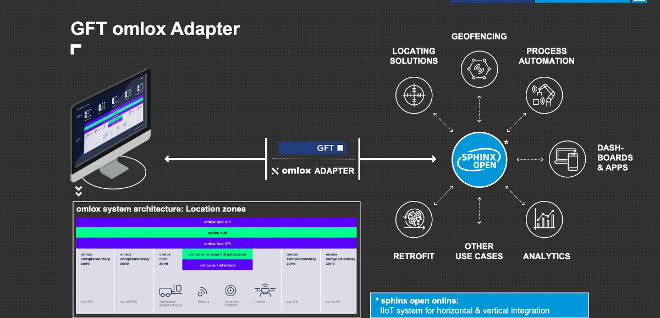
Wagner: In the GFT subsidiary that I am responsible for, we have been working on the topic of localization technology for years and consider this common standard to be a great achievement. Localization services and localization technology are a promising market for the industry, which is why we have anchored the topic as a priority in the GFT Industry strategy. This is why we have become a Gold Partner with omlox. Even in the early development phase of the new standard, we made our own IIoT platform sphinx open online compatible in order to identify new meaningful use cases for the industry by linking machine and component data with omlox localization data. After all, the decisive factor here is not just to have good geodata, but to integrate it into a functioning business logic.
Can the connection between omlox and GFT's IoT platform really be described as "plug and play"?
Wagner: Yes , that's no exaggeration. The complete package consists of the hardware to be connected plus the omlox standard plus the adapter for the IoT platform plus sphinx open online. The adapter was developed just in time by our GFT colleagues in Karlsruhe and is already available to users. This complete package opens up completely new possibilities for industrial companies - including the automation of delivery and all subsequent steps. The special feature of sphinx open online is the "model in the middle", i.e. communication in all directions. It is not just about collecting and displaying data - so-called "dashboarding" - but also about the automated checking of conditions and triggering of actions.
How do omlox and sphinx open online work together in detail?
Wagner: We have just launched the latest release of sphinx open online - version 9.0. The new location service it contains provides the business logic that makes working with location data effective by defining and processing conditions. The service links information such as the materials required for each process step, their locations and target points and triggers actions without delay as soon as production preparation is complete, for example. The production step can then start automatically or the employee can be supported with detailed digital work instructions. Employees who change location and have a position tag can be provided with the appropriate information for each position. Once defined, linking rules can be used many times, but can also be adapted at any time.
Can you explain this in more detail? Do you have any examples of how this works in practice?
Wagner: A very simple example: by using tracking technology, employees are spared the time-consuming search for tools, materials and vehicles. The IoT platform visualizes the position of moving objects in buildings and in the surrounding area - and can also display and link a wide range of information about these objects. It is also possible to combine localization data with data from other IT systems or with machine data. With sphinx open online, processes can be optimized and necessary interventions can be initiated immediately - whether by a production manager or by the system itself. This is because events can also be triggered automatically based on the signals from the localization solution, so that warehouses and factories develop into environments with self-organizing processes and networked objects. I think this perspective is highly interesting for many companies and shows that the use of omlox is an important piece of the puzzle for the digitalization of industry.
How would you proceed if you wanted to introduce omlox with the help of GFT?
As part of our consulting services, we offer customers workshops to identify practicable use cases within three days. Together, we take a close look at the potential for optimizing location-dependent business processes. Our experts work on the basis of best practices and have already carried out many digitalization projects in which location data was combined with other production-related information. Just last year, for example, we were able to demonstrate our experience in the field of localization solutions for a major German car manufacturer.
What else can omlox bring in the future?
In future, the omlox standard will simplify many use cases that are currently still difficult to implement, as it offers the possibility of easily connecting hardware and software from different manufacturers. I think we will only gradually find out which doors are suddenly open to us as a result. The technology can also develop into an enabler for completely new business models or digital services. So we really are still at the beginning here, and everyone who participates is taking an important and visionary step towards the future.


You might also be interested in
Spectra Launches 5G RedCap Router for Industrial IoT Applications
With its new 5G RedCap routers, Spectra is expanding its portfolio to include a mobile communication technology for industrial applications designed to bridge the gap between traditional 5G and established IoT standards such as LTE-M and NB-IoT.
 read more...
5G in the industrial IoT
The Chair of Production Systems at Ruhr-Universität Bochum LPS is researching industrial applications with a local 5G network in the context of Industry 4.0.
read more...Implement milling tasks economically
Milling covers a wide range of applications - from the machining of large free-form surfaces in the aviation industry and in the manufacture of wind turbines to the milling of cavities and highly automated mass production.
read more...Mitsubishi Electric invests in the future
Further production building in Owariasahi City
Due to the growing importance of the Japanese region of Owarisahi in Aichi, Mitsubishi Electric Corporation is increasing its planned investments and announcing the construction of a second production building.
read more...Industrial Connectivity Lab opens
Siemens customers test wireless technologies
Siemens has opened a new test lab for industrial connectivity technologies at its Erlangen site. Embedded in the Siemens Technology Center on the Erlangen campus, the Industrial Connectivity Lab offers 300 square meters of space for testing...
read more...A sustainable foundation for the industry
The networks are growing together - this refers to the ongoing merging of IT and OT. Christian Korff, Managing Director Global Accounts and Member of the Management Board, Cisco Germany, explains the challenges and levers involved.
read more...It started with a timer for X-ray machines
In 2023, the automation expert Omron can look back on 90 years of innovative company history, in which many technological boundaries have been crossed and milestones set.
read more...Flexible component transport in production
Stein Automation presents the Stein 400 workpiece carrier system for parts weighing up to 80 kilograms and the C5G logistics control system.
read more...Extended image processing options
High-performance multispectral line scan camera with 5GigE
The new Linea2 4k Multispectral 5GigE camera takes machine vision systems to the next level with its performance and value, offering a 5GigE interface with five times the bandwidth of the Linea GigE camera.
read more...