
Machine learning
Machine learning in production
Machine learning processes open up new possibilities for evaluating data in a useful way, thereby increasing the level of intelligence of machines and systems.
This article outlines the challenges associated with the use of machine learning in the production environment and highlights current trends and exemplary use cases.
Machine learning (ML) is considered a key technology for the realization of intelligent technical systems. ML enables systems to learn from data without having been explicitly programmed for the task. Data-driven modeling holds great potential, especially when it comes to mapping complex interdependencies. In the field of machine vision, for example, accuracies are already being achieved that are on a par with human performance levels. ML therefore helps to increase the degree of automation in production, improve process reliability and reduce waste.
Challenges
Sufficient data availability is a prerequisite for the use of ML processes. While in the consumer environment, for example for the development of voice-controlled assistants, data is available to almost any extent, it is often difficult to obtain production data. As systems and processes are usually company-specific, the associated data can only be transferred to other applications to a limited extent. In addition, there is often a lack of sensors, system interfaces and traceability to generate a database of sufficient quantity and quality.
The widely used supervised learning methods also require a training data set consisting of process data and the associated annotations, such as quality features. Obtaining these annotations is often time-consuming. The manual annotation of image data is also subject to a certain degree of subjectivity, as different people do not always arrive at identical results when assessing defect images. A further complication is presented by changes in production-related conditions, which are also reflected in the data set. While the increasing wear of a component only becomes noticeable gradually, deviating system settings or material batches lead to abrupt changes in the observed process variables. To prevent a trained ML model from losing quality unnoticed, its performance must be monitored and, if necessary, a new training process based on an updated data set must be initiated.
Current trends
While data preparation is still characterized by manual work, the selection and optimization of ML models is increasingly simplified by paradigms such as Automated Machine Learning (AutoML). AutoML automates the otherwise time-consuming, iterative process of model development. This makes it possible to create simple ML models in a short time and without in-depth specialist knowledge.
Another potential that has often gone unnoticed to date is the reusability of the knowledge externalized in ML models. Transfer learning techniques make it possible to reuse ML models once they have been trained for similar use cases, thereby saving redundant training work.
Similar to the consumer sector, an increasing dominance of deep learning, a subtype of ML, can be observed in production-related ML applications. Deep learning refers to artificial neural networks with numerous intermediate layers that demonstrate their advantages particularly with unstructured data such as image, aerial or structure-borne sound recordings.
Application in practice
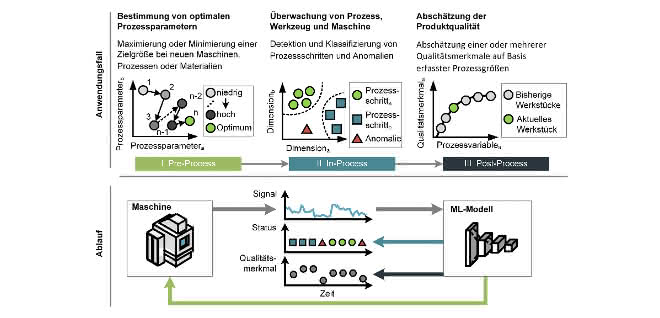
The potential applications of ML are wide-ranging. If consideration is limited to individual processes, a distinction can be made between pre-process, in-process and post-process applications as shown in the diagram.
When a machine is set up for the first time, process parameters must be determined that can be used to manufacture the product to the required quality. While simple metamodels based on polynomials can only represent the process to be investigated to a limited extent, ML-based models deliver high levels of accuracy even for many factors with complex, non-linear interactions.
One of the most prominent applications of ML continues to be the monitoring of processes during operation. Terms such as novelty or anomaly detection refer to ML approaches that detect unforeseeable events, such as tool breakage, on the basis of process data.
Once a process cycle has been completed, the recorded process data can be used to draw conclusions about the product quality achieved. For example, the force-displacement curves of a pressing process allow conclusions to be drawn about the joint quality achieved. Based on this, the initially set process parameters can be readjusted in order to compensate for production deviations.
In summary, it can be said that the use of ML will continue to intensify in the future due to constantly improving data availability. Methods and tools that allow models to be easily created and reused will enable companies to further increase the return on investment in ML projects.
Dominik Kißkalt, Andreas Mayr, FAPS of the FAU Erlangen-Nuremberg
Briefly explained: The MHI e.V.

The Wissenschaftliche Gesellschaft für Montage, Handhabung und Industrierobotik e.V. (MHI e.V.) is a network of renowned university professors - institute directors and chair holders - from German-speaking countries. The members conduct both fundamental and application-oriented research on a wide range of current topics in the fields of assembly, handling and industrial robotics. Further information on the society, its members and activities: www.wgmhi.de
Briefly explained: FAPS

The overarching goal of the Chair of Factory Automation and Production Systems (FAPS) at FAU Erlangen-Nuremberg is to network all the sub-functions of a factory into an overall computer-integrated concept. At its two locations in Erlangen and Nuremberg, the chair employs over 120 people, who are spread across the seven research areas of Engineering Systems, Automated Production Systems, Electronics Production, Electrical Engineering, Vehicle Electrical Systems, Biomechatronics and Home Automation. The transfer of knowledge on cross-sectoral topics, such as machine learning or software engineering, is realized in the form of technology fields. Companies are supported within the framework of joint industrial and research projects, consultations and training courses. www.faps.fau.de


You might also be interested in
E-scooter with customizable damping
The startup Scuddy has significantly improved the flexibility, performance, customizability and ergonomics of its second-generation foldable e-scooter of the same name - thanks in part to damping technology from ACE.
 read more...
Hurdles on the road to success
Welding is one of the most complicated processes in the manufacturing process, and it is becoming increasingly difficult to find suitable personnel. Can this problem be solved by automating processes? Can or should the robot colleague replace the...
read more...New plug-and-play solutions for the warehouse
Exotec announces a new Skypath conveyor system, the optimized Skypicker picking robot and Deepsky, another proprietary storage software. All three products can be seamlessly integrated into the manufacturer's Skypod system.
read more...Production automation
At Motek, Weiss will be presenting solutions for the linear and rotary movement of workpieces that can be easily integrated into the overall system of hardware and software.
read more...Solutions for surface hardening
Many industrially used components require a combination of a tough core and a hard surface layer so that they can better withstand the stresses of use. Hardening is achieved by rapidly heating the surface and then cooling it quickly.
read more...Wheel bearings and wheel bearing sets
Low-friction rolling behavior
Hecht Kugellager offers a wide range of bearing technology for use in the automotive industry, commercial vehicles and mobile machinery.
read more...Simulation in product development
The Munich-based start-up Spyra significantly shortens the development time of its production by using Solidworks simulation solutions.
read more...Doubling production capacity by 2026
Nabtesco is investing in a third production site, doubling its production capacity to two million precision gearboxes per year by 2026.
read more...Counterbalance trucks with lithium-ion technology
Clark has relaunched the GEX and GTX series.
read more...