

Improving battery production
Reduce high reject rates with AI algorithms
The future of lithium-ion battery production is golden. In the three decades or so since the technology found its way from the labs to the production lines, it has steadily evolved and is now well on its way to becoming a key factor in a global transportation revolution. As demand grows, so does the pressure on manufacturers. How can they effectively scale and improve their operations to turn the challenges they face into opportunities? Klaus Petersen, Director Automotive and Lithium Battery Industries, Factory Automation Emea at Mitsubishi Electric, examines the factors that are still causing battery manufacturers to react cautiously and how they can be overcome.

Lithium-ion batteries require expensive raw materials and undergo a complex production process with high scrap rates. One solution is digitalization - the implementation of digital technologies to collect and process the large amounts of data generated in modern production. They are used to gain insights that bring benefits to the production process.
Meeting rising demand
One can only estimate how dramatically the lithium-ion battery sector will grow over the next ten years. Rising demand from the electric vehicle sector has already contributed to the global market growing from around USD 40 billion in 2018 to more than USD 60 billion in 2022. The growth trend is expected to accelerate. According to forecasts, the market will be worth more than a quarter of a trillion dollars by the end of the decade.
However, the sheer scale of this expansion brings with it a number of challenges. Not only will competition increase sharply, but the raw materials used to manufacture lithium-ion batteries will become even scarcer and more expensive as demand increases. Lithium, cobalt and nickel must be mined and processed before they can be used for production. The IEA forecasts that the total demand for minerals required for the production of electric vehicles will increase 30-fold between 2020 and 2040. In order to meet the demand for electric vehicles, production must be made as efficient as possible. One bottle-neck in production is the implementation of effective quality control and the reduction of high reject rates.
Very high reject rate
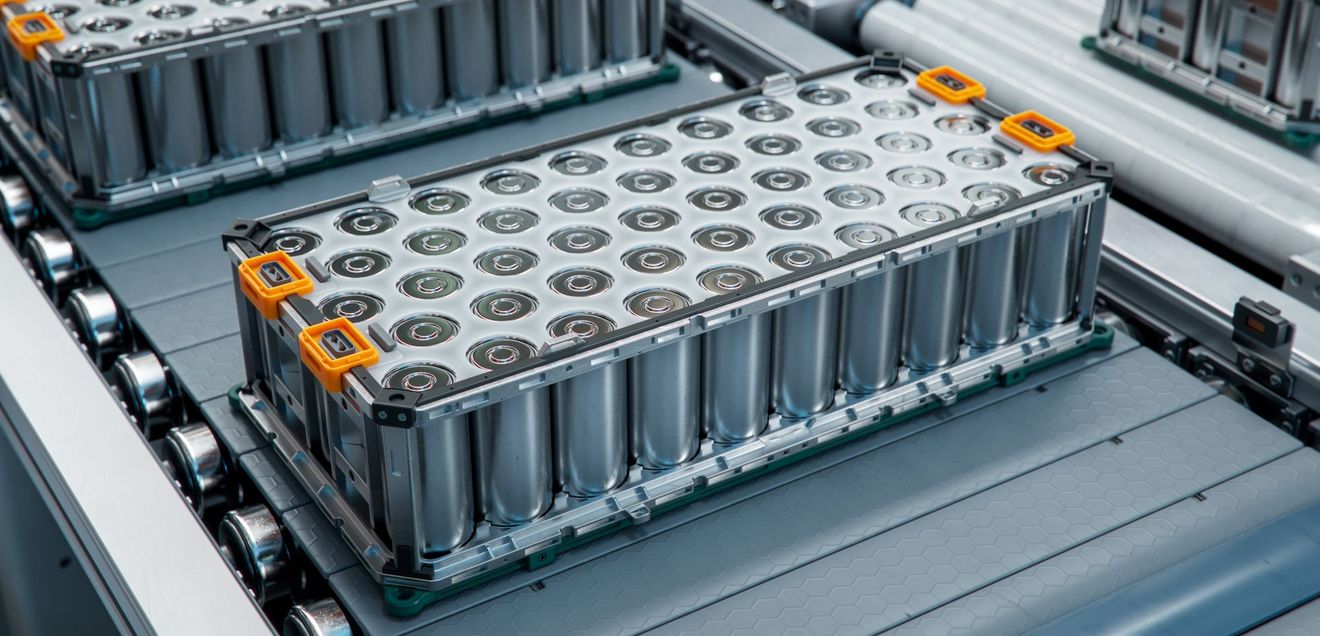
Around ten percent of finished products do not meet the minimum requirements and end up as scrap. In many cases, this rate can even rise to 30 percent. This is one of the reasons why the battery usually accounts for up to 60 percent of the total cost of an electric vehicle. It is also unacceptable for sustainability reasons. However, the production of lithium-ion batteries is complex; the reject rates are not due to the negligence or irresponsible behavior of the manufacturers, but rather the manufacturing process and the implementation of conventional quality control measures are demanding.
Influence of the coating thickness on the energy capacity
First, strips or foils are made from metal - copper for the anode and aluminum for the cathode. The size of these strips varies depending on the design and specifications of the batteries produced; they are usually several hundred meters long, often over a kilometer at larger production sites. The width ranges from a few centimeters to more than a meter. To convert them into batteries, the strips are coated with a thin layer of active material slurries. Lithium cobalt oxide, lithium iron phosphate or other lithium metal oxides are used for the cathode, while the anode is coated with graphite or silicon-based materials. Regardless of the materials used, the coating thickness has a major impact on the energy capacity and ion transport efficiency of the finished battery. Thicker coatings can store more active material, which can increase the overall energy storage capacity of the battery. However, coatings that are too thick can impede the movement of lithium ions between the electrodes, which reduces the charging and discharging speed of the battery.
Consistent coating thicknesses over a large area
This balance between thickness for increased energy storage and the need for efficient ion transport is critical. It has a direct impact on battery performance, especially in EV applications that require rapid energy delivery. If a coating is too thick or too thin, large sections of a tape may be unsuitable for use in a finished product. Although the ideal thickness varies depending on the manufacturer's requirements, cathode coatings are usually in the range of 100 to 200 μm, while anode coatings are slightly thinner at 70 to 120 μm; equivalent to the thickness of a human hair. It is considered a challenge to obtain a consistently thin film over a large area. Many factors can influence the thickness of the end product - from the temperature of the film to the humidity in the plant. In order to capture this complex, constantly changing data, the implementation of suitable production technologies and sensors can be helpful.
AI-driven solution Melsoft Mailab
The principle of predictive maintenance can also improve battery production. It is possible to determine which parameters need to be checked in order to obtain high-quality cells. This increases the value of functional batteries and reduces the amount of materials that need to be scrapped. Mitsubishi Electric has already applied this knowledge to real production lines for lithium-ion batteries. The team focused on the aspect of uneven layer thickness and collected data from 127 different parameters to determine which ones might be related. With the help of Mitsubishi Electric's AI-driven solution Melsoft Mailab, it was found that four factors correlate strongly with variations in layer thickness: Voltage, coating pressure, excess temperature and distance from the coating opening. The team developed a diagnostic rule to detect the thickness. The experts then combined it with industrial automation technology, such as voltage regulators, to carefully monitor and change the parameters. This ensures that as much of the strip as possible meets the quality standards.
Realizing a digital future

Introducing the tools, technology and expertise required for a digital production line requires more than just buying the right equipment. It must be approached from two angles simultaneously - the technical and the operational. On the technical side, a manufacturer must have access to the right tools. This means ensuring that all machines and sensors have excellent connectivity and are linked to a high-quality data hub using advanced industrial networking solutions. Solutions such as the CC-Link IE TSN network and MELIPC industrial computers can enable highly accurate sampling, which is essential for working with materials as complex and variable as lithium-ion batteries.
AI-supported algorithms uncover correlations
In addition, excellent visualization and correlation tools, such as those included in Mailab and the Iconics Genesis64 suite, are important. This allows experts to uncover the insights hidden in the data; AI-powered algorithms uncover correlations that a human would never have discovered. With a digital twin tool like Mitsubishi Electric's Melsoft Gemini, manufacturers can create a virtual replica of the process and test any changes. However, it is important not to overcomplicate a digital twin, especially in the early stages of a company's digital journey. At an operational level, digitalization in lithium-ion battery manufacturing starts with creating a solid operational foundation, which is essential for harnessing the full potential of new technologies.
Pilot projects with clear, measurable goals are a strategic way to achieve quick wins, gain buy-in from stakeholders and pave the way for wider implementation. This methodical approach enables the smooth integration of digital manufacturing technologies, reduces risks and increases the efficiency and quality of the manufacturing process.
Challenges become opportunities
With the increasing demand for electric vehicles, the expansion of lithium-ion battery production requires strategic planning and the use of technology and data to efficiently manage the complexities. Digitalization enables real-time monitoring and analytics, improving decision-making and product quality while reducing waste. The transition to digitalized manufacturing requires investment and rethinking, but promises tangible results.


You might also be interested in
Commvault Appoints Brian Lanigan as Chief Partner Officer
Commvault has appointed Brian Lanigan to the position of Chief Partner Officer. He is responsiblefor thecompany’s global partner strategy and is tasked with further expanding the global partner networkof the data security, backup, and recovery...
 read more...
Is sovereignty a question of hardware?
Industry warns of dependencies in IT infrastructure
Europe is seeking digital independence: how sovereignty can be implemented in concrete terms remains a key question in view of the high level of dependencies in the IT infrastructure. Frank Konrad, Managing Director of Microsens GmbH & Co. KG,...
read more...Factory planning without compressed air...
How vacuum becomes mobile
Modular factories, mobile robotics and rising energy prices are fundamentally changing automation. One solution: into the future without compressed air. Electric vacuum systems reduce costs, save energy and support flexible manufacturing and...
read more...Opening the store floor for data rooms
The WGP wants to support SMEs with digitalization
At its spring conference, the Scientific Society for Production Engineering (WGP) focused on the digitalization of small and medium-sized enterprises (SMEs) in particular. Against the backdrop of the ongoing crisis in the industry, the researchers...
read more...Integration of existing meters into digital...
Spectra digitizes existing meter infrastructures
The G30 M-Bus gateway from Spectra GmbH & Co. KG integrates existing meters via Modbus and WLAN into energy management and building management systems for efficient monitoring and retrofitting.
read more...AI as an efficiency driver in production
From pilot project to AI factory
Industrial AI raises key production figures such as OEE, quality and energy efficiency to a new level - but only with the right IT architecture. This is what Chris Kramar, Director and General Manager OEM Solutions DACH at Dell Technologies, says in...
read more...Trade fair preview all about automation 2026
Platform for industrial automation, robotics and digitalization
Over 500 exhibitors, a packed program with presentations, special areas and guided tours: all about automation in Friedrichshafen (10 + 11 March 2026) stands for industrial automation, robotics and digitalization - and for direct dialogue. Three...
read more...Digitizing manual assembly
In modern production, craftsmanship and high-tech come together. Where once only human skill was required, today production lines are created that combine manual precision with digital intelligence.
read more...Digitization of the entire value chain
At SPS 2025, ifm will be demonstrating how the digitalization of the entire value chain can be implemented in practice. In an interview, Michael Marhofer, CEO of the ifm group of companies, explains which technologies are in focus, which industry...
read more...