
IIoT platforms
How to become master of your production data
For digitalization to be successful, people and technology must work together smoothly. When selecting the technology, certain requirements must be taken into account. For example, an IT platform for the Industrial Internet of Things (IIoT) should be open, manufacturer-independent and modularly expandable.
What does the Internet of Things (IoT) mean in a few words? The Internet of Things means that software programs on platforms provide the data that is collected by networked devices. It sounds abstract, but it has changed our everyday lives enormously. The great triumph of the IoT was founded on the megatrend of platformization: the mother of all platforms - Apple iTunes (now the App Store) - was soon joined by many other digital prefabricated houses. They brought entire industries to their knees. The best-known platforms of our time: Facebook, Amazon, Ebay, Google, WhatsApp, SnapChat, Instagram, Flickr, Netflix, Spotify, Twitter, LinkedIn, Xing.
This platformization has also fully embraced the industrial IoT, the IIoT. There are now more than a dozen providers of IIoT platforms at an international level. The consulting firm ISG has analyzed the most important providers (https://bit.ly/2CZan0v).
But how does an IIoT platform actually benefit companies, whether they are SMEs or multinational corporations? An IIoT platform brings companies a lot if it meets certain technological requirements. The key benefits are higher productivity, greater competitiveness and more location and job security.
The biggest advantage is when the IIoT platform does not represent the ecosystem of just one manufacturer, but corresponds to an open standard that is independent of manufacturers. Ideally, this open standard is designed like a modular, expandable prefabricated house solution. In this case, the main advantage for production managers is that they (once again) become the builders of their current and future IT architecture in production.
1. connect quickly: Feed planning (ERP) with real-time data from the machines
What is most important to production managers: How do I connect my heterogeneous machine park to a new platform? In most factory halls, machines from different years and from different manufacturers are the rule.
To achieve this, platform suppliers must be able to offer companies simple solutions. For example, connecting three pilot machines must not take much longer than three days - including networking with the planning level (ERP) via an adapter.
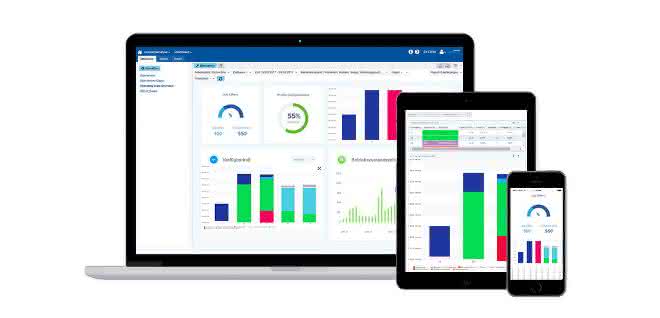
The next step is to transform big data from the machines into usable smart data in real time. This requires high-performance and rule-based data processing machines. Ultimately, the aim is to generate digital mirror images on all the computers required on the store floor, which production managers and workers can use to virtually analyze operating states and production progress and optimize them in real terms.
Such real-time data processing is achieved, for example, by rule engines that work on the basis of main memory-based IN-MEMORY and CEP technology (Complex Event Processing). They act as a bridge between the store floor and the top floor, on which precisely measured production data flows into the corporate management system (ERP), such as SAP. Tanja Knechtskern from Controlling at Grammer AG recently reported at an Industry 4.0 congress: "This actual feedback to SAP is a real enrichment for us in Controlling."
2. get started right away: With pre-installed applications that are important
There are a handful of applications that are essential for managers of digital transformation projects. Seamless traceability of all processes is a must in all industries today. "Customers demand this from us," says Alexander Stappert from BorgWarner Europe. "We need seamless traceability of all processes. The main aim is to minimize liability risks. Because as a supplier, the burden of proof lies with us in the event of damage."
In a BorgWarner Europe factory project in Poland, for which Alexander Stappert was responsible, the traceability of all parts and processes was the primary objective of the digital control system. The result: the data records from seven months - several million in total - are now displayed and evaluated in two seconds. A pleasant "side effect" of seamless traceability: BorgWarner was able to increase productivity in various factories by between five and 15 percent.
Companies can therefore expect a modern IIoT platform to have the most important applications for production pre-installed and pre-configured. These include Performance analyses for overall equipment effectiveness (OEE), visualizations and alarms, detailed planning & control of orders and capacities, energy data management, traceability (track & trace), production data management (documents).
3. remain fit for the future: Integrate third-party solutions with open interfaces
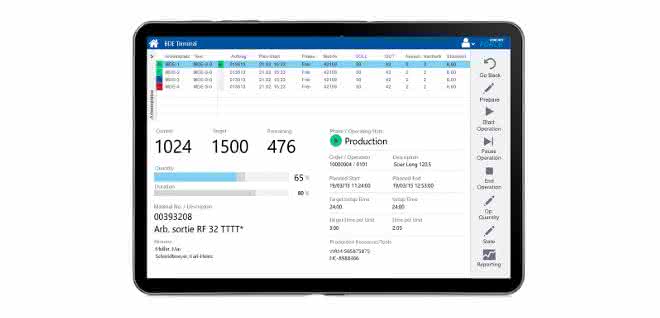
Being smart means being open: The latest criterion for a modern IIoT platform comes from a "freedom movement" in the USA - the OPEN API Initiative(http://www.openapis.org). It has set itself the goal of promoting the free exchange of data between applications and applications from different manufacturers through open user programming interfaces (API - Application Programming Interface).
Another movement, the Force Bridge Community, is pursuing the goal of developing an open industry standard for smart manufacturing (http://edu.forcebridge.io/). Leading industrial companies, software pioneers and universities have come together in this specialist community. The result is the first open interface for smart manufacturing - the Force Bridge API, now in its second version (https://docs.forcebridge.io/api/).
This interface gives companies great freedom: programmers can seamlessly integrate existing IT systems as well as third-party systems such as applications for tool data management, quality assurance or predictive maintenance.
One example of the advantage of vendor independence: the family-owned company Kostal, one of the top 100 automotive suppliers in the world, combines SAP applications with the Forcam platform, for example. "This allows us to specifically overcome weaknesses in the standard systems and supplement them in a targeted manner," says Kostal IT Manager Patrick Saslona. MES systems for production data acquisition (Manufacturing Execution System) do not offer this great freedom because they represent closed IT silos, even if they are often marketed as an open platform.
"Get digital or die"
Digitization is not an end in itself. It should bring concrete results: Making work processes and tasks easier, increasing productivity in terms of safeguarding sites and jobs. Raynald Richard from the Swiss company MPS Micro Precision Systems AG in Biel, a leading manufacturer of precision parts for medical technology, watches, automation, aviation and optics, describes the benefits for workers and managers alike. Raynald Richard speaks of "flying blind" before the introduction of digital manufacturing. Today, after switching to digital control, the production status of 700 products is displayed visually at MPS. Top and store floor are seamlessly interlinked, there is maximum cost transparency thanks to real-time data, and efficiency is continuously improved.
Conclusion: The successful digitalization of production that increases productivity is not witchcraft, but depends on high-tech solutions for the machines as well as modern change processes for the employees. Technological and cultural change must go hand in hand. The following applies to the technological part of the transformation: production managers should choose the most powerful and manufacturer-independent IT platform.
If you want to secure your future, you can no longer avoid digitalization. The former CEO of General Electric, Jeff Immelt, put it in a nutshell: "If you went to bed last night as an industrial company, you will wake up today as a software and analytics company." Or simply: get digital or die.
Franz Gruber, founding managing director of Forcam / ag


You might also be interested in
Predictive maintenance in retrofit
Predictive maintenance pays off. This is because early detection of impending failures means that systems can be serviced in a targeted manner before production downtime occurs. But how complex is it to integrate such a maintenance concept into an...
 read more...
Maintenance instead of replacement
The circular economy starts with the machinery
Sustainability in industry starts with machines, says our guest author from Deguma: How maintenance, modernization and the 5R strategy save resources, energy and CO₂.
read more...3D printing for unplanned requirements
The material fails and the machine suddenly stops? Then you need to take the right measures to be able to resume production quickly. Material failure in the form of faulty components or material wear in the frame are a risk for any production.
read more...High demands in terms of safety, application and robustness
Demanding work in the electrical trade and energy supply as well as smooth processes in production require innovative and customized measurement technology that scores points for safety, ease of use and resilience.
read more...Car meets e-bike: riding with lubrication-free polymer bearings
Studies show that the proportion of pedestrian and bicycle traffic is increasing in urban areas. With the JetBike, JetBike GmbH from Braunschweig presents a mixture of e-bike and car and relies on lubrication-free polymer bearings from Igus.
read more...Hydraulic hub for more efficient servicing
Bosch Rexroth presents a digital toolbox for service and maintenance. With a comprehensive range of digital services, the Hydraulic Hub simplifies and accelerates the service and maintenance of hydraulic products and increases machine availability.
read more...Arnold Umformtechnik expands after-sales...
Faster help with VR glasses
Arnold Umformtechnik is expanding the after-sales service for its machines to include digital remote services. The focus is on data security, simple operation and clear processes.
read more...147,000 euros per hour: high costs for German companies due to unplanned downtime
According to the "Value of Reliability" study, 67% of industrial companies in Germany experience unplanned downtime at least once a month. This costs the German economy 147,000 euros per hour. Nevertheless, reactive maintenance concepts are not...
read more...Maintenance starts with a maintenance planner
Legal requirements stipulate that machines and systems must be serviced regularly. The maintenance work serves to ensure occupational safety and economic efficiency.
read more...