

Artificial intelligence
How AI brings practical added value
Artificial intelligence automates processes, maintains machines, makes decisions and finds solutions to tricky problems. Companies can benefit enormously from this. However, this requires the right AI strategy and a successful combination of algorithms, methods and data.

Artificial intelligence (AI) is not a product, but a generic term for a variety of methods and techniques. At first glance, this includes things as diverse as deep learning, machine learning, neural networks, image and speech recognition, robotic process automation, chatbots and decision-support systems. All of these techniques are based on the conviction that the knowledge needed to solve problems is already available in the data, it just needs to be recognized and used. Self-learning algorithms are used to extract a solution pattern from data volumes and time sequences, which also adapts to new situations.
In clearly defined application scenarios, all of these different methods contribute to computers suggesting a certain "intelligence", that they can learn and make decisions independently that were not yet laid out in the original algorithmic rules. Companies in Germany have now recognized the added value of artificial intelligence for the further development of their products and services. However, the most difficult question remains as to which application scenarios promise long-term added value and what a successful AI strategy should look like.
Evaluate application scenarios
A three-step approach is recommended for the introduction of AI projects in companies. The starting point and therefore the first step in AI projects is the identification and description of potential use cases. Design thinking methods, which aim to achieve the first prototypes very quickly, have proven their worth at this point. In workshops, and accompanied by a specialized IT service provider, the specialist departments develop possible use cases. Step two deals with the selection of suitable methods, algorithms and mathematical processes that are best suited to the implementation of the use case. In the third step, the database must be defined and prepared either from internal or external data sources in order to train the forecasting models.
A very typical application is image recognition or image analysis. It is already being used successfully in medical diagnostics, for example in the evaluation of X-ray images. According to medical studies, suitable training material and the use of convolutional neural networks (CNNs) can significantly increase the hit rate in cancer diagnosis, for example. A good radiologist achieves a hit rate of around 60 percent; with well-trained CNNs, the rate can be increased to over 80 percent.
Insurers are also relying on image recognition in initial pilot projects and using it to automate claims processing and settlement processes. This is not a simple undertaking, as thousands and thousands of images of accidents are required to train the algorithm for a motor vehicle claim, for example. To do this, an insurer has to evaluate its own image data archives or also consult external images. However, the time-consuming process is rewarded in the end with a claims settlement that takes just a few hours instead of days or weeks.
Banks and insurance companies
The smart image analysis algorithms not only benefit insurance companies by reducing the personnel and time required to process simple motor vehicle claims, enabling them to offer insurance policies at lower prices. The customer also benefits: They send photos of the damage taken with their smartphone to the insurer. There, artificial intelligence analyzes the expected amount of damage based on the photos and depending on the vehicle type and recommends authorized workshops that are located near the scene of the accident.
All information is sent back to the insured customer by email within a few seconds. Another solution used in the banking and insurance sector is fraud detection and prevention optimized with the help of AI. AI algorithms detect suspicious patterns and hidden anomalies much faster than human advisors. Improved fraud prevention is also about reducing losses so that customers can ultimately be offered more competitive, lower-priced products.
In predictive maintenance, machines or systems are serviced using sensors. For loading cranes, construction cranes, wind turbines or high-voltage power lines, drones are now being used for simplified data acquisition and proactive maintenance: a solution approach developed by CGI for an energy supplier in Scandinavia that has been used cost-effectively for some time. The images or videos generated by the drones - combined with a machine learning-based analysis program - identify weak points in components before their total failure leads to downtime and help fitters to carry out repairs.
A solution for the predictive maintenance of elevators has also been developed for ThyssenKrupp, which reduces errors and downtimes many times over. Predictive maintenance generates a whole range of added value: customers do not suffer any loss of business due to machines breaking down, technicians are only needed to replace spare parts on site, sensors and drones take over the monitoring and, finally, parts are replaced just-in-time and not when they would actually continue to function faultlessly for several months.
Create timetables automatically
In transport, logistics and passenger transport, for example, AI systems can automate the creation of timetables and help to track vehicle movements and the utilization of rail networks in real time in order to compare target and actual conditions and identify potential for optimisation. Chatbots are used in call centers, financial advisory services and hotlines to test their potential and customer acceptance.
All these examples show a small selection of use cases in companies in all sectors. Many have already been implemented, others are being planned and others are being considered. One decisive factor is that companies and decision-makers need a clear understanding of where and how artificial intelligence methods and processes can be used. The more concretely the use case is described, the more successfully AI projects can be implemented.
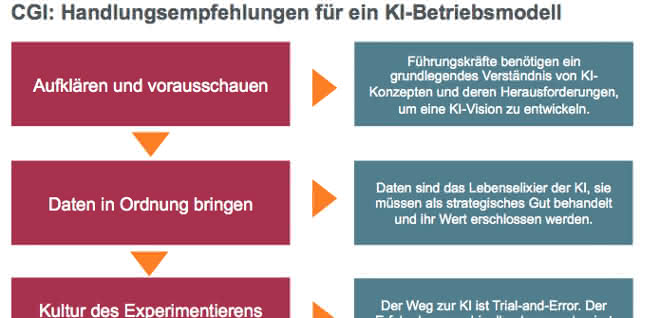
The basis of AI activities is always a predictive model that is adapted to existing data during the learning phase and thus explains the occurrence of certain events. A project team trains a suitable mathematical algorithm with a suitable amount of data and implements the idea in a proof of concept. As a rule, models are trained using historical data, partly because the validity of the predictions can be checked there. After all, everything has already happened. If the results are satisfactory, the model is used to predict future events. The challenge is to define the right data set in order to be able to train the mathematical models. Ultimately, the success of the project also depends on this.
Qualified employees are crucial
Technological requirements, organizational conditions and human resources are among the key challenges. AI solutions require a lot of computing power and, in the case of image recognition, also Graphical Processing Units (GPU).
However, qualified employees with knowledge of mathematical and static methods are also required. This includes developers with experience in the use of programming languages such as Python, R and the deep learning frameworks Caffee and Theano or TensorFlow, a framework for the numerical calculation of data flow graphs. A partnership with a qualified technology company is particularly worthwhile for companies that are not involved in research and development themselves.
Lars Keuneke, Director Consulting Services at CGI Germany


You might also be interested in
Predictive maintenance in retrofit
Predictive maintenance pays off. This is because early detection of impending failures means that systems can be serviced in a targeted manner before production downtime occurs. But how complex is it to integrate such a maintenance concept into an...
 read more...
Maintenance instead of replacement
The circular economy starts with the machinery
Sustainability in industry starts with machines, says our guest author from Deguma: How maintenance, modernization and the 5R strategy save resources, energy and CO₂.
read more...3D printing for unplanned requirements
The material fails and the machine suddenly stops? Then you need to take the right measures to be able to resume production quickly. Material failure in the form of faulty components or material wear in the frame are a risk for any production.
read more...High demands in terms of safety, application and robustness
Demanding work in the electrical trade and energy supply as well as smooth processes in production require innovative and customized measurement technology that scores points for safety, ease of use and resilience.
read more...Car meets e-bike: riding with lubrication-free polymer bearings
Studies show that the proportion of pedestrian and bicycle traffic is increasing in urban areas. With the JetBike, JetBike GmbH from Braunschweig presents a mixture of e-bike and car and relies on lubrication-free polymer bearings from Igus.
read more...Hydraulic hub for more efficient servicing
Bosch Rexroth presents a digital toolbox for service and maintenance. With a comprehensive range of digital services, the Hydraulic Hub simplifies and accelerates the service and maintenance of hydraulic products and increases machine availability.
read more...Arnold Umformtechnik expands after-sales...
Faster help with VR glasses
Arnold Umformtechnik is expanding the after-sales service for its machines to include digital remote services. The focus is on data security, simple operation and clear processes.
read more...147,000 euros per hour: high costs for German companies due to unplanned downtime
According to the "Value of Reliability" study, 67% of industrial companies in Germany experience unplanned downtime at least once a month. This costs the German economy 147,000 euros per hour. Nevertheless, reactive maintenance concepts are not...
read more...Maintenance starts with a maintenance planner
Legal requirements stipulate that machines and systems must be serviced regularly. The maintenance work serves to ensure occupational safety and economic efficiency.
read more...