

Edge computing
A new approach to the convergence of industrial technology and IT
The major cloud providers have now also recognized that a large proportion of IT will not be located in data centers in the future. However, the promise of end-to-end edge-to-cloud environments will only be fulfilled if a convergence of industrial and information technology is created at the edge. The smartphone provides the model for this.
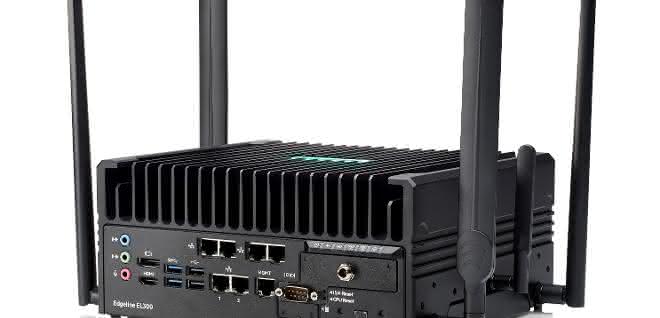
According to a study by Roland Berger, 30 billion intelligent sensors will be sold worldwide every year by 2020. They will find their way into oil platforms, vehicles and production machines, generating masses of data everywhere. Together with adaptive AI algorithms, this data forms the basis for edge-to-cloud environments that integrate data and processes from field level to enterprise level. This should provide new insights into the functioning of systems and processes and help to make decisions and act in real time in line with the situation. The aim is to improve processes by orders of magnitude in industry, logistics, production and the energy sector - and to develop new products, services and business models.
New decentralization paradigm
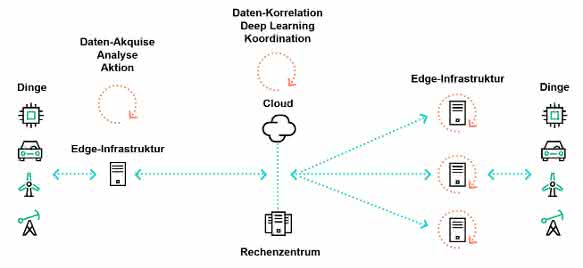
This points to a new IT paradigm. After the last wave of centralization, which focused on the cloud, the trend is now moving back towards decentralization: the importance of the periphery, understood as everything that can be equipped with a data-generating sensor, is increasing. Market research company Gartner predicts that in six years' time, three quarters of company data will be generated and processed outside all data centers, at the edge. Today, according to Gartner, this figure is ten percent. Until now, the prevailing view has been that data generated in the Internet of Things (IoT) is processed in the cloud. However, transporting the sensor data there takes far too long and is also too insecure. Delays at the edge can literally have fatal consequences if machines do not switch off or traffic lights do not change. In addition, bandwidth is often scarce or only available in phases at the edge of the network, which can literally be anywhere. And: it is unnecessarily expensive to send masses of mostly redundant data through the network.
So, according to the modified concept formulated at Carnegie Mellon University, for example, an intermediate station is needed that not only sorts and forwards data, but also processes it independently, referred to by the university researchers as a "cloudlet". This became the edge, mini or micro data centers available today - small, but fully equipped with fire protection, air conditioning and an uninterruptible power supply. The third stage, closest to production, is now often formed by gateways, but these do not have sufficient computing and storage power to perform all the tasks that should actually be performed in the immediate vicinity of the end devices. In many cases, it is necessary to place an intelligent system directly at the data-generating end device, which records, normalizes and analyses the data generated, initiates the necessary reactions on site and otherwise sends data that is worthwhile to the micro data center or directly to the cloud.
Edge systems as a bridgehead for OT-IT convergence
The term "cyber-physical systems" indicates what is important here. It is about the convergence of industrial technology (operational technology, OT) and information technology (IT) with the aim of making physical processes as flexible, intelligent and autonomous as if they were virtual processes. Edge systems are the bridgehead for this integration: an IT position on OT territory that enables operations to be carried out on this territory. In other words, data from sensors, SCADA and PLC systems is analyzed using standard IT applications, and actions are derived from this data, which in turn are executed by SCADA or PLC systems.
Setting up and operating such data loops is highly complex because a large number of different components have to be orchestrated with each other. These include, for example, the industrial systems with their sensors and controllers; drivers, adapters and middleware for bidirectional communication between OT and IT; and the standard IT applications at the edge, in the data center and in the cloud.
Edge IT systems have to operate in enemy territory in two respects: in an environment full of unfamiliar technologies and inhospitable operating conditions. Not only can the latter be downright hostile for IT systems, but factories, wind turbines and oil production platforms often lack the skills needed to set up and maintain these complex systems.
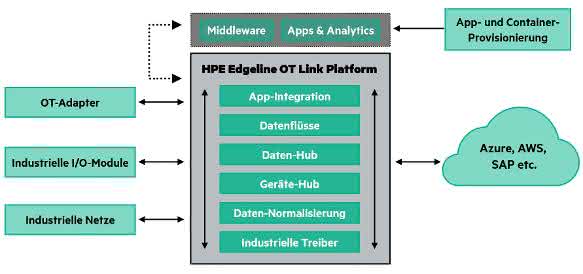
A new approach is therefore needed for edge systems to fulfill their role as a bridgehead for OT-IT integration. A model for this can be found in our pockets: the smartphone with its apps.
Everything from a single source
Older people still remember the days when you had a phone for making calls, a Walkman for listening to music, a camera for taking photos and a PC for surfing the internet. Steve Jobs had three ideas that radically changed this situation. Firstly, he physically integrated the phone, music player, camera and Internet into one device. Secondly, he created an ecosystem of applications that constantly created new ways to creatively utilize these physical components. Thirdly, he made the application so simple that really any fool would be able to use it. This model can be transferred almost one-to-one to the edge systems that form the core of cyber-physical systems. Private life becomes easier when you only have to operate one device rather than five different ones. OT-IT integration also simplifies processes in industrial environments.
In automotive manufacturing, for example, different test and measurement systems are often used for production-synchronous testing and engineering. One car manufacturer decided to replace this heterogeneous environment with edge IT systems with an integrated PXI interface module. With a single device class, he was able to process large volumes of vehicle data in the desired level of detail in real time and set up applications such as hardware-in-the-loop simulation, rapid control prototyping, bus monitoring and automation control. This standardization enabled the car manufacturer to achieve such great efficiency gains that it was able to increase the number of vehicles produced per day.
Despite all standardization efforts, industrial environments are still characterized by great heterogeneity. Convergent edge systems must therefore offer a wide range of options for controlling OT systems as standard - such as digital I/O, CAN bus, Modbus or Profinet - either via a multi-protocol standard such as PXI or via dedicated adapters. Programming interfaces and field programmable gate arrays (FPGA) also allow the customized creation of OT adapters, including the implementation of programmable logic controllers on the Edge IT system.
Application development without coding
As with smartphones, the true value of convergent edge systems only becomes apparent with the applications that link the various OT and IT components into a useful process. For example, video quality control in production: a video camera records the products rolling past on a conveyor belt; a machine learning program uses the video recordings to detect product defects; a detected product defect triggers an impulse in a programmable logic controller to push the defective product off the conveyor belt.
In many cases today, this kind of organized interaction between OT and IT is set up and programmed manually - which involves a great deal of effort and is prone to security vulnerabilities. One solution to this problem is so-called no-code workflow generators. The data sources, adapters, drivers, middleware, applications and PLCs can be combined into a workflow by linking corresponding graphical symbols with the mouse. The IT applications with which the OT data is analyzed and processed - such as PTC ThingWorx or SparkCognition - are selected from an application catalog and, packaged in a container, transferred from the cloud to the edge system.
Foolproof system management
Once all these requirements have been met, the problem of system management at the edge still needs to be solved. Administrators are not dealing with hundreds or thousands of systems in the air-conditioned and access-protected rooms of their local data center - but with hundreds of thousands of systems in all kinds of remote and inhospitable locations. Setting up and maintaining the systems manually is therefore out of the question. Instead, what is needed is a system management system that - similar to a smartphone - performs most tasks autonomously. This includes a wealth of tasks such as commissioning the edge hardware, loading and installing firmware, operating system and applications, keeping them up to date, system monitoring and troubleshooting.
Other edge-specific conditions that the system management must take into account include a fragile network connection - typical in mobile deployment scenarios or at remote locations. This means, for example, that interrupted update processes are resumed at the point where they were interrupted - and that the edge system actively reports when it is back online after a network interruption. In addition, the system management must offer edge-specific security functions because there is no access control at the edge as there is in the data center.
Factory revolution
The invention of the iPhone triggered a revolution that has changed the way we live and do business. The same must happen with edge IT systems, which, according to Gartner, will bear the brunt of the digital universe in the future. Only then can the rosy promises of efficiency, growth and revenue of the Industrial Internet of Things be realized. Physical OT-IT convergence, no-code application development and foolproof system management at the edge are the keys to this. The convergence of OT and IT will shift the coordinate systems of these industries.
OT and IT manufacturers are conquering foreign territories and forging new partnerships to create new services, products and business areas - at the same time, they have to defend their traditional territories against attacks. Vendor lock-in in the OT sector today is reminiscent of the situation on the mainframe market 30 years ago due to the many proprietary technologies. The world of IT has made the arduous journey from proprietary to open systems. The world of OT has yet to do so.
Peter Widmer, Global Category Manager Converged Servers, Edge & IoT Systems at Hewlett Packard Enterprise


You might also be interested in
ebm-papst is growing again thanks to AI and data centers
ebm-papst returned to a growth trajectory in fiscal year 2025/26. Air Technology, data center applications, and artificial intelligence are driving revenue and investment.
 read more...
SPE on the Verge of a Market Breakthrough
Single Pair Ethernet (SPE) has moved beyond the conceptual phase and is increasingly being implemented in industrial settings. The focus here is not only on higher data rates and simplified cabling, but above all on the issue of system integration...
read more...More than 900 exhibitors already registered
Around six months before the start of the trade fair, more than 900 companies have registered for SPS 2026 in Nuremberg. The trade fair focuses on industrial AI, cyber security and digital transformation.
read more...Virtual PLCs in practice: How vPLCs make production systems more flexible and scalable
The increasing networking of IT and OT is fundamentally changing industrial automation. The IT/OT Integration Summit shows how modern technologies can make production environments more efficient, flexible and future-proof. The event will focus on...
read more...Sales growth in a turbulent market environment
Thanks to innovations and a focus on strategic industrial markets, Sick was able to moderately increase its sales in the 2025 financial year. In a turbulent market environment, the company was able to maintain its position and gain market share with...
read more...Siemens presents new AI agent
Siemens is launching 'Eigen Engineering Agent', an AI for automation technology. The solution is integrated into the TIA Portal, has been tested with over 100 companies and is designed to significantly accelerate engineering processes.
read more...Schaeffler keeps sales almost stable
Schaeffler generated revenue of EUR 23.5 billion in 2025 and increased EBIT before special items to EUR 936 million. At 266 million euros, free cash flow was significantly above the prior year and forecast. Net income remained negative due to high...
read more...Advancing artificial intelligence together
Helukabel is stepping up its activities in the field of artificial intelligence and is now a member of the IPAI. The innovation and collaboration platform for companies, research facilities, institutions and administration has set itself the goal of...
read more...New impetus for ifm sales
Two new positions were filled at ifm at the start of 2026: Markus Wolf becomes Managing Director Sales Germany, Sven Quant takes over the position of Central Managing Director in the Process Sensors division within the ifm Group.
read more...