

Data analysis in the industry
Making process data usable, increasing added value
The analysis of industrial process data makes optimization potentials visible and can contribute to increasing the company's success.
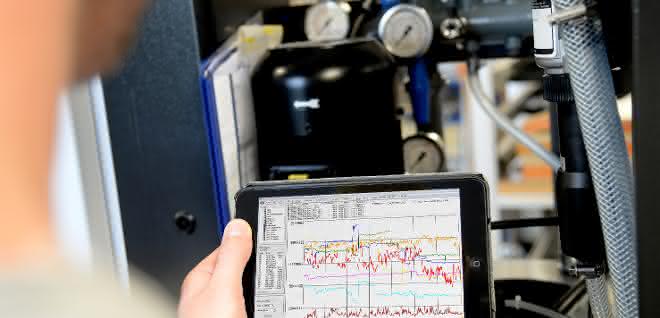
Increasing digitalization in production means that more data is available than ever before. There is a valuable treasure trove of information lying dormant here that is still too rarely exploited by many plant operators. How can the data be read and how can it be analyzed to improve the value chain? The challenge is to make it usable.
Temperatures, pressures or speeds: Machines and computer systems in modern production plants are constantly exchanging such information with each other. This process data is not only used to ensure that networked machines know the current status of the devices connected to them so that they can react accordingly. Plant operators can also gain valuable insights - provided the data is interpreted correctly. Especially when additional data such as quality data, maintenance reports or order data are included in the analysis. The findings can be used for predictive maintenance or to improve the efficiency of systems, for example.
Aims of the analysis of process data
In addition to the possible applications already mentioned, the following objectives, for example, are to be achieved in industrial data evaluation:
- the reduction of failures and thus increased availability
- higher product quality
- an increase in production output
- easier engineering of effective new systems
- Reduced workload for employees
However, before a targeted analysis of process data is possible, it must first be made usable. A real challenge. This is because the available process data usually comes from many different sources and is therefore characterized by great heterogeneity. Disorder usually prevails.
While the value and time are still unambiguous, the variability begins with the units. For example, the temperature is given in degrees Celsius, but the unit is sometimes abbreviated to C, sometimes to C°, degrees C, etc. Even more complicated is the classification of other metadata that describe the properties of the respective measuring point. These were and are assigned according to a wide variety of conventions (e.g. KKS, technical locations, AKS ...), which are often not strictly adhered to and are further developed over time.
But it is not just units and conventions that differ - the different systems in which data is collected must also be taken into account. For example, information from field systems is sent in a continuous data stream, while data from higher-level systems such as ERP or MES is provided as individual data packages. Furthermore, required data may be in the hands of partners. It is obvious that this results in different requirements for data aggregation. All the potentially available data results in a flood of heterogeneous information that is of little use in unstructured form.
Step by step to effective data use
Never before has so much data been generated in an industrial environment as today. In principle, this is an advantage, but in practice it is clear that the complexity of the task increases depending on the amount of data. For example, an energy report needs to be created for an industrial plant. Although the procedure is error-prone and time-consuming, it can generally lead to the desired result. However, if it is a plant with 50,000 measuring points, of which several thousand measurements of energy and media flows are available, the task becomes much more difficult. This is because not every measuring point provides information that is relevant for an energy report and the sheer mass of data is too large to be organized manually.
It is clear that a strategic approach is required here: The first step is to structure the measuring points. To this end, it is crucial to bring the metadata into a standardized form and to map the various conventions to a generally valid one. Another elementary component is to bring the topological information of the measuring points into a standardized form. Only when this data is uniform and largely standardized and therefore comparable can an automated reporting system be created on its basis. For example, by compiling the energy reports according to various aspects algorithmically and no longer manually by the user. Many years of experience and know-how are just as much a prerequisite for this as the use of an appropriate technological solution.
Support from an experienced partner
In order to be able to use the process data efficiently, it is not only necessary to implement a powerful tool. Support from an experienced partner is also recommended. Providers who strive to achieve sustainable success for their customers offer practical support right from the development of a suitable strategy. The second component is the software already mentioned. What is needed is a powerful tool that cleans up the available data, structures it and converts it into standard information using algorithmic processes. When selecting a provider, plant operators should therefore not be satisfied with a modern-looking user interface that merely makes manual tasks easier. It is more important to carefully examine the range of services offered, because in the best case scenario, the software will automate these activities.
The most important questions are: Which functions does the system map? Are these sufficient to effectively increase added value? How do the workload, susceptibility to errors, performance and traceability scale with a rapidly growing number of measuring points? And is an experienced partner available to provide support before, during and after the purchase if necessary? Only if these questions can be answered in the affirmative will the analysis of the process data provide profitable insights.
Marc Steinhaus, authorized signatory at Steinhaus Informationssysteme


You might also be interested in
Predictive maintenance in retrofit
Predictive maintenance pays off. This is because early detection of impending failures means that systems can be serviced in a targeted manner before production downtime occurs. But how complex is it to integrate such a maintenance concept into an...
 read more...
Maintenance instead of replacement
The circular economy starts with the machinery
Sustainability in industry starts with machines, says our guest author from Deguma: How maintenance, modernization and the 5R strategy save resources, energy and CO₂.
read more...3D printing for unplanned requirements
The material fails and the machine suddenly stops? Then you need to take the right measures to be able to resume production quickly. Material failure in the form of faulty components or material wear in the frame are a risk for any production.
read more...High demands in terms of safety, application and robustness
Demanding work in the electrical trade and energy supply as well as smooth processes in production require innovative and customized measurement technology that scores points for safety, ease of use and resilience.
read more...Car meets e-bike: riding with lubrication-free polymer bearings
Studies show that the proportion of pedestrian and bicycle traffic is increasing in urban areas. With the JetBike, JetBike GmbH from Braunschweig presents a mixture of e-bike and car and relies on lubrication-free polymer bearings from Igus.
read more...Hydraulic hub for more efficient servicing
Bosch Rexroth presents a digital toolbox for service and maintenance. With a comprehensive range of digital services, the Hydraulic Hub simplifies and accelerates the service and maintenance of hydraulic products and increases machine availability.
read more...Arnold Umformtechnik expands after-sales...
Faster help with VR glasses
Arnold Umformtechnik is expanding the after-sales service for its machines to include digital remote services. The focus is on data security, simple operation and clear processes.
read more...147,000 euros per hour: high costs for German companies due to unplanned downtime
According to the "Value of Reliability" study, 67% of industrial companies in Germany experience unplanned downtime at least once a month. This costs the German economy 147,000 euros per hour. Nevertheless, reactive maintenance concepts are not...
read more...Maintenance starts with a maintenance planner
Legal requirements stipulate that machines and systems must be serviced regularly. The maintenance work serves to ensure occupational safety and economic efficiency.
read more...