
Machine vision
Autonomous systems under the magnifying glass
Optical lens systems have been used since ancient Egypt, and since the development of machine vision theory in the 1970s, technological advances in this field have significantly advanced the industry. The development of autonomous machine vision systems is another major step forward. By Yonatan Hyatt
The machine vision industry has seen significant growth over the past 20 years, establishing its importance as an indispensable aspect of manufacturing. The market growth of automation and robotics is an important factor for the machine vision industry, as automated technologies rely heavily on machine vision to perform their tasks effectively.
Developments in image registration, computer vision, deep learning and other AI technologies are radically transforming the market. In the report Machine Vision and The Impact of Artificial Intelligence, ABI Research describes how deep learning is driving widespread adoption of machine vision in many sectors, including automotive, retail, consumer, industrial and surveillance. From autonomous vehicles to stores with robotic staff, machine vision is a key enabler.
The next milestone in machine vision
An important application of machine vision is quality assurance (QA). Here it helps manufacturers to determine whether their products are defective. Both regulatory and customer requirements regarding quality, combined with increasing competitive pressure, are prompting more and more QA managers to carry out a visual inspection.
Best practices in manufacturing require investment in machine vision QA products to detect defective products and, if possible, the reasons for them. Before the introduction of autonomous vision systems, there were countless challenges to overcome as solutions were complex, time consuming and expensive.
Due to the complexity of conventional machine vision solutions, a manufacturer had to commission an external system integrator to carry out the project - from creating proofs of concept and test plans to selecting a large number of different components and bringing them together in the form of a highly technical solution on the production line. Due to the expertise required, this was not feasible for the company's own factory personnel. Another challenge was the lack of flexibility of machine vision solutions. Even the smallest change to the environment or the product being inspected required the involvement of the system integrator once again.
To overcome these challenges, Inspekto has developed an autonomous machine vision system that enables manufacturers to benefit from visual QA at any point in their production - at a tenth of the cost and extremely fast installation. The system is suitable for any handling method and can be used for visual quality assurance, phase revisions and sorting.
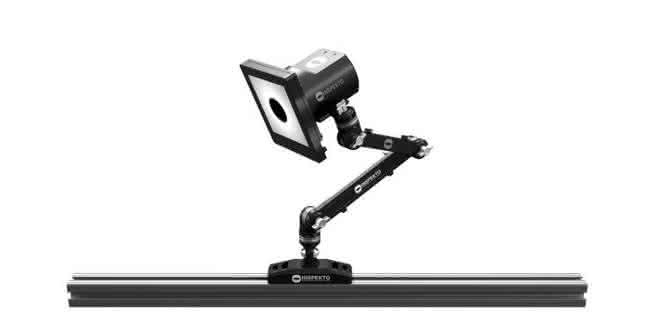
The S70 consists of a single, stand-alone device that integrates software and hardware. It can be installed in less than an hour by your own staff and there is no downtime during the installation and setup of the system.
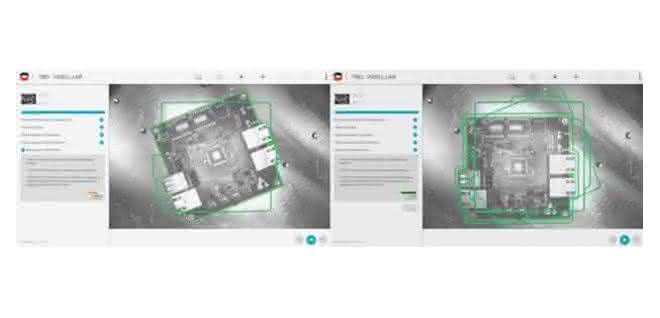
The system consists of four main components: Image processing sensor, Inspekto arm, mounting adapter and Inspekto controller. For installation, the operator first selects the position of the sensor. The operator then determines a mounting location near the sensor. The mounting adapter can be attached to any Bosch profile on the production line and the telescopic arm can be attached to the sensor. Following these simple steps, the operator can connect the controller and the system will start automatically. To set up the inspection, the operator draws a polygon as an outline around the area to be inspected, selecting zones of interest and those that can be omitted. The entire process requires no training and can be carried out independently by the production line personnel.
Simply "plug and inspect"
Once the system is operational, the AI aspect of the Inspekto S70 comes into play. To ensure the capture of clear, informative images, the system's algorithms optimize the camera and lighting settings for the object and its surroundings. The AI algorithm can then detect and localize the object without any input from the operator.
The final step is for the operator to verify some good sample references so that the S70 learns what a sample product looks like. The system uses as few references as possible for this, depending on the part to be inspected and its movement profile. The inspection process can now begin.
Each new image is compared with the references to verify shape tolerances and surface variations. As the system doesn't just look for predefined defects or make a comparison with faulty parts, it finds defects that the manufacturer wouldn't even have thought of.
The S70 can be installed at a different point on the production line at any time thanks to its self-adjustment options. It enables comprehensive quality assurance, where machine vision technology can be integrated at any point on the production line to monitor every step. The operator can easily identify whether a product is faulty and where the defect has occurred. This allows them to determine the causes of a defective product and optimize the system if necessary.
Yonatan Hyatt, CTO of Inspekto / am


You might also be interested in
Fraunhofer IOSB Opens Humanoid Robots Lab
The Fraunhofer IOSB is opening a Humanoid Robots Experience Lab in Karlsruhe, Lemgo, and Ilmenau. Companies and organizations can use these facilities to test potential applications for humanoid robots and develop pilot projects.
 read more...
Artificial Intelligence in Manufacturing
Trumpf and IPAI Are Expanding a European AI Network for Industry
The high-tech company Trumpf is an official partner of the IPAI AI network in Heilbronn. Together, the partners aim to exchange experiences, develop new AI applications for industrial use, and advance the development of artificial intelligence in...
read more...Case Study: Networked Manufacturing Platform for Toolmaking
Using a networked manufacturing platform, Escha GmbH & Co. KG, a manufacturer of industrial fastening technology, has comprehensively modernized its toolmaking operations.
read more...Barcelona Declaration on Robotics and...
Robotics Associations Adopt Global Automation Strategy
The global robotics industry is stepping up its collaboration. The associations AER Automation, A3, IFR, and VDMA Robotics + Automation have formed a long-term alliance by signing the “Barcelona Declaration on Robotics and Automation 2026.” The...
read more...Jane Heffner is the new president of the International Federation of Robotics
Jane Heffner is the new president of the International Federation of Robotics. Adrien Brouillard has been appointed vice president of the global federation.
read more...Greater Transparency in the Robotics Market
RoboFinder Launches as an Independent Comparison Platform
Launch at Gitex Europe: 'RoboFinder' aims to bring more transparency to the professional service robotics market. In this interview, founder and CEO Brian Engels discusses market potential, challenges, and the goals of the new platform.
read more...Artificial Intelligence for the Physical Space
Alibaba Expands Qwen Model Family with a Robotics Suite for Physical AI
Alibaba is expanding its Qwen model family with a robotics suite for Physical AI. The three models—for manipulation, navigation, and simulation—are designed to assist autonomous robots with complex tasks in real-world environments.
read more...International Federation of Robotics
U.S. Robotics Industry Sees Double-Digit Growth
In the U.S., sales of industrial robots rose by 11% compared to the previous year: 38,000 units were newly installed in 2025. This significant recovery is driven by robust growth in the food industry and other non-manufacturing sectors. However, the...
read more...Development Collaboration for Humanoid Robotic Hands Launched
Schunk is entering into a new development partnership with Robert Bosch Robotics. Their shared goal is to develop an industrial-grade robotic hand that can be integrated into various humanoid robot systems.
read more...