
Lenze at the Hannover Messe Digital
Applications of the digital twin
In the future, the digital twin will be as commonplace as the provision of data sheets on the website is today. This is why Lenze has been researching the digital twin for several years and is now taking further steps towards its application.
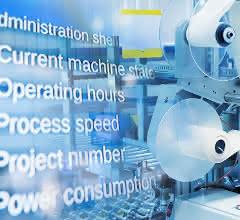
Developers and designers can use a web service, the Easy System Designer, to create the first digital image of a machine. Further web services then enrich this structure directly with technical data and documentation of the devices used. The resulting digital twin creates a new standardized and automated consistency of data and information and is therefore the basis for use in other tools and applications. And these are just the first steps.
"We will provide asset data for our system components, such as the digital type plate, technical data and documentation, via web services. This may not sound very exciting at first, but the added value over the entire life cycle of a system is enormous - because this data is passed on from engineering to commissioning and maintenance," explains Patrick Bruder, Business Development Manager Automation at Lenze.
Common data master
The provision of component data by the supplier simplifies integration processes in the development project. The aim is to bring products to market more quickly and cost-effectively by avoiding duplicate modeling work and, ideally, completely hardware-free development.
The automation specialists from Hamelin want to move away from the pure visualization of a product. A digital twin is the complete digital representation of a machine or system in all its aspects. It is not necessarily a specific file or a specific model, but rather a bracket around all versioned and referenced data of a product. This means that all tools can work on a common data master over the product life cycle, which is successively supplemented with additional information.


You might also be interested in
Predictive maintenance in retrofit
Predictive maintenance pays off. This is because early detection of impending failures means that systems can be serviced in a targeted manner before production downtime occurs. But how complex is it to integrate such a maintenance concept into an...
 read more...
Maintenance instead of replacement
The circular economy starts with the machinery
Sustainability in industry starts with machines, says our guest author from Deguma: How maintenance, modernization and the 5R strategy save resources, energy and CO₂.
read more...3D printing for unplanned requirements
The material fails and the machine suddenly stops? Then you need to take the right measures to be able to resume production quickly. Material failure in the form of faulty components or material wear in the frame are a risk for any production.
read more...High demands in terms of safety, application and robustness
Demanding work in the electrical trade and energy supply as well as smooth processes in production require innovative and customized measurement technology that scores points for safety, ease of use and resilience.
read more...Car meets e-bike: riding with lubrication-free polymer bearings
Studies show that the proportion of pedestrian and bicycle traffic is increasing in urban areas. With the JetBike, JetBike GmbH from Braunschweig presents a mixture of e-bike and car and relies on lubrication-free polymer bearings from Igus.
read more...Hydraulic hub for more efficient servicing
Bosch Rexroth presents a digital toolbox for service and maintenance. With a comprehensive range of digital services, the Hydraulic Hub simplifies and accelerates the service and maintenance of hydraulic products and increases machine availability.
read more...Arnold Umformtechnik expands after-sales...
Faster help with VR glasses
Arnold Umformtechnik is expanding the after-sales service for its machines to include digital remote services. The focus is on data security, simple operation and clear processes.
read more...147,000 euros per hour: high costs for German companies due to unplanned downtime
According to the "Value of Reliability" study, 67% of industrial companies in Germany experience unplanned downtime at least once a month. This costs the German economy 147,000 euros per hour. Nevertheless, reactive maintenance concepts are not...
read more...Maintenance starts with a maintenance planner
Legal requirements stipulate that machines and systems must be serviced regularly. The maintenance work serves to ensure occupational safety and economic efficiency.
read more...