

AI made in Germany
Opportunities in the niche
For a long time, Germany basked in the role of global tech pioneer. However, we are lagging behind when it comes to digitalization and artificial intelligence. However, there are still AI niches in which German industry can definitely score points.
In 2020 alone, private companies from the USA and China invested more than 33 billion US dollars in developments related to artificial intelligence. In Germany, market experts expect around five billion euros to be invested in AI - from 2018 to 2025 1.
However, it is not only the capital that is flowing rather sparsely in view of the rapid development and the sheer size of the future AI market in this country. There has also been a lack of concrete use cases that generate real added value and could serve as a blueprint for future users. What's more, the prerequisites for AI applications are often lacking. Many machines and systems are still not or insufficiently networked, and expertise in the field of cloud computing still leaves a lot to be desired.
Combining engineering skills and AI
"Made in Germany essentially stands for German engineering, be it in mechanical engineering, in the development of industrial and infrastructure systems or in automotive engineering," says Danny Claus, AI specialist at software company doubleSlash. "We have a head start in this area. At least for the time being."
However, this lead is no longer all that great and is dwindling rapidly, according to the AI expert. "Industrial companies around the world are currently in the process of networking and digitalizing their data at a rapid pace. The next logical step is the use of artificial intelligence. In a few years' time, the lead of German engineering will no longer be of any use to us when it comes to digitalization and AI."
In Germany, we are therefore well advised to look for niches that are not yet occupied and to focus on proven strengths. Danny Claus believes that the plant, mechanical and automotive engineering sectors in particular, as well as medical technology, are predestined for this.
Creating practical conditions for the use of AI
However, it is not enough to simply drive forward the expansion of AI expertise in Germany. It is also necessary to create the conditions for its use in companies and machines. Above all, however, the business cases targeted with AI must be economically viable in order to have any chance of finding a market. "That sounds trivial, but in reality many companies find it very difficult. All too many ideas and approaches get stuck in the proof of concept phase and don't make the leap to a productive solution."
This opens up countless application scenarios, some of which offer great potential for savings and added value. With AI support, manual processes in the company can be automated and made even more efficient. For example, an AI application can evaluate the images provided by imaging processes in quality control much faster and more accurately than humans.
Once a company has decided to actively use digitalization and AI, one of the first steps is: "Look specifically for use cases that really pay off, for example by making processes more efficient and/or reducing costs. Or scenarios that allow you to offer additional digital services for which the customer is prepared to pay. After all, you can only count on sufficient support from management if the business case pays off quickly. You generate quick results and a sense of achievement, paving the way for subsequent implementation."
Making maintenance processes more efficient
According to the AI expert, maintenance processes for industrial systems are among the most promising application scenarios. "There is a lot of potential for AI applications here, the topic is still relatively untapped internationally - and we have a lot of basic expertise in this area in Germany."
For example, maintenance managers can use modern AI methods to detect failures and malfunctions in plant and machinery at an early stage or even predict them thanks to well-trained algorithms. This allows maintenance processes to be planned with foresight and made significantly more efficient. At the same time, predictive maintenance reduces downtimes, lowers costs and increases customer satisfaction as well as efficiency.
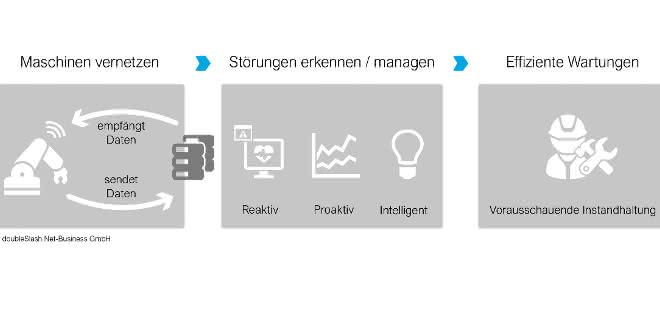
The economic potential is huge: according to McKinsey, production plant downtimes can be reduced by up to 50 percent and maintenance costs by 20 to 40 percent2. This clearly shows that investments in this area can quickly pay off. "This means that the probability of making a profitable business case is high. I am therefore convinced that German companies would do well to invest more in such use cases
Networking machines and systems
The key prerequisite for AI applications is that you have data. The more, the better. This is because the amount of available data correlates with the quality of the results that an AI system produces. The consequence: "In order to help AI achieve a breakthrough in Germany, we need as many companies as possible whose machines and systems are networked with data technology and which are fully digitalized on this basis."
The impact of digitalization on the development of new business models, innovative strength and speed can be seen in the examples of companies whose business model is fully digitalized: Amazon, Google & Co. generally find it easy to access the data of their millions and millions of customers and products.
Based on this data, they can build and train new AI applications within a very short space of time. With the added advantage that the data tells them exactly where the needs of their target groups lie, how their products are being used and which parameters are changing. There is no better basis for business success.
Traditional German machine and plant manufacturers have a much harder time here - if only because their business models are still based on hardware. A wind turbine, a printing press or a streetcar still has to be networked and integrated into a value-adding, data-driven business model.
This requires the development of special IoT solutions that read data from the respective systems and transmit it to a backend designed for this purpose with the help of IoT edge devices.
Courage for digitalization
Such solutions must first be developed individually by the respective manufacturers. This requires a clear entrepreneurial decision and the courage to invest money in such a not insignificant investment. "But it's worth it, because it allows you to exploit completely new potential in terms of digitalization throughout the entire company that was previously untapped," Danny Claus is convinced.
Tesla shows how this can be done: Tesla owners can book AI-based functions such as the "Enhanced Autopilot" via an app virtually while the car is running. This allows the company offering the service to tap into additional value creation potential without having to invest heavily once it has been developed. And it gives them a very precise view of what the customer wants.
This example can be transferred to many other application scenarios. In essence, it is always about booking certain services "on demand" based on networking and AI and only paying for their use, says Danny Claus. "Even now, many products are no longer purchased; consumers use and pay for them when they need them. This trend is currently growing very quickly, and AI is indispensable for this."
It is clear that digitalization, which runs through the entire value chain in the company, opens up completely new business and payment models. Networking is almost always the prerequisite for this.
Using cloud technologies
The requirements for AI applications differ significantly from those of traditional software in one respect in particular: the training of AI models can be very resource-intensive, as - see above - they are generally based on large amounts of data with which computationally intensive operations are performed. Consequently, these applications must be highly scalable. In addition, there are requirements such as functions for versioning and monitoring data and AI models as well as collaborative work between data science teams.
Cloud-based solutions such as Microsoft Azure or Amazon Web Services (AWS) already provide extensive, partly ready-made services and solutions for this. They can also be combined with other IoT technologies such as ThingWorx, which greatly simplifies integration into use cases as described above.
Most large German corporations have now outsourced many of their IT applications to the cloud or are on their way there. In doing so, they have managed to master the very high data protection challenges, particularly in the EU.
However, there are still reservations in many medium-sized companies in particular, where numerous traditional hidden champions are based. And, of course, there is also simply a lack of experience or experts who have mastered these technologies.
Danny Claus is convinced: "It is high time that SMEs in Germany close this gap. In my view, this is an almost historic opportunity to position themselves as pioneers in the field of digitalization and artificial intelligence in combination with traditional industrial applications
Conclusion
AI is a key technology for maintaining the international competitiveness of "Made in Germany" in the future. However, it is not enough to focus solely on AI itself. Instead, many German companies must first create the necessary conditions: they should network their products as quickly as possible and establish end-to-end digitalization that includes the entire value chain in the company. They should also accelerate the expansion of their technological expertise in the cloud sector. Only then can the full potential of artificial intelligence be fully exploited.
One example of how this works is provided by Celonis. The company specializes in process mining, i.e. the systematic analysis and evaluation of business processes. It is obvious that AI helps to analyze and evaluate processes quickly and, above all, accurately. This is precisely why Celonis uses artificial intelligence.
Another example of the productive use of AI can be found at the Munich-based company Konux. With a relatively simple use case - identifying faults in railroad switches - Konux has managed to build a successful business model using AI, IoT and cloud technologies. A model that is backed by over 130 million euros in venture capital. This makes it currently the most highly funded AI start-up in Germany.


You might also be interested in
ESTIA aims to strengthen Europe's cloud
New tech alliance for EU sovereignty
Twelve companies, including Dassault Systèmes, are founding the European Sovereign Tech Industry Alliance (ESTIA). The initiative aims to strengthen Europe's technological independence and define requirements for sovereign cloud services. The start...
 read more...
Deutsche Telekom and Nvidia launch one of Europe's largest AI factories
With the Industrial AI Cloud in Munich, Deutsche Telekom and NVIDIA are creating one of the largest AI factories in Europe. Companies can train AI models, carry out simulations and access 10,000 GPUs.
read more...Leveraging data potential with AI and streaming
Huge data treasures are still lying dormant in many manufacturing companies. And yet it is high time that these treasures were unlocked. There is often a lack of resources and capacity to make data usable in real time. Streaming production data can...
read more...More awareness of noise
Dematic offers solutions that are tailored to different cloud environments and reduce environmental impact through reduced material consumption and improved energy efficiency.
read more...Generative AI in the automation environment
The mechanical engineering and automation industry is undergoing profound change. This transformation is being driven by more volatile global trade, geopolitical crises and increasing market pressure, which demands greater agility, technological...
read more...Rigid data structures have had their day
The traditional data center is no longer the center of data. A hybrid cloud storage approach enables manufacturing companies to both meet the current requirements of data-intensive processes and future-proof their infrastructure.
read more...Software as a service in three stages
CIM Database Cloud is a new out-of-the-box solution from Contact for end-to-end digital product development.
read more...How production can benefit from AI
Together with AI technology, IIoT networking makes it possible to better control machine parameters and optimize quality with predictive quality. Downtimes and set-up times can also be further minimized. Cloud platforms also make these technologies...
read more...More expertise for digital engineering
Altair, a computational science and artificial intelligence (AI) company, has acquired OmniV, a technology from Michigan, USA-based software company XLDyn.
read more...