

AI in production
Competitive with machine learning
As the heart of the German capital goods industry, mechanical and plant engineering is the flagship of the country's economy. Every year, nine percent of national research and development expenditure flows into this sector, making it one of the strongest research sectors in Germany. In order to maintain their leadership in production innovation in the future, even in the face of strong competition, machine and plant manufacturers will have no choice but to take current technological advances in the field of artificial intelligence into account - specifically with regard to its sub-sector of machine learning (ML). ML refers to the ability of self-learning algorithms to recognize patterns and regularities in large amounts of data after prior training. Based on this artificially generated experience, they enable IT systems to find new solutions. ML algorithms differ in the way they learn from data: whether using labeled or unlabeled examples (supervised and unsupervised learning) or by rewarding or punishing a trial-and-error process (reinforcement learning). While the technology has so far primarily been used in the consumer sector, for example for individualized purchase recommendations, it is now also finding its way into the industrial environment. This is thanks to advances in algorithmic computing capacity and more available data.
Machine learning optimizes processes
A number of use cases can be outlined, both at the level of product properties and internal processes, which hold out the prospect of promising advantages of machine learning for mechanical and plant engineering. For example, ML-based systems can make core business processes such as the preparation of quotations much more efficient. In view of increasingly individualized production orders and a growing selection of complex machine configurations, this is becoming ever more time-consuming. ML algorithms are able to learn correlations between machine configurations and costs. Using historical data on previously created quotations, products and prices, intelligent machines (i.e. those working with ML algorithms) can estimate the costs incurred. This speeds up the preparation of quotations considerably and reduces the potential for errors. Similarly, the duration of work processes can also be predicted. ML algorithms can also predict replenishment times based on data from past orders, which enables more precise production planning and improves adherence to delivery dates.
Machine learning methods are particularly useful for processes that are determined by many measurable parameters in an unknown manner. This is the rule for complex physical machine processes. It is difficult to model these using formulas. Yet this would be necessary in order to optimize them in a targeted manner. However, if ML algorithms learn the behavior of the systems used, they are able to make predictions about the process (adaptive control). Based on conclusions drawn from historical data, they can adjust the process parameters before actual measured values are available. This significantly improves process quality. Dead times, in which a machine stands still while the throughput results are awaited after a new parameterization, are eliminated.
Intelligent machines create added value
At product level, ML generates added value through new services. One example of this is predictive maintenance. Based on process and sensor data recorded and evaluated by the system, intelligent machines are able to independently notify the user when maintenance is required. This helps to avoid downtime at a later date. Maintenance can take place at scheduled times so that production does not come to a standstill. One day, machines may even be able to order the necessary spare parts autonomously.
ML can also improve the performance of the machines themselves. The more efficient evaluation of sensor and machine data, for example, enables more precise statements to be made about the expected product quality (predictive quality), allowing it to be optimized in a targeted manner. Causes of quality deviations can be identified and eliminated more quickly, which reduces rejects. Advances in image processing generated by ML also contribute to more efficient quality inspection. ML-based vision systems in combination with corresponding sensors enable human-like image recognition. This enables machines to correctly identify surfaces with textures, which would not be possible with conventional image processing systems. New parts to be inspected can also be learned by the machine without great effort, which can significantly reduce development and product launch times.
Design concrete application scenarios
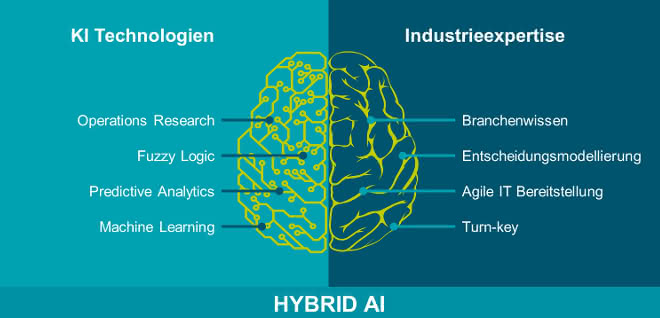
Overall, the use of ML-based systems means that machines are becoming increasingly autonomous and contribute to more efficient process handling on their own. This will also increase the performance of intelligent APS systems, which are already optimizing and simplifying the planning of production processes. Ideally, an intelligent machine will eventually be able to recognize which parts it should produce and when. The basis for this extended range of services is the combination of ML algorithms with other intelligent technologies and expert knowledge based on experience. As part of this hybrid approach, ML adds a data-driven component to knowledge-based decision-making: While operations research algorithms map existing expert knowledge on processes and behavioral patterns, for example, and fuzzy logic helps to convert imprecise information into explicit decisions, ML algorithms are also able to make predictions based on given data and thus generate new knowledge. This enables users to derive additional added value from their production data.
For machine and plant manufacturers, integrating machine learning into their own processes is often a challenge. Many companies initially get bogged down with complex projects and fail because they have not thoroughly thought through all the relevant aspects. A concrete application scenario should therefore be defined and backed up with quantifiable goals before the project starts.
A suitable database is essential here. In order to identify all relevant data, it is advisable to draw up a kind of map in advance that shows where which data is generated. A helpful database is often already available through the ERP systems used. It is important to set up an IT infrastructure that collects all relevant data, evaluates it automatically and feeds the results back into the process - this is the key to the success of the project. In order to ensure adequate data preparation (data maturity), experienced service providers should therefore be consulted who can respond precisely to the respective operating context during implementation.
It is also important to clarify in advance how and where the expertise for dealing with ML can be built up within the company and who is responsible when decisions are delegated to the system. The trust of all those involved in the system should not be neglected: only if this is present can ML be successfully integrated into internal processes and improve them in the long term. It helps to keep in mind that, in terms of a hybrid approach, the combination of empirical knowledge and algorithmic computing capacity ultimately promises the greatest possible added value.
Securing future viability
ML therefore offers mechanical and plant engineering a wide range of opportunities to optimize both products and process quality. With this technology, IT can become a key driver of innovation in the industry and guarantee its leading global role in the future. The expertise of users will remain of great importance and will continue to help ensure that algorithms are used in the right places. Due to the strong momentum that ML develops when used, companies that are currently still hesitant will quickly be left behind. The right time to get to grips with machine learning is no sooner or later than now.
Andreas Gladis, Head of the Production division at Inform.


You might also be interested in
Predictive maintenance in retrofit
Predictive maintenance pays off. This is because early detection of impending failures means that systems can be serviced in a targeted manner before production downtime occurs. But how complex is it to integrate such a maintenance concept into an...
 read more...
Maintenance instead of replacement
The circular economy starts with the machinery
Sustainability in industry starts with machines, says our guest author from Deguma: How maintenance, modernization and the 5R strategy save resources, energy and CO₂.
read more...3D printing for unplanned requirements
The material fails and the machine suddenly stops? Then you need to take the right measures to be able to resume production quickly. Material failure in the form of faulty components or material wear in the frame are a risk for any production.
read more...High demands in terms of safety, application and robustness
Demanding work in the electrical trade and energy supply as well as smooth processes in production require innovative and customized measurement technology that scores points for safety, ease of use and resilience.
read more...Car meets e-bike: riding with lubrication-free polymer bearings
Studies show that the proportion of pedestrian and bicycle traffic is increasing in urban areas. With the JetBike, JetBike GmbH from Braunschweig presents a mixture of e-bike and car and relies on lubrication-free polymer bearings from Igus.
read more...Hydraulic hub for more efficient servicing
Bosch Rexroth presents a digital toolbox for service and maintenance. With a comprehensive range of digital services, the Hydraulic Hub simplifies and accelerates the service and maintenance of hydraulic products and increases machine availability.
read more...Arnold Umformtechnik expands after-sales...
Faster help with VR glasses
Arnold Umformtechnik is expanding the after-sales service for its machines to include digital remote services. The focus is on data security, simple operation and clear processes.
read more...147,000 euros per hour: high costs for German companies due to unplanned downtime
According to the "Value of Reliability" study, 67% of industrial companies in Germany experience unplanned downtime at least once a month. This costs the German economy 147,000 euros per hour. Nevertheless, reactive maintenance concepts are not...
read more...Maintenance starts with a maintenance planner
Legal requirements stipulate that machines and systems must be serviced regularly. The maintenance work serves to ensure occupational safety and economic efficiency.
read more...