
Automotive supplier
Robot cells put on the track
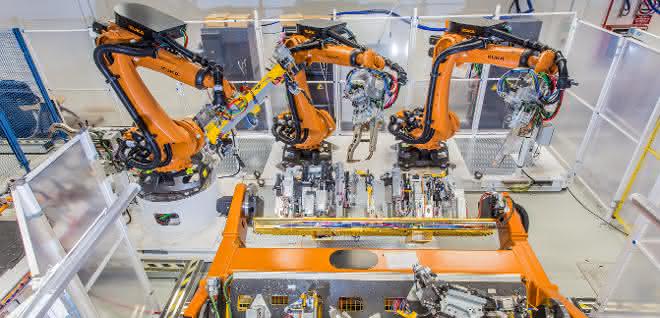
Production at Italian automotive supplier PMC is fully automated. More than 100 robots from Kuka, mainly from the KR-Quantec family, ensure smooth and reliable parts production in modular cells. Just seven months were available for the implementation.
The heart of the Italian automotive industry beats in Turin. The Fiat Group was founded here in 1899, and the Lingotto district is largely shaped by it. The Lingotto building, with a test track on the roof, was once the largest car factory in the world. Fiat-Chrysler, now part of the world's fourth largest car manufacturer Stellantis, still produces cars in Turin. One of the factory halls where Maserati manufactures the "Quattroporte" and "Ghibli" models is only a few hundred meters away from Kuka's Italian branch.
Two PMC production halls are also located just a few hundred meters from the Fiat Chrysler Automobiles (FCA) plant in Melfi. The Italian automotive supplier specializes in the production of body parts and is involved in the construction of the Fiat 500X, Jeep Renegade and Jeep Compass car models, among others. PMC's production is largely automated: More than 100 Kuka robots work in modular cells. They apply sealant, weld, check quality and process components.
The collaboration between PMC and Kuka began when the manufacturer was looking for a strategic and reliable partner to realize a new fully automated production line. The requirements that Kuka was confronted with in Italy set the pulse of manager Osvaldo Casetta racing. "In short: a 54-robot line with just six manual operators had to be able to meet the requirements of two different vehicle models," says Casetta, describing the initial situation.
The biggest challenge was the tight deadline. PMC wanted a maximum of seven months to pass from the start of conception to the first produced part - an extremely short time frame.
There were also other important points to consider: "Production had to be designed for 20 shifts per week, adapted to the needs of the customer Fiat-Chrysler." Just-in-time production only allowed a short maintenance break on Sunday morning, "the buffer to the main production line didn't allow any more leeway," explains Casetta. "Our focus was therefore on maximum availability; PMC could not afford a production downtime under any circumstances." In a nutshell: "We wanted a zero-defect strategy for a turnkey solution," says Vincenzo Marchesiello, Production Engineer at PMC in Melfi. "A sustainable concept, robust design and reliable products were the basic requirements for this."
Smart software: rehearsals until the real thing
Kuka hit the PMC nerve with the right automation portfolio. The modular solutions consisting of cells, robots, application packages, user-friendly software and the associated service matched PMC's just-in-time philosophy. The Kuka team simulated the future production environment down to the smallest detail in order to be able to implement all the specifications by the start of production, thus optimizing the processes and workflows.
There are quite a few of these at the PMC plant: Nuts and brackets are welded onto components of various sizes, ranging up to almost the length of a car, sealants are applied and various inspection processes ensure the high quality of the work carried out. Even the transportation of the components between the cells is largely automated. Support is provided by multi-axis turning units that bring massive body parts into the correct position.
In conjunction with the sophisticated control software, very small parts such as seatbelt reinforcements, nuts for electronic wiring or pins for fastening the interior plastics are welded onto large parts such as wheel arches. In the end, the entire body interior of the three vehicles is produced in this way. Just seven months after the contract was awarded, PMC delivered the first components to Fiat-Chrysler, which were produced with the help of the KR-Quantec robots.
A partnership that lasts
Automated production is paying off for PMC. "With the modular welding cells from Kuka and the support of the planning team, we are able to keep pace with the ever-increasing market requirements," emphasizes Marchesiello from PMC. Consistently high quality with maximum productivity and low costs - this is the mix that PMC believes is the reason for the success of its collaboration with Kuka.
Accordingly, PMC also relies on Kuka's support for its plant in Brazil: a total of 78 robots from Augsburg work in the fully automated production line. All parties involved attach great importance to defining the cooperation as a partnership of equals. "We will soon be expanding the production of components for the Jeep Compass and are looking forward to having Kuka on board again," says Marchesiello.
Sebastian Schuster, Global PR & Content Manager at Kuka


You might also be interested in
Predictive maintenance in retrofit
Predictive maintenance pays off. This is because early detection of impending failures means that systems can be serviced in a targeted manner before production downtime occurs. But how complex is it to integrate such a maintenance concept into an...
 read more...
Maintenance instead of replacement
The circular economy starts with the machinery
Sustainability in industry starts with machines, says our guest author from Deguma: How maintenance, modernization and the 5R strategy save resources, energy and CO₂.
read more...3D printing for unplanned requirements
The material fails and the machine suddenly stops? Then you need to take the right measures to be able to resume production quickly. Material failure in the form of faulty components or material wear in the frame are a risk for any production.
read more...High demands in terms of safety, application and robustness
Demanding work in the electrical trade and energy supply as well as smooth processes in production require innovative and customized measurement technology that scores points for safety, ease of use and resilience.
read more...Car meets e-bike: riding with lubrication-free polymer bearings
Studies show that the proportion of pedestrian and bicycle traffic is increasing in urban areas. With the JetBike, JetBike GmbH from Braunschweig presents a mixture of e-bike and car and relies on lubrication-free polymer bearings from Igus.
read more...Hydraulic hub for more efficient servicing
Bosch Rexroth presents a digital toolbox for service and maintenance. With a comprehensive range of digital services, the Hydraulic Hub simplifies and accelerates the service and maintenance of hydraulic products and increases machine availability.
read more...Arnold Umformtechnik expands after-sales...
Faster help with VR glasses
Arnold Umformtechnik is expanding the after-sales service for its machines to include digital remote services. The focus is on data security, simple operation and clear processes.
read more...147,000 euros per hour: high costs for German companies due to unplanned downtime
According to the "Value of Reliability" study, 67% of industrial companies in Germany experience unplanned downtime at least once a month. This costs the German economy 147,000 euros per hour. Nevertheless, reactive maintenance concepts are not...
read more...Maintenance starts with a maintenance planner
Legal requirements stipulate that machines and systems must be serviced regularly. The maintenance work serves to ensure occupational safety and economic efficiency.
read more...