

Research
Model-based control
A research group at the Institute for Control Engineering of Machine Tools and Manufacturing Units (ISW) at the University of Stuttgart is working on models that also take object dynamics into account when calculating robot control sequences and trajectories.
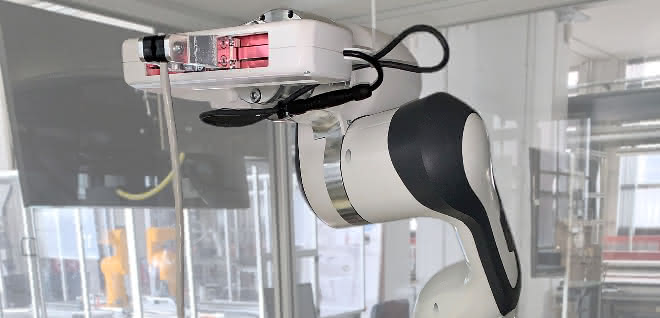
A key challenge for robots lies in non-reproducible processes, for example when components are provided in an undefined position or process steps cannot be carried out according to a defined sequence.
Where humans can determine and compensate for the deviation using their acquired process knowledge, the robot must be provided with a model of the process and suitable sensor technology, on the basis of which the control sequence and trajectory can be planned and, if necessary, adapted. Whether a model is required for a specific handling task depends on the requirements and boundary conditions of the task in question. Using the example of a pick-and-place scenario, various options with the corresponding models are listed below.
If components are not stored in a magazine, or more precisely, do not have a known initial position, this information must be provided for the robot controller. For this purpose, kinematic models are used that describe the relationship between positions, speeds and accelerations. If these relationships are known for a component, the question of when the robot end effector should be positioned where and in which pose can be easily answered and the trajectory planned accordingly. A classic industrial example of this is components on a conveyor belt that are provided in a random order. If a robot is to pick them up, its position must be detected. If the conveyor belt is in motion, the belt speed can be taken into account in the gripping point calculation in order to consider the time required to execute the movement.
Problematic momentum of its own
If the dynamic requirements of the component need to be taken into account, a dynamic model is required that also takes the acting forces into account. When handling geometrically large, flat components such as sheet metal, for example, the robot movement can cause a natural oscillation. This increases the force on the gripper, which in the worst case can exceed the gripping force and lead to object loss. It is therefore important to calculate a suitable trajectory in advance using model-based control.
The difficulty with dynamics models often lies in the physical modeling, which quickly becomes complex and time-consuming even for supposedly simple tasks. Further difficulties arise in determining the relevant parameters for the model. If these are too complex to calculate, the real-time requirements of the process may be violated. Furthermore, some of these parameters cannot be identified, which is why model-based control cannot be used.
Simulated object dynamics
It is not only advantageous to consider the dynamics of the component when handling large metal sheets, but also when handling deformable objects such as cables or hoses. These objects are characterized by the fact that their own weight is often sufficient to change not only their position but also their shape. Since a deformation occurs as a result of a force, a dynamic model of the deformation behavior can be used to calculate the shape of the object.
The ISW has developed an approach that takes into account the deformation behavior in the robot's trajectory planning. The manipulated object is modeled as a multi-body system consisting of individual rigid bodies coupled via joints with spring and damper properties. The resulting movement under the force of the robot can then be calculated using a multi-body simulation, whereby the robot is modeled in the simulation alongside the manipulated object. The ISW uses the open-source software DART (Dynamics Animation and Robotics Toolbox) to solve the equation of motion.
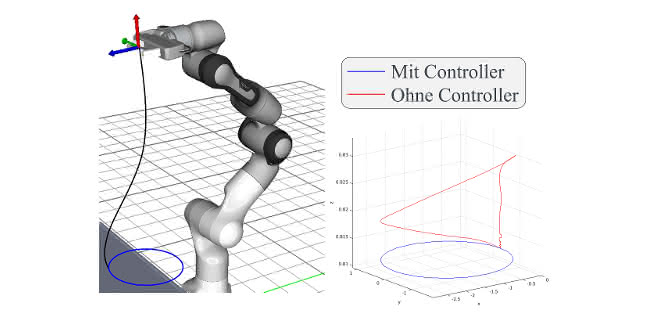
The simulated object dynamics predict which movement of the object will result from a force applied by the robot. In order to follow a predefined movement, the necessary force of the robot can now be inferred directly by inverting the system of equations and formulating a control law that uses the inverted solution of the simulation model to calculate the necessary manipulated variable on the robot side. This makes it possible to follow predefined trajectories, taking into account the deformation behavior of the object.
The approach was validated at the ISW with the Panda robot from the manufacturer Franka Emika using a circular motion. The objective was to move a deformable cable along a circular path, taking into account the object dynamics in such a way that the loose end describes a circle with a defined diameter. While the trajectory of the loose end diverges from the target trajectory very quickly without the dynamics taken into account, the trajectory specification on the circular path could be stabilized by taking the object dynamics into account in the control law.
This example for validating the approach is to be transferred to industrial applications in future research work. Areas of application include automated assembly in control cabinet or automotive construction. Although there is already a very high degree of automation in these areas, the wiring of individual cables and cable harnesses is still largely carried out manually.
Manuel Zürn; Markus Wnuk; Christoph Hinze; Dr.-Ing. Armin Lechler; Prof. Dr.-Ing. Alexander Verl


You might also be interested in
Helu makes its first trade fair appearance under a new brand name
Helu Kabel will be presenting itself as Helu for the first time at Hannover Messe 2026, showcasing system solutions, Heluchain cables and new industrial luminaires.
 read more...
Strategic realignment with brand relaunch
In future, Helukabel will trade as Helu
The Helukabel Group is parting with part of its name: in future, the company will only operate under the Helu brand. With this step, the specialist for electrical connection technology is underlining its strategic development from a classic cable...
read more...Modular plant construction for corrugated board
Insight into the production of corrugators at BHS Corrugated: Automated, modular and equipped with Helukabel components.
read more...Best quality for the steel
Conditions in the steel industry are harsh and inhospitable. The machines used must be able to withstand the demanding environmental conditions in order to deliver the best quality at all times.
read more...If the standard cable is not sufficient
Lapp offers cables for countless applications - but not for all of them. From time to time, the developers have to modify a standard cable or develop a special cable.
read more...Slight decline in sales, strong investments
The Lapp Group has not been spared from the weakening global economy. However, the company only recorded a slight loss in the past 2024 financial year.
read more...Electrical connection technology
Cables and wires for industrial automation
Heukabel offers system solutions for cable routing from a single source. The subsidiary EKD Systems specializes in tailor-made cable drag chains made of steel, stainless steel and plastic, which are used in moving machines and systems as well as in...
read more...Lapp relies on Ultramid from BASF
Mobile charging of electric vehicles
The automotive industry is currently undergoing the biggest transformation in its history. The boom in battery electric vehicles in particular is presenting the industry with major challenges. Lapp, as a supplier of cables and connection...
read more...Cable handling application
At this year's Motek, ArtiMinds Robotics is showcasing a robot-based automation solution for the sensor-assisted assembly of flexible cables in connector housings.
read more...