
Machine retrofit 4.0
With the Edge Controller to the Smart Factory
Keba shows how digital transformation can be achieved with machines already in the field. A controller, the core component of the Kecontrol Flexcore automation system, serves as a bridge between machine automation and the IT level.
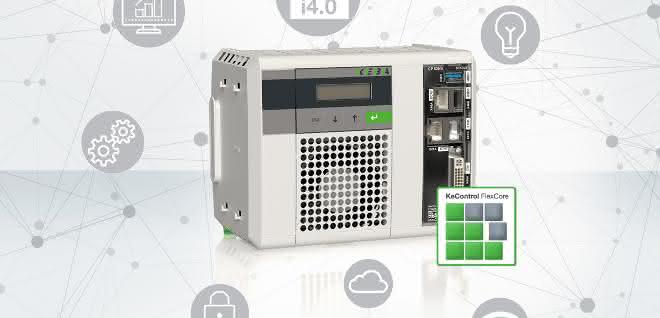
Industry 4.0 has become the omnipresent key topic in the manufacturing industry. Machine builders of the future are concerned with how they can embark on the path to the digitalized factory. They are faced with three challenges:
Greenfield concepts
Industry 4.0 concepts are often based on the planning of a completely new factory. However, in order to master the digital transformation in production, the brownfield challenge must also be overcome. Existing machines need to be connected to each other (horizontal networking) as well as to the higher IT level up to the cloud (vertical networking). And with as little effort, cost and risk as possible.
Huge amounts of data
The starting point for the smart factory is sensor technology. It is used to record data relevant to the manufacturing process directly at the machine. However, this data is usually so extensive that it can neither be stored locally for long nor transferred in full to the higher level. Valuable information that forms the basis for analyses such as predictive maintenance is therefore not available.
Protocol announcements
Even if companies do not (yet) want to deal with Industry 4.0 solutions, a certain degree of integration of machines into corporate IT is standard nowadays. Technological development means that old protocols are being discontinued - often for security reasons. If company servers are not converted to new protocols, the company is potentially insecure. If a switch is made, machines can no longer communicate with the server. Re-implementation in the control software is associated with a high level of effort and risk. So what can be done?
Edge computing
Edge computing refers to decentralized data processing at the edge of a network. A physical edge device - which collects, filters and analyzes data - forms the interface from Operational Technology (OT) at machine level to Information Technology (IT) at company level and on to the cloud.
Edge devices can therefore overcome all three of the challenges outlined above. On the one hand, there is no need to intervene in control architectures that have often evolved over decades, which involves a great deal of effort and the risk of production downtime. On the other hand, the extensive operating and process data can be pre-processed. In addition, the device acts as a communication interface between machines and company servers, speaking several protocols.
When an industrial controller is used as an edge device, the world of Industry 4.0 is open to machine builders. I/O modules allow additional signals to be sampled via analog and digital inputs, enabling predictive maintenance, for example.
An edge controller supports various communication protocols (SMB, OPC UA, TSN, MQTT), which can be used to connect all the necessary units horizontally and vertically to form a smart factory. Cloud connections can also be implemented in this way. The integration of any future protocols is also not an obstacle. as


You might also be interested in
Fraunhofer IPMS develops new 10G TSN endpoint
The demands on Ethernet networks in automotive, industrial and safety-critical applications are increasing rapidly. The Fraunhofer Institute for Photonic Microsystems IPMS is responding to this with a new 10G TSN endpoint IP core that enables...
 read more...
Ewald H. Kuk holds the keynote speech
On September 23 and 24, the international community from industry, research and development will once again meet in Stuttgart to discuss the latest developments in Time-Sensitive Networking (TSN). This year's keynote speech will be given by an...
read more...Basis for future-proof OT networks
Future-proof OT network solutions are the basis for advancing digitalization in industry. High-performance industrial Ethernet switches with a large number of ports, high data rates and extensive functions are required to ensure reliable and secure...
read more...EtherCAT all-rounder
In an interview with Andreas Mühlbauer, Thomas Rettig, Senior Management Control System and Communication Architecture at Beckhoff Automation, cites reliability, speed and compatibility as decisive factors for industrial communication.
read more...The tiger among processors
Since the move towards the Industrial Internet of Things (IIoT) and Industry 4.0 has picked up speed, processor boards and modules must be able to process exponentially growing amounts of data.
read more...One thing will win
Single Pair Ethernet is the technology that enables migration from various legacy networks to a universal physical layer. This is a further step towards making data available from the individual edge sensor through production to the desktop or...
read more...Faster start of series production with Computer-on-Module series and starter kits
TQ is presenting four versatile module series at this year's embedded world: TQMa243xL, TQMa64xxl, TQMa117xl and TQ110EB as well as a new, powerful SMARC starter kit in a practical form factor.
read more...One network for all applications
Reliable data communication with high data rates and deterministic time behavior is one of the prerequisites for production in accordance with the principles of Industry 4.0.
read more...Security of automation solutions
End-to-end safety in automation
Networking in industry and the associated Industrial Internet of Things (IIoT) are redefining the requirements for security - and therefore also for the automation solutions used.
read more...