
Real-time networks
TSN realizes Industry 4.0
Time-Sensitive Networking (TSN) is an innovative technology that facilitates the implementation of future-proof Industry 4.0 applications in companies.
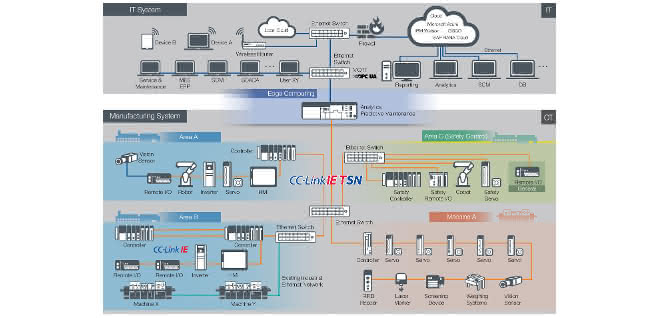
It enables a significant improvement in industrial Ethernet standards through greater convergence and transparency between IT (information technology) and OT (operational technology). Companies that use convergent and transparent communication systems gain precise insights into their processes and thus obtain information to improve quality, increase productivity and ultimately reduce production costs. TSN offers companies many new opportunities for individual production areas, right through to the realization of the smart factory.
TSN - The technical background
TSN is a technology that extends the properties of current Ethernet-based industrial networks. It is located in the data link layer, layer 2 of the OSI reference model. The extensions are defined by the IEEE 802.1 Ethernet sub-standards and aim to achieve determinism and convergence of various data streams in a network.
Two particularly important TSN sub-standards with regard to these functionalities are IEEE 802.1 AS and IEEE 802.1 Qbv. The IEEE 802.1 AS sub-standard is originally based on IEEE 1588 "Standard for a Precision Clock Synchronization Protocol for Networked Measurement and Control Systems" and ensures that all components in the network follow a common time system. This achieves the basic requirement of synchronizing all network components with high precision. The network clock master is responsible for time synchronization. It sends time information in the format of Ethernet packets to each network node as well as to the "time-aware system" in the network. As a result, all network components work according to the same clock and minimize the probability of time deviations (jitter), which would delay data transmission. This is a significant difference to standard Ethernet networks, in which each device follows its own individual clock. Here, timing errors add up and lead to unwanted jitter.
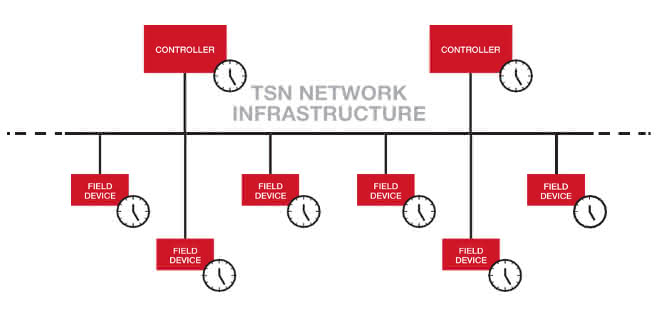
IEEE 802.1Qbv uses the synchronized environment created by IEEE 802.1AS for effective traffic scheduling systems. This sub-standard provides for network switches with so-called time-aware shapers (TAS) to transport time-critical data, such as movement and control data. TAS enable the prioritization of urgent and regular data using periodic time windows (slots) created by a time division multiple access (TDMA) process. Within these slots, only scheduled or reserved time-critical or mission-critical data is transmitted without collision. As all TAS and network components are synchronized, all participants know when prioritized data is sent and processed. The send and receive times are determined in this way via the traffic definitions of the data packets. The TSN standards prevent network overload through traffic planning and enable deterministic communication in which no data packet is lost.
New possibilities through TSN
This means that in addition to machine control data such as I/O states, safety (functional safety) and motion control data are also transported synchronously in real time via the same network. Furthermore, asynchronous, non-time-critical data of any kind, based on TCP/IP or UDP/IP, such as cameras or barcode readers, can be transmitted at any time. This allows different types of data to be routed and controlled predictably through the network. This results in simpler, leaner, more cost-effective and easier to maintain network architectures, which above all reduces investment costs (capex).
In addition, convergence offers the opportunity to merge the areas of OT and IT and creates a new level of transparency in manufacturing processes. Whether the implementation of convergence and transparency is successful depends largely on the performance of the supporting industrial networks. The network must transfer large volumes of data from a wide variety of sources to different areas of the company. This data traffic must be deterministic, i.e. reliable and predictable, in order to achieve operational performance and efficiency gains. For end users, machine builders and automation providers, this is a new efficient, cost-saving and holistic approach to implementing innovative ideas for production planning of manufacturing processes.
Retro-fit allows end users to upgrade and expand their systems with TSN-based network technology for future innovations. When integrating existing systems and their Ethernet-based networks, the higher-level associated systems are also taken into account. This enables what is known as data convergence, i.e. the merging of IT and OT, and means that investments that have already been made are safeguarded while the latest technologies are also used in the expansions. Furthermore, the number of networks required for operation is reduced and costs are cut by merging different data streams while still ensuring determinism. For their part, machine manufacturers can pass on cost savings to their customers because less hardware and engineering effort is required overall for the development, configuration and installation of network systems. The engineering effort for the data connection is significantly reduced. For example, direct addressing from the edge PC or from the IT level from a local Scada system or a cloud application to end devices can take place at the OT level without having to prepare or constantly update a mapping with predefined data in the PLC, as is usually the case. This speeds up the implementation of projects and simplifies optimizations for later function expansions.
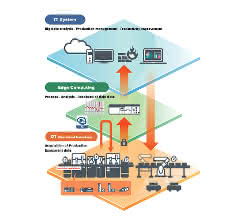
The convergence supported by TSN facilitates data exchange between company levels and makes processes more transparent for end users. Ultimately, transparency means being able to transport, extract and analyze more data from industrial processes in a time-critical manner in order to obtain meaningful information that contributes to a better understanding of manufacturing operations. This knowledge can then be used to optimize performance, productivity, efficiency and end product quality.
Higher productivity with AI analysis
TSN supports the creation of networks that transmit a wide variety of data flows, which are naturally also suitable for analysing errors and localizing potential problems. Incoming data and error messages are provided with real-time time stamps in the TSN network and can be analyzed for specific patterns in the cloud or locally in the edge PC using artificial intelligence (AI), for example. This allows causes and symptoms to be clearly differentiated and the appropriate measures to be taken. Another example is predictive maintenance with vibration analysis, which recognizes certain vibration patterns and can assign them to a fault type. This enables end users to take immediate countermeasures to prevent damage or to plan and carry out maintenance or repair work on their systems in advance. This reduces downtime, increases overall availability and makes the entire production system more productive.
The CC-Link Partner Association (CLPA) has a very good track record with its pioneering open automation networks. At the end of 2018, the CLPA published CC-Link IE TSN as a TSN-based industrial network that enables automation manufacturers to develop TSN-capable products. CC-Link IE TSN enables companies in the manufacturing industry to transparently visualize and improve their production processes. Companies that want to optimize their plants, machines or automation products with TSN make a reliable choice with CC-Link IE TSN. This is the first open industrial Ethernet that combines Gigabit bandwidth with TSN functionality to meet the requirements of both current and future applications. In addition, compatible products and solutions from leading automation vendors are already available for end users. Christoph Behler, CLPA


You might also be interested in
ebm-papst is growing again thanks to AI and data centers
ebm-papst returned to a growth trajectory in fiscal year 2025/26. Air Technology, data center applications, and artificial intelligence are driving revenue and investment.
 read more...
SPE on the Verge of a Market Breakthrough
Single Pair Ethernet (SPE) has moved beyond the conceptual phase and is increasingly being implemented in industrial settings. The focus here is not only on higher data rates and simplified cabling, but above all on the issue of system integration...
read more...More than 900 exhibitors already registered
Around six months before the start of the trade fair, more than 900 companies have registered for SPS 2026 in Nuremberg. The trade fair focuses on industrial AI, cyber security and digital transformation.
read more...Virtual PLCs in practice: How vPLCs make production systems more flexible and scalable
The increasing networking of IT and OT is fundamentally changing industrial automation. The IT/OT Integration Summit shows how modern technologies can make production environments more efficient, flexible and future-proof. The event will focus on...
read more...Sales growth in a turbulent market environment
Thanks to innovations and a focus on strategic industrial markets, Sick was able to moderately increase its sales in the 2025 financial year. In a turbulent market environment, the company was able to maintain its position and gain market share with...
read more...Siemens presents new AI agent
Siemens is launching 'Eigen Engineering Agent', an AI for automation technology. The solution is integrated into the TIA Portal, has been tested with over 100 companies and is designed to significantly accelerate engineering processes.
read more...Schaeffler keeps sales almost stable
Schaeffler generated revenue of EUR 23.5 billion in 2025 and increased EBIT before special items to EUR 936 million. At 266 million euros, free cash flow was significantly above the prior year and forecast. Net income remained negative due to high...
read more...Advancing artificial intelligence together
Helukabel is stepping up its activities in the field of artificial intelligence and is now a member of the IPAI. The innovation and collaboration platform for companies, research facilities, institutions and administration has set itself the goal of...
read more...New impetus for ifm sales
Two new positions were filled at ifm at the start of 2026: Markus Wolf becomes Managing Director Sales Germany, Sven Quant takes over the position of Central Managing Director in the Process Sensors division within the ifm Group.
read more...