
Automation toolset
The IIoT as an overall concept
Digitalization, networking and IIoT are occupying more and more companies that want to advance their production or offer new digital services and products. However, the path from an IoT pilot project to widespread use is often a rocky one.
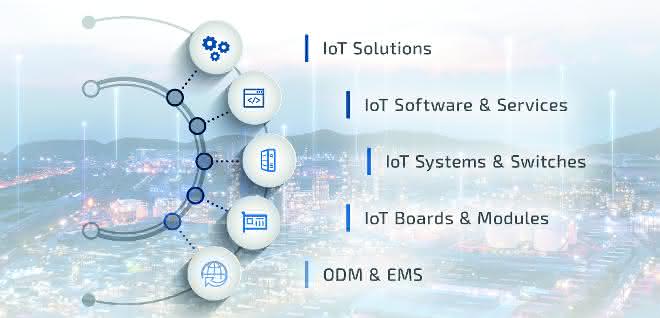
Digitalization projects relating to Industry 4.0, IIoT and artificial intelligence rely on the networking of all assets, sensor technology and the integration of a wide variety of data. In practice, there are many proofs of concept and pilots, but these topics have not yet become widespread in most companies. This is also due to the approach to individual projects, as the focus should be on processes rather than projects. Hardware alone is no longer the solution, which is one of the reasons why manufacturers will have to add software and process consulting to their portfolios in future.
Wherever the aim is to benefit from networking and data analytics, the focus is often on end-to-end processes that run through entire value chains. It is therefore of little use if just one department gets to work. Most topics are interdisciplinary - the entire company must continue to develop. It is therefore important that the setup is right and that people from all departments are involved. At the same time, the large number of topics and participants poses major challenges for project management. Digitalization is ultimately a comprehensive process that consists of many small projects. However, IoT-related software has a deep impact on company processes. Without clear objectives, new complexity problems can arise, especially when it comes to data collection and processing.
One toolset for all IoT scenarios
Different digitalization approaches are each based on different sensors, machines or devices and their data. To avoid having to reinvent the wheel in every context, Kontron relies on a toolset of hardware, software and expertise that can be expanded as required and can grow in line with increasing operational requirements. The Susietec toolset helps to map almost all IoT application scenarios in the industry. The close coupling of software and hardware development within the Kontron Group is proving to be an advantage. For real-time applications in particular, it is important that hardware such as gateways or other edge devices and the software are aligned with each other. In the AI environment, algorithms often run at the edge, for example in automated quality control based on computer vision in production. Coordinated software and hardware solutions are therefore increasingly important here. There is also a growing need for high-performance computing (HPC) in this area.
Only selected machine and sensor data should migrate to the cloud, not only for latency and security reasons, but also to avoid overloading networks. This means that data must be pre-processed at the edge and made available for different applications in hybrid infrastructures. This requires middleware that can cache data in order to enrich it with timestamps, aggregate it, compress it or convert it. This is the only way to make information usable and comparable for data analytics.
Interfaces with end-to-end security
The Susietec toolset also makes a significant contribution to mastering the interface problem. Typically, a large proportion of the data from the controllers and sensors is used for process control when linking the systems integrated into the process chain. Experience has shown that in many projects it is also necessary to connect the production control system with an ERP system. As a connectivity platform, the Susietec toolset provides end-to-end security features and bundles all interfaces transparently. A large number of standardized interfaces are already available, so only minor adjustments are often required when integrating new systems.
Instead of investing in a huge solution with a lot of ballast, companies should be able to use exactly those components of the toolset that they need for the respective use case. These can be automation approaches in production, control topics in the back office, optimizations in field service or apps that visualize and streamline processes. The individual applications are networked with each other in such a way that companies can create a consistent, integrated IoT landscape and gradually adapt it to new requirements.
The step-by-step approach can be seen, for example, in a practical project in special machine construction: the initial aim was to evaluate error messages and lay the foundations for predictive maintenance. Soon, the service technicians were also to receive messages on their tablet or smartphone. Finally, a module was set up that manages the entire deployment planning, scheduling coordination, spare parts management and on-site support. New requirements are often added over time. Nevertheless, it is important to take a close look at AI and machine learning concepts, for example, and bring expertise on board.
A general trend that can be observed is that digital services are becoming increasingly important, not least in the field of mechanical and plant engineering and maintenance. IIoT solutions should therefore also enable secure access via a portal for third parties, such as service technicians. For example, alerts and analyses relating to predictive maintenance or machine optimization can be forwarded. Remoting for remote diagnostics and maintenance offers considerable potential for efficiency. Even with this topic, which at first glance seems straightforward, there are many hurdles to overcome, such as firewalls and specific security requirements at the location of machines and systems. Commercial tools quickly reach their limits here.
IIoT scenarios are often very individual. There are different configurations for each use case: For example, only certain data needs to be stored and forwarded to different systems. For example, if machines are rented out in a pay-per-use model, the information on operating times must be available centrally in the cloud. However, if only a maintenance service is offered, this data is not required in the cloud. Data management tailored to the respective use case is crucial.
Security by design is an essential topic
The vulnerability of increasingly open systems in industrial production is growing from year to year, as the figures from the Federal Office for Information Security's annual situation reports clearly show. The BSI advises strategies in which security already starts in the design process. In the IIoT environment, this means that the difference must already be made in the software by configuring a secure operating system individually for the use case and maintaining it with regular security patches. The requirements and communication channels are very different here. Standard operating systems often have to be trimmed to the respective situation with considerable configuration and maintenance effort. In addition, the system performance is often so heavily loaded with security features that the devices cannot fulfill their actual function optimally. This is why the use of Susietec SecureOS can be worthwhile from a certain number of devices in the field.
With Susietec, Kontron offers a toolset for all aspects of device management, remoting and edge computing. It also includes data management and real-time data processing, AI, machine learning and analytics. The toolbox of software, coordinated hardware and expertise enables the simple development of apps and intelligent dashboards, among other things.
Bernhard Günthner, Executive Vice President IoT Software of the S&T Group / am


You might also be interested in
ESTIA aims to strengthen Europe's cloud
New tech alliance for EU sovereignty
Twelve companies, including Dassault Systèmes, are founding the European Sovereign Tech Industry Alliance (ESTIA). The initiative aims to strengthen Europe's technological independence and define requirements for sovereign cloud services. The start...
 read more...
Deutsche Telekom and Nvidia launch one of Europe's largest AI factories
With the Industrial AI Cloud in Munich, Deutsche Telekom and NVIDIA are creating one of the largest AI factories in Europe. Companies can train AI models, carry out simulations and access 10,000 GPUs.
read more...Leveraging data potential with AI and streaming
Huge data treasures are still lying dormant in many manufacturing companies. And yet it is high time that these treasures were unlocked. There is often a lack of resources and capacity to make data usable in real time. Streaming production data can...
read more...More awareness of noise
Dematic offers solutions that are tailored to different cloud environments and reduce environmental impact through reduced material consumption and improved energy efficiency.
read more...Generative AI in the automation environment
The mechanical engineering and automation industry is undergoing profound change. This transformation is being driven by more volatile global trade, geopolitical crises and increasing market pressure, which demands greater agility, technological...
read more...Rigid data structures have had their day
The traditional data center is no longer the center of data. A hybrid cloud storage approach enables manufacturing companies to both meet the current requirements of data-intensive processes and future-proof their infrastructure.
read more...Software as a service in three stages
CIM Database Cloud is a new out-of-the-box solution from Contact for end-to-end digital product development.
read more...How production can benefit from AI
Together with AI technology, IIoT networking makes it possible to better control machine parameters and optimize quality with predictive quality. Downtimes and set-up times can also be further minimized. Cloud platforms also make these technologies...
read more...More expertise for digital engineering
Altair, a computational science and artificial intelligence (AI) company, has acquired OmniV, a technology from Michigan, USA-based software company XLDyn.
read more...