

Industrial communication
Single Pair Ethernet revolutionizes factory networking
The standard paves the way for an unhindered flow of data across all levels of the automation pyramid.
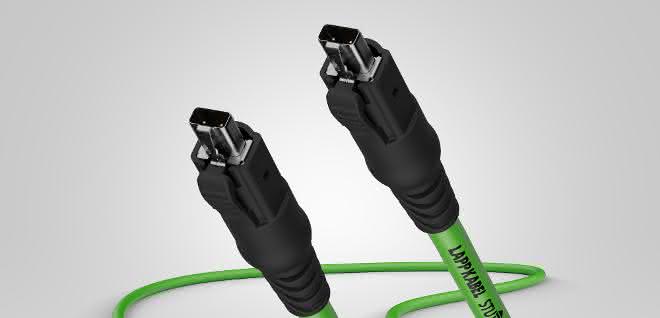
It seems to be an unwritten law: Data transfer rates are increasing and increasing - even in digital communication in factories. Today, cables can handle data rates of up to 10 Gbit/s and even more in the future. However, maximum speed is not always the decisive factor. At field level, there is an increasing demand for space-saving and easy-to-process cables that also allow standardized data exchange with the upper levels of the automation pyramid. This is where Single Pair Ethernet (SPE) comes into play, which has rightly become a hype topic. After all, SPE is an important future technology for digitalization in the production environment.
More and more capacity required
In the past, communication in industry was implemented using fieldbuses, such as Profibus, which can only transmit 12 Mbit per second and is far too slow for today's requirements. Industrial Ethernet was introduced at the turn of the millennium. Users had to go from two to four cores, which doubled the connection effort, and the cables became more complex, more expensive, required more space and the effort involved increased. Cat.6 and Cat.7 brought gigabit data transmission into production, but also an even higher connection effort because there are now four pairs or eight cores in one cable.
With Single Pair Ethernet, the focus is back on what is really necessary. SPE cables only have one twisted pair of wires instead of four. Nevertheless, SPE is almost as fast as Multi Pair Ethernet, but it allows much greater distances, is more compact and requires less effort during installation. SPE makes the field level smart and ensures consistent, reliable networking across the entire automation pyramid.
Manufacturers pull together
Manufacturers want to avoid the uncontrolled growth of fieldbuses at all costs. The SPE Industrial Partner Network has therefore set itself the task of standardization. Numerous cable and connector manufacturers have joined forces to drive the technology forward. The members of the consortium see SPE as the upcoming standard at sensor-actuator level and as the basic infrastructure for intelligent sensors and actuators and the smart factory.
The potential applications are huge: SPE is suitable for networking information systems in public transport, for example for displaying stops or seat reservations, for cameras for monitoring purposes or for passenger counting, as well as for infotainment and WLAN. In battery electric vehicles, SPE offers a more compact design with smaller bending radii and therefore more flexibility in engineering. SPE also saves weight: a cable with four wire pairs weighs around 4.6 kg per 100 m, compared to just 3.0 kg with SPE. In building automation, SPE can network sensors, for example from fire alarm systems or brightness or temperature sensors, as well as access control systems, information panels for room occupancy and much more.
Distances up to 1,000 meters
SPE bridges large distances in large plants such as those in the chemical industry. For distances of up to 1,000 meters, additional properties for the process industry have been defined for SPE under the term APL (Advanced Physical Layer) based on 10Base-T1L in accordance with IEEE 802.3cg. For example, APL includes intrinsic safety, which allows use in potentially explosive areas.
One of the pioneers is Lapp, which began developing industrial-grade SPE cables at an early stage and is already offering its first products. The specialist for integrated electrical connection systems is also driving standardization forward, together with other manufacturers of connection technologies. SPE is already internationally standardized, laying the foundation for worldwide distribution. Several proposals for industrial connectors have been incorporated into the IEC 63171 standard. Lapp favors the mating face according to IEC 63171-6 and is actively involved in the dissemination of this standard by participating in the SPE Industrial Partner Network. The company is thus contributing to a quick decision by the market. To enable users to plan and test an SPE network now, they need planning and installation guidelines for the respective applications. In the case of Industrial Ethernet systems, these guidelines are drawn up by user organizations such as PI for Profinet or ODVA for Ethernet/IP. Lapp is already working on this with the other member companies in the working groups.
Rapid introduction pays off
Companies would do well to get to grips with SPE as soon as possible, identify fields of application and discuss these requirements with manufacturers such as Lapp. System decisions are now being made and manufacturers need customer requirements for system design. At the same time, users should now build up their technological knowledge of SPE. Manufacturers and the Industrial Partner Network already offer extensive information material such as webinars or eLearnings. Companies should think about new network structures right from the start: Trunk capability, Power over Dataline or longer cable lengths are just some of the options. Those who are familiar with them and transfer them to their application can benefit from them to the maximum.
On the other hand, not every installation has to be carried out in a single pair just because it is possible. You should always keep an eye on the entire Ethernet network in production. In many cases, a 4-pair Ethernet installation still makes sense in order to avoid installing bottlenecks just to save some copper. Users should remember that it must still be possible to connect standard Ethernet devices if the system is expanded in the future.


You might also be interested in
Helu makes its first trade fair appearance under a new brand name
Helu Kabel will be presenting itself as Helu for the first time at Hannover Messe 2026, showcasing system solutions, Heluchain cables and new industrial luminaires.
 read more...
Strategic realignment with brand relaunch
In future, Helukabel will trade as Helu
The Helukabel Group is parting with part of its name: in future, the company will only operate under the Helu brand. With this step, the specialist for electrical connection technology is underlining its strategic development from a classic cable...
read more...Modular plant construction for corrugated board
Insight into the production of corrugators at BHS Corrugated: Automated, modular and equipped with Helukabel components.
read more...Best quality for the steel
Conditions in the steel industry are harsh and inhospitable. The machines used must be able to withstand the demanding environmental conditions in order to deliver the best quality at all times.
read more...If the standard cable is not sufficient
Lapp offers cables for countless applications - but not for all of them. From time to time, the developers have to modify a standard cable or develop a special cable.
read more...Slight decline in sales, strong investments
The Lapp Group has not been spared from the weakening global economy. However, the company only recorded a slight loss in the past 2024 financial year.
read more...Electrical connection technology
Cables and wires for industrial automation
Heukabel offers system solutions for cable routing from a single source. The subsidiary EKD Systems specializes in tailor-made cable drag chains made of steel, stainless steel and plastic, which are used in moving machines and systems as well as in...
read more...Lapp relies on Ultramid from BASF
Mobile charging of electric vehicles
The automotive industry is currently undergoing the biggest transformation in its history. The boom in battery electric vehicles in particular is presenting the industry with major challenges. Lapp, as a supplier of cables and connection...
read more...Cable handling application
At this year's Motek, ArtiMinds Robotics is showcasing a robot-based automation solution for the sensor-assisted assembly of flexible cables in connector housings.
read more...