
TSN in use
New infrastructure enables AI applications
With a new infrastructure concept, the SmartFactory-KL partner consortium is presenting a scalable solution that is suitable for industrial intelligence applications. The use of TSN in data exchange between the infrastructure and server also ensures transmission quality.
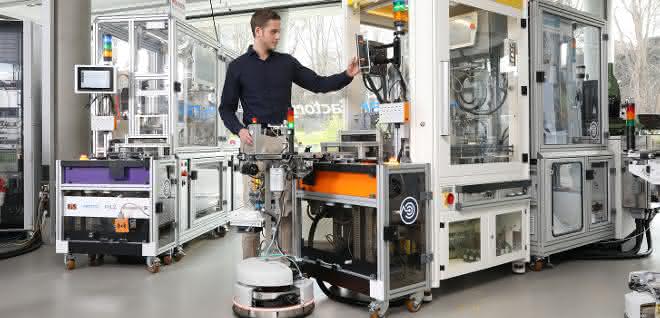
The infrastructure of the SmartFactory-KL partner consortium's Industry 4.0 production plant was given a new, star-shaped, scalable installation concept this year. The infrastructure nodes support independent production islands with several modules. "With this solution, we are taking the next step towards the practical introduction of a standardized module interface. This allows a production system to be reconfigured quickly and flexibly," says Prof. Dr. Martin Ruskowski, head of the Innovative Factory Systems research department at DFKI.
These nodes now provide computing power via edge computing for industrial intelligence applications. An exemplary application for edge computing in the infrastructure box is the display of consumption data from the individual modules directly on the box. This allows the production employee to quickly view the data and assign it to the connected modules. This simplifies the decentralized monitoring of the system function and enables malfunctions in the production modules to be analysed by evaluating the supply data and initiating the necessary maintenance steps.
Real-time capability: prioritization of data
A new feature is that the SmartFactory-KL uses real-time technology TSN (Time-Sensitive Networking) to transfer data between the infrastructure and server. With the help of TSN, data packets can be prioritized. This means that priority classes can be used to flexibly decide which data must be available immediately and for which a delay is acceptable. TSN guarantees, for example, that safety-critical data is sent with the highest priority and arrives even when the network is heavily loaded. In an overloaded network, this ensures that a module is process-safe, i.e. continues to work reliably.
"TSN makes an important contribution to both horizontal and vertical integration. Furthermore, OPC UA in combination with TSN enables manufacturer independence at the data transmission level. This means that any sensors and actuators can send and receive data in real time and existing systems can be flexibly retrofitted. The previous proprietary fieldbuses are no longer an obstacle," says Prof. Dr. Detlef Zühlke, CEO of SmartFactory-KL, summarizing the advantages for the industry.
The partners of the SmartFactory-KL Industry 4.0 demonstrator are B&R Automation, Bosch Rexroth, Eplan, Festo, Harting, Huawei, IBM, Kist, Mettler Toledo, Minitec, Phoenix Contact, Pilz, Proalpha, TÜV Süd and Weidmüller. as
Hall 8, Stand D18


You might also be interested in
Fraunhofer IPMS develops new 10G TSN endpoint
The demands on Ethernet networks in automotive, industrial and safety-critical applications are increasing rapidly. The Fraunhofer Institute for Photonic Microsystems IPMS is responding to this with a new 10G TSN endpoint IP core that enables...
 read more...
Ewald H. Kuk holds the keynote speech
On September 23 and 24, the international community from industry, research and development will once again meet in Stuttgart to discuss the latest developments in Time-Sensitive Networking (TSN). This year's keynote speech will be given by an...
read more...Basis for future-proof OT networks
Future-proof OT network solutions are the basis for advancing digitalization in industry. High-performance industrial Ethernet switches with a large number of ports, high data rates and extensive functions are required to ensure reliable and secure...
read more...EtherCAT all-rounder
In an interview with Andreas Mühlbauer, Thomas Rettig, Senior Management Control System and Communication Architecture at Beckhoff Automation, cites reliability, speed and compatibility as decisive factors for industrial communication.
read more...The tiger among processors
Since the move towards the Industrial Internet of Things (IIoT) and Industry 4.0 has picked up speed, processor boards and modules must be able to process exponentially growing amounts of data.
read more...One thing will win
Single Pair Ethernet is the technology that enables migration from various legacy networks to a universal physical layer. This is a further step towards making data available from the individual edge sensor through production to the desktop or...
read more...Faster start of series production with Computer-on-Module series and starter kits
TQ is presenting four versatile module series at this year's embedded world: TQMa243xL, TQMa64xxl, TQMa117xl and TQ110EB as well as a new, powerful SMARC starter kit in a practical form factor.
read more...One network for all applications
Reliable data communication with high data rates and deterministic time behavior is one of the prerequisites for production in accordance with the principles of Industry 4.0.
read more...Security of automation solutions
End-to-end safety in automation
Networking in industry and the associated Industrial Internet of Things (IIoT) are redefining the requirements for security - and therefore also for the automation solutions used.
read more...