

Protocol converter
HMS presents 2nd generation
HMS Networks presents the 2nd generation of Anybus Communicator protocol converters. The device connects serial field devices and machines to industrial networks.
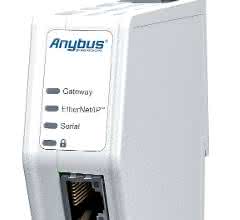
The Anybus Communicator product family has been on the market for almost 20 years and is used to connect serial devices and machines to fieldbuses or Industrial Ethernet. The new Communicator is already available for EtherNet/IP. Versions for Modbus-TCP, Profinet and Profibus will follow. The two product generations are offered in parallel due to different product life cycles.
The 2nd generation Communicators are based on the proven Anybus NP40 network processor, which is also used in the embedded solutions from HMS Networks. As a result, the protocol converters meet demanding requirements in terms of performance, reliability and security.
With new hardware and software, cycle times can be realized that are up to 10 times faster than with the first generation device, depending on the application. Up to 1,448 bytes can be sent to the higher-level PLC and up to 1,448 bytes can be received from the PLC.
In order to meet current and future security challenges, the protocol converters are equipped with a security chip. Secure boot ensures that the firmware is not manipulated.
The protocol converters are mounted on a top-hat rail and have a slimline housing. They have industrial certificates such as CE and UL. The operating temperature range extends from -25 to 70 °C, meaning that the protocol converters provide reliable service even under demanding industrial conditions.
Simple configuration and deployment
Before the connection between the Communicator and the higher-level PLC is established, the user configures the protocol converter for communication with their sub-network, which can consist of one or more devices or machines. To do this, the Ethernet configuration port of the protocol converter is connected to a PC. The user can then open the new graphical, web-based Communicator user interface using their preferred browser. The configuration is done by drag & drop. No additional software is required.
The device communicates with the connected devices via Modbus RTU. Up to 150 Modbus commands are supported, which also enables very complex configurations with several nodes. Completed configurations can be securely saved and managed for future use. As soon as the protocol converter is configured, it can be integrated as a node in the higher-level PLC system.
The user can also use the configuration port and the Communicator's web interface to monitor and diagnose network traffic. Both the connection status to the higher-level PLC and the serial sub-network as well as the status of individual serial nodes are displayed. Communication protocols are available for further analysis.


You might also be interested in
ebm-papst is growing again thanks to AI and data centers
ebm-papst returned to a growth trajectory in fiscal year 2025/26. Air Technology, data center applications, and artificial intelligence are driving revenue and investment.
 read more...
SPE on the Verge of a Market Breakthrough
Single Pair Ethernet (SPE) has moved beyond the conceptual phase and is increasingly being implemented in industrial settings. The focus here is not only on higher data rates and simplified cabling, but above all on the issue of system integration...
read more...More than 900 exhibitors already registered
Around six months before the start of the trade fair, more than 900 companies have registered for SPS 2026 in Nuremberg. The trade fair focuses on industrial AI, cyber security and digital transformation.
read more...Virtual PLCs in practice: How vPLCs make production systems more flexible and scalable
The increasing networking of IT and OT is fundamentally changing industrial automation. The IT/OT Integration Summit shows how modern technologies can make production environments more efficient, flexible and future-proof. The event will focus on...
read more...Sales growth in a turbulent market environment
Thanks to innovations and a focus on strategic industrial markets, Sick was able to moderately increase its sales in the 2025 financial year. In a turbulent market environment, the company was able to maintain its position and gain market share with...
read more...Siemens presents new AI agent
Siemens is launching 'Eigen Engineering Agent', an AI for automation technology. The solution is integrated into the TIA Portal, has been tested with over 100 companies and is designed to significantly accelerate engineering processes.
read more...Schaeffler keeps sales almost stable
Schaeffler generated revenue of EUR 23.5 billion in 2025 and increased EBIT before special items to EUR 936 million. At 266 million euros, free cash flow was significantly above the prior year and forecast. Net income remained negative due to high...
read more...Advancing artificial intelligence together
Helukabel is stepping up its activities in the field of artificial intelligence and is now a member of the IPAI. The innovation and collaboration platform for companies, research facilities, institutions and administration has set itself the goal of...
read more...New impetus for ifm sales
Two new positions were filled at ifm at the start of 2026: Markus Wolf becomes Managing Director Sales Germany, Sven Quant takes over the position of Central Managing Director in the Process Sensors division within the ifm Group.
read more...