
Digital Twin
Industry 4.0 needs modern networks
The development of Industry 4.0 applications requires more than just the automation of production lines. Rather, exact digital images of the physical systems and processes are required in order to predict events and optimize operations in near real time. This requires modern network technologies that connect the actual applications on the factory floor with their digital images.
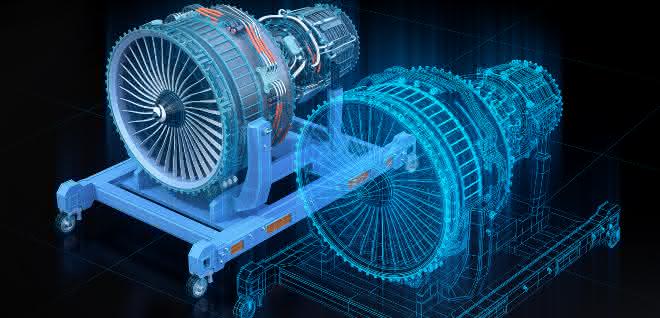
More and more companies are developing and implementing digital models that exactly match the equipment, machines, systems and processes used in their production lines. These virtual representations, called digital twins, provide a unique tool for control and product lifecycle management (PLM) or simulate what could happen in the real application, for example the interactions between components or the component wear rate and failure.
In any case, digitalization enables manufacturing companies to make their processes transparent and manage their systems efficiently because meaningful data and information from operations provide them with a sound basis for online decision-making. Digital models benefit production even if they are not linked to their counterparts in the real world. Smart, responsive factories can be realized much better if the real application is linked to the digital model in quasi real time, creating closed control loops.
Only when the virtual and real worlds communicate with each other can it ultimately be checked whether the processes in production match the predictions of the models. When manufacturing companies are working on their strategy for the digital migration to Industry 4.0, they must therefore also address the question of a suitable industrial network.
It is advisable to rely on the expertise of network specialists for industrial automation. In the case of the CC-Link Partner Association (CLPA) and its partners, companies can rest assured that the solutions are state of the art and will continue to fit as requirements evolve. Over the years, CLPA has helped the industry transition from fieldbus technology to Ethernet technology, and is now shaping the future again: Time Sensitive Networking (TSN).
The open CLPA technology available on the market, CC-Link IE TSN, can process the large amounts of data generated by sensors and models in cyber-physical systems in a timely manner. To do this, it combines Time Sensitive Networking (TSN) with Gigabit Ethernet. With the help of these two key factors, manufacturing companies can also transfer existing, fully functional automation solutions into the future, even if they are based on 100 Mbit Ethernet. With networks such as CC-Link IE TSN, manufacturing companies can operate their current processes with maximum compatibility and future-proofing. as


You might also be interested in
Fraunhofer IPMS develops new 10G TSN endpoint
The demands on Ethernet networks in automotive, industrial and safety-critical applications are increasing rapidly. The Fraunhofer Institute for Photonic Microsystems IPMS is responding to this with a new 10G TSN endpoint IP core that enables...
 read more...
Ewald H. Kuk holds the keynote speech
On September 23 and 24, the international community from industry, research and development will once again meet in Stuttgart to discuss the latest developments in Time-Sensitive Networking (TSN). This year's keynote speech will be given by an...
read more...Basis for future-proof OT networks
Future-proof OT network solutions are the basis for advancing digitalization in industry. High-performance industrial Ethernet switches with a large number of ports, high data rates and extensive functions are required to ensure reliable and secure...
read more...EtherCAT all-rounder
In an interview with Andreas Mühlbauer, Thomas Rettig, Senior Management Control System and Communication Architecture at Beckhoff Automation, cites reliability, speed and compatibility as decisive factors for industrial communication.
read more...The tiger among processors
Since the move towards the Industrial Internet of Things (IIoT) and Industry 4.0 has picked up speed, processor boards and modules must be able to process exponentially growing amounts of data.
read more...One thing will win
Single Pair Ethernet is the technology that enables migration from various legacy networks to a universal physical layer. This is a further step towards making data available from the individual edge sensor through production to the desktop or...
read more...Faster start of series production with Computer-on-Module series and starter kits
TQ is presenting four versatile module series at this year's embedded world: TQMa243xL, TQMa64xxl, TQMa117xl and TQ110EB as well as a new, powerful SMARC starter kit in a practical form factor.
read more...One network for all applications
Reliable data communication with high data rates and deterministic time behavior is one of the prerequisites for production in accordance with the principles of Industry 4.0.
read more...Security of automation solutions
End-to-end safety in automation
Networking in industry and the associated Industrial Internet of Things (IIoT) are redefining the requirements for security - and therefore also for the automation solutions used.
read more...