
Image processing systems
Seeing and thinking with embedded vision
The "intelligence" of autonomous and networked systems is largely determined by their ability to recognize facts as well as their surroundings. Embedded vision systems, which significantly expand the possibilities of the machine, make a significant contribution to this. By Claudia Unterhuber
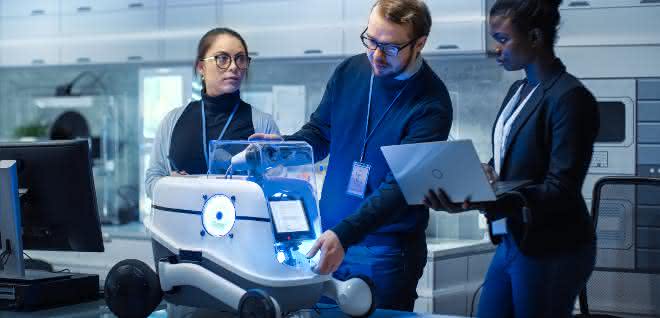
The growing number of "intelligent" devices and machines in industry and the consumer sector places new demands on the embedding of image processing functionalities and systems. Whether self-driving cars, intelligent vacuum cleaners or interacting robots as colleagues in industrial production - only fully integrated vision systems as a native component of these new applications make them useful.
Embedded vision enables visual intelligence for machines and thus teaches them to see and think. Embedded vision describes the combination of image processing within a device with digital processing and intelligent algorithms to evaluate the image and video data obtained. This enables the "seeing and thinking" machine to react to events and processes and interact with the environment. Integrated image processing is the basis for safe human-machine collaboration and the networked work of robots and machines in automated Industry 4.0.
Advantages of embedded vision platforms
Progressive miniaturization combined with increasing performance has been and continues to be important for the spread of fully integrated systems. Embedded vision leads to reduced space requirements, less weight and therefore lower energy consumption and lower unit costs. This means that a drone can also see without significantly increasing in size or weight - which is hugely important for energy consumption, maneuverability and range. The dynamics of a robot are also not affected by the lightweight and compact systems. Intelligent "recognizing" applications can thus be built into stationary as well as mobile and even portable devices.
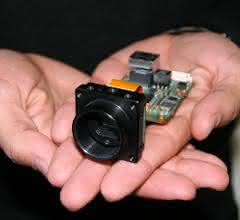
Dr. Christopher Scheubel, Framos IP & Business Development, says: "Miniaturization makes it possible to replace external machine vision systems with integrated embedded vision. This development will continue to accelerate over the next few years, for example through new technologies such as the Intel RealSense Suite. In a few years, almost every device will be able to see and think through embedded vision systems."
As an integrated technology in devices and machines, embedded vision ensures that all industries and every type of application can benefit from image processing. Seeing robots or self-positioning lasers are industrial examples. In the consumer sector, self-driving cars and many other applications give an idea of the great potential of embedded vision.
Part of the overall system
Traditional image processing systems consisting of an external camera, a stand-alone PC and accessories often required a lot of space and were usually expensive. They were developed as proprietary systems, which made it very complicated to integrate them into an application. Embedded vision systems, on the other hand, are integrated directly into the device or machine, and the development is therefore interlinked with the device as part of the overall project right from the start. Embedded vision systems can be designed for a specific application, which leads to a significant reduction in costs per system for large quantities.
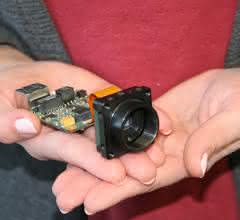
Embedded vision systems essentially consist of three components: a miniature camera without a housing, a processing unit and a space-saving interface. The systems can be designed completely flexibly. The heart of the system is the intelligent camera, which can be a simple vision sensor or a high-end camera. Camera and lighting settings are therefore just as much a part of the overall system as the parameterization and programming of vision algorithms.
Embedded vision for Industry 4.0 and IoT
Due to the properties described above and the wide variety of designs, embedded vision systems are the basis for the intelligent automation of Industry 4.0 and modern manufacturing. The potential of seeing, thinking and therefore interactive machines is fully realized in Internet-of-Things environments and networked systems. The integration of different vision systems with different video and vision inputs and outputs as well as different imaging pipelines is a challenge for the new embedded architectures and image processing-based analyses in real time. Triggers and control pulses can be controlled synchronously with the overall system, even in dynamic systems under changing conditions. This is precisely the advantage of embedded vision and the opportunity to make new applications see and think with the help of image processing. Manufacturers need consistently precise results for quality control, robot control and more efficient production. The ever deeper integration of embedded vision and its further development are helping to ensure successful implementation.
|
Industrial applications |
Consumer applications |
|
Drones for process monitoring and optimization |
Home robotics, e.g. robot vacuum cleaners and robot mowers |
|
Human-machine collaboration |
Home security |
|
Quality and process control |
Entertainment (virtual reality) |
|
Mixed reality (MR) for assembly tasks, for example |
Wearables, e.g. helmets and clothing |


You might also be interested in
Housing and inserts for plenty of power
Lapp presented the expansion of its Epic Power series at SPS 2023: four new M23 circular connector inserts and three new M23 housings. The special feature: all housings can be combined with any of the four inserts.
 read more...
News and product updates from Smartgas
Portable gas analyzers for outdoor use
Smartgas is starting the second half of the year with a series of updates to existing products and a number of new products. Portable analyzers expand the range of applications, while new accessories such as protective housings and heating modules...
read more...Everything accurate in switch cabinet construction
To ensure smooth work processes, tools for processing enclosures and housings must function flawlessly and reliably. Häwa rounds off its punching range with the Multi-Press 500.
read more...Shafts and conversion parts
The Rodriguez range includes ball bushings including matching housings, shaft brackets, crossbars and supports.
read more...Cooling and temperature control units
Hygienic packaging sells safely
In few industries are the requirements for hygiene in the production process as strict as in the food sector - the health of consumers has top priority. This results in enormous challenges for all machines and components involved, especially in...
read more...Simple tool change in seconds
With the CMS, Schunk is launching a user-friendly, manual change system for quick component replacement. In addition to its simple and convenient operation, the CMS also stands out with its extensive range of optional modules and complementary end...
read more...Motion controller for small drives
Medium power range covered
Faulhaber has another housing-less and compact motion controller in its range, which is particularly suitable for integration in device construction and medical technology applications.
read more...Welding solutions in the name of resource efficiency
At the Welding & Cutting trade fair in Essen (September 11-15), Fronius will be focusing on the major drivers in welding technology. Quality requirements are increasing in all industries, but the required welding specialists are scarce. In...
read more...Safe solutions for cable installations
From thick power cables to thin sensor lines, cables and lines must be routed safely through systems and machines. A challenge that should not be underestimated, explains Jörg Sokat, Head of Product Management at Pflitsch.
read more...