
Artificial intelligence
From data to cognitive knowledge
Artificial intelligence. Digitalization influences the success of companies. It is linked to disruptive concepts such as IoT, deep learning/machine learning, data analysis, big data, cloud and edge computing and thus to the all-encompassing artificial intelligence (AI).
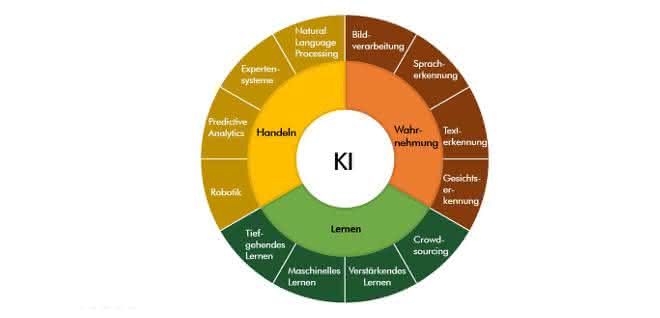
This enables developments for efficient, sustainable applications. While the industrial revolution replaced muscle power, the "digital revolution" with AI is characterized by the transfer of cognitive services to a "machine" that becomes smarter from experience. In addition to the risk to cyber security, the downside is the disappearance of human labor, especially simple labor, and falling tax revenues, as "intelligent machines" are tax-exempt. On the other hand, new fields of activity are emerging. International studies support this optimism.
What is AI
AI uses a combination of planning, searching, optimizing, logical processing and recognition via approximation methods to investigate and solve intelligent automation with machine learning by using fast computer networks with high computing power. Human action structures are simulated. Such fail-safe, error-avoiding computers and networks can independently process problems and suggest better decisions. They are not intelligent in the sense of a mixture of logical thinking, empathy, tact and ethics.
AI is often defined as an implementation that simulates "intelligent behavior" using special algorithmic programs (e.g. data analysis programs, computer games). Such "weak" AI is contrasted with "strong" AI. It provides support for difficult tasks that are characterized by uncertainties and probabilities. Its way of working often surpasses human behavior. "Strong" AI solutions require the cooperation of a wide variety of skills, programs and systems based on large amounts of data in order to create optimal solutions flexibly and reliably. The beginnings of AI date back to the 1940s.
Realization
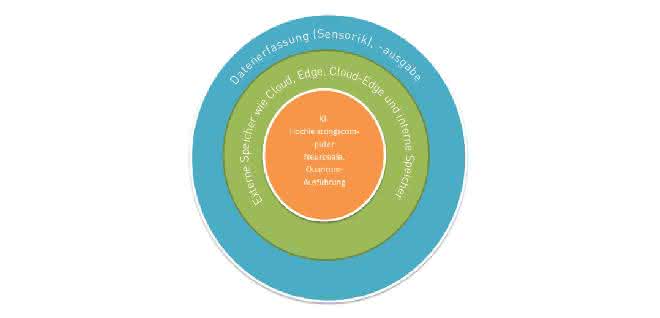
An AI system consists of the functional groups shown in the picture (top right), whose components are arranged in a decentralized manner with varying degrees of power depending on the task. All of them are reliably networked at the highest data transmission speed. A high-performance computer acts as the control center, whose operational speed is realized alongside supercomputers using quantum-class devices and artificial, neural structures KNN with the ability of machine learning ML (machine or deep learning).
Quantum computers work with molecules, atoms and subatomic particles. Phenomena such as superposition and quantum entanglement become usable. The quantum bit qubit replaces the classic bit and can form zero, one or both at the same time. Extremely fast processing in minimal space becomes usable, the computing power of the qubits increases exponentially with their quantity (20 qubits can already occupy millions of bit states). The latest developments use the spin of an electron as a qubit. The associated solid consists of two semiconductor layers (such as silicon or germanium close to absolute zero). The free electron is directed by electric fields. Other approaches use the direction of current in a superconductor ring or the energy level in atoms or molecules. The qubit numbers achieved to date are 50-70.
KNN is modeled on the information architecture of the human brain. The corresponding computer system can recognize hidden correlations better than a human being. Using mathematical and stochastic methods, it transforms disorganized raw data (such as measurement results and photos) into structured information in order to derive correlations and trends. On the one hand, CNNs are simulated using software. On the other hand, there are neuromorphic systems consisting of electronic, network-compatible resistors with memory - the memristors (artificial word from "memory" and "resistor").
The design and location of the two other, functionally known shells in the diagram above depend on the task and spatial extent as well as the safety requirements.
Impact and applications
All areas of society benefit from AI. In the world of work, it is changing activities, job profiles, work content and organization. Its ability to analyze large amounts of data faster and more thoroughly than humans for data-based decisions can compensate for the lack of specialists.
One thing that all of the possible uses for the digital transformation of society have in common is that they mostly involve a combination of analysis techniques. In addition to IT technologies, methods from statistics, linguistics and neurology are also used so that adaptive machines can independently prepare reliable decisions. A huge amount of available data requires a very high number of computing operations to process it.
The following examples, some of which have already been tried and tested, are of a technical and industrial nature. However, areas not mentioned here for reasons of space also promise significant success:
- Predictive maintenance, detection of possible misbehavior with automatic information/maintenance (predictive maintenance)
- Traffic control
- Ridesharing
- (decision making), for example when introducing new products
- Distribution
- Monitoring
- Driving with permanent analysis of traffic, surroundings, driving behavior, environmental influences with ethical components, energy source
- Robotics
- (for example multi-motor drive systems).
Risks and outlook
Fear of artificial intelligence is unfounded. Nevertheless, it is not without some risks, as it does not have a moral standard for the time being. It becomes problematic if AI is equipped with our own characteristics. In one experiment, for example, the AI made decisions based on ML that demonstrably discriminated against people. In addition, cyber security must be guaranteed at all times and in all places.
With AI, the digital revolution in general, challenges such as information overload, cyber risks, the "race" for innovation, currency stability and the like must be mastered by society, above all with future-oriented and basic training.
Of particular interest will be policy support through AI with fast, optimized decision proposals, the transparency of which is guaranteed by blockchain technology. Germany probably needs to make progress in this area overall, as according to an EU study, our country is not one of the leaders in the "digital" European comparison. The world leaders in the digital age are the USA and China. Joachim Krause


You might also be interested in
ESTIA aims to strengthen Europe's cloud
New tech alliance for EU sovereignty
Twelve companies, including Dassault Systèmes, are founding the European Sovereign Tech Industry Alliance (ESTIA). The initiative aims to strengthen Europe's technological independence and define requirements for sovereign cloud services. The start...
 read more...
Deutsche Telekom and Nvidia launch one of Europe's largest AI factories
With the Industrial AI Cloud in Munich, Deutsche Telekom and NVIDIA are creating one of the largest AI factories in Europe. Companies can train AI models, carry out simulations and access 10,000 GPUs.
read more...Leveraging data potential with AI and streaming
Huge data treasures are still lying dormant in many manufacturing companies. And yet it is high time that these treasures were unlocked. There is often a lack of resources and capacity to make data usable in real time. Streaming production data can...
read more...More awareness of noise
Dematic offers solutions that are tailored to different cloud environments and reduce environmental impact through reduced material consumption and improved energy efficiency.
read more...Generative AI in the automation environment
The mechanical engineering and automation industry is undergoing profound change. This transformation is being driven by more volatile global trade, geopolitical crises and increasing market pressure, which demands greater agility, technological...
read more...Rigid data structures have had their day
The traditional data center is no longer the center of data. A hybrid cloud storage approach enables manufacturing companies to both meet the current requirements of data-intensive processes and future-proof their infrastructure.
read more...Software as a service in three stages
CIM Database Cloud is a new out-of-the-box solution from Contact for end-to-end digital product development.
read more...How production can benefit from AI
Together with AI technology, IIoT networking makes it possible to better control machine parameters and optimize quality with predictive quality. Downtimes and set-up times can also be further minimized. Cloud platforms also make these technologies...
read more...More expertise for digital engineering
Altair, a computational science and artificial intelligence (AI) company, has acquired OmniV, a technology from Michigan, USA-based software company XLDyn.
read more...