
Production technology
First IoT hackthon at RWTH Aachen University
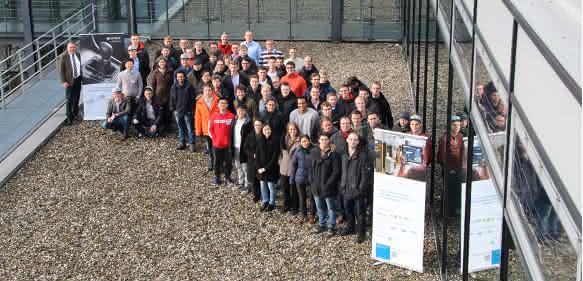
The first WZL/IMA Industrial Internet of Things Hackathon, organized by the Cybernetics Lab IMA/ZLW & IfU and the Friends of the Machine Tool Laboratory WZL at RWTH Aachen University, ended under the motto "Get Your #Bits Together!". 58 students, trainees and young professionals demonstrated their skills in the field of machine learning.
Production plants, so-called large-scale cyber-physical systems, which weigh 30 tons and eject two components per second, generate a high volume of data of up to 0.5 PB per day due to the new possibilities of digitalization. In order to be able to use these data volumes to increase the efficiency of production systems, new approaches, for example from the field of machine learning, must be used. However, this requires not only technical production expertise to interpret the results, but also IT expertise to analyze the data. The hackathon set itself the goal of combining the two disciplines and inspiring the next generation of specialists for these new topics.
At the first WZL/IMA Industrial Internet of Things Hackathon, 58 participants competed against each other in 13 teams. The aim was to develop the best solution for the four predefined tasks. The participants had a whole weekend to develop concepts, code programs and carry out validations on real example cases from production technology. In addition, the participants were able to get to know and visit the machine tool laboratory at RWTH Aachen University as well as the new replacement area at Rotter Bruch, exchange ideas with the scientific staff and apply for one or two thesis projects. The surrounding network on campus was also explained in a guided tour.
The teams had a total of four different tasks to choose from. Each team had to choose one of the tasks in advance and then solve it. The tasks focused on questions from the fields of forming technology, material modeling and product tracking. To solve the tasks, the participants had to draw on current trend topics such as machine learning and deep learning for digital image processing.
"All you need for good ideas is a suitable environment, and we more than succeeded with the hackathon," says Daniel Trauth, organizer of the hackathon, head of the Machine Learning in Production Engineering working group within the Production Engineering profile area and senior engineer for grinding, forming and technology planning at the WZL at RWTH Aachen University.
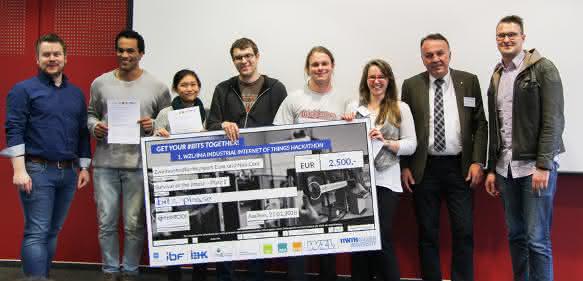
First place in the survival-of-the-fittest category went to the "Bits Please" team. Chia-Yuen Chou, Markus Höhnerbach, Oliver Lehmacher, Vera Loeser and Eric van Lessen were visibly delighted with the main prize of 2,500 euros. Their approach contributes to component or product tracking using RFID tags. Second place in the category (1,500 euros) went to Erik Fleischhauer, Tim Fleischhauer, Hendrik Gruss, Merlin Marek and Birger Normann with the "Skynet!" team. Third place (500 euros) went to the "digitalPriests" (Jonathan Alms, Christian Bartsch, Luca Tabone, Victor ter Smitten and Jonas Zagatta).
In addition, Lukas Körfer, Phillip Legran, Kevin Leonardics, Lennart Moltrecht and Eugen Salzmann with the "InCES" team were delighted to receive the innovation prize worth 500 euros, which was awarded for the most creative and unusual solution approach. The prize money was awarded by the main sponsor Feintool Technologie. The VDI District Association Aachen also awarded prizes for young talent. The winners (Dimitrios Begnis, Alexander Brennecke, Patrick Cönen, Stella Coumbassa, Niklas Dahl, Jiahui Geng, Andre Gilerson, Dominik Jeurissen, Jan Kaemmerer, Florian Maurer, Gerhard Moellemann, Yu Qiao, Michel Schmidt, Tobias Springer, Jakob Wunsch, Xiaoli Yang and Haochen Zuo) were delighted to receive a Raspberry Pi 3 bundle including an 8 GB SD card, official housing and power supply unit worth a total of 1,000 euros.
The Production Engineering (ProdE) profile area and the Cluster of Excellence Integrative Production Technology for High-Wage Countries as well as the Institute of Forming Technology IBF and the Institute of Ferrous Metallurgy IEHK at RWTH Aachen University are supporting the implementation of the hackathon. Building on the concepts developed, the researchers at the WZL and IMA are now working on interdisciplinary and current topics that can be returned to the students in the form of student theses and seminar papers. as


You might also be interested in
Housing and inserts for plenty of power
Lapp presented the expansion of its Epic Power series at SPS 2023: four new M23 circular connector inserts and three new M23 housings. The special feature: all housings can be combined with any of the four inserts.
 read more...
News and product updates from Smartgas
Portable gas analyzers for outdoor use
Smartgas is starting the second half of the year with a series of updates to existing products and a number of new products. Portable analyzers expand the range of applications, while new accessories such as protective housings and heating modules...
read more...Everything accurate in switch cabinet construction
To ensure smooth work processes, tools for processing enclosures and housings must function flawlessly and reliably. Häwa rounds off its punching range with the Multi-Press 500.
read more...Shafts and conversion parts
The Rodriguez range includes ball bushings including matching housings, shaft brackets, crossbars and supports.
read more...Cooling and temperature control units
Hygienic packaging sells safely
In few industries are the requirements for hygiene in the production process as strict as in the food sector - the health of consumers has top priority. This results in enormous challenges for all machines and components involved, especially in...
read more...Simple tool change in seconds
With the CMS, Schunk is launching a user-friendly, manual change system for quick component replacement. In addition to its simple and convenient operation, the CMS also stands out with its extensive range of optional modules and complementary end...
read more...Motion controller for small drives
Medium power range covered
Faulhaber has another housing-less and compact motion controller in its range, which is particularly suitable for integration in device construction and medical technology applications.
read more...Welding solutions in the name of resource efficiency
At the Welding & Cutting trade fair in Essen (September 11-15), Fronius will be focusing on the major drivers in welding technology. Quality requirements are increasing in all industries, but the required welding specialists are scarce. In...
read more...Safe solutions for cable installations
From thick power cables to thin sensor lines, cables and lines must be routed safely through systems and machines. A challenge that should not be underestimated, explains Jörg Sokat, Head of Product Management at Pflitsch.
read more...