

Factory networking
Standards prevail
Data networks in factories must be fast, real-time capable and standardized, demands Oliver Riedel, Professor at the Institute for Control Engineering of Machine Tools and Manufacturing Units (ISW) at the University of Stuttgart. But there is still some homework to be done before then. As a leading manufacturer of cables, Lapp is well prepared for the changes. by Bernd Müller

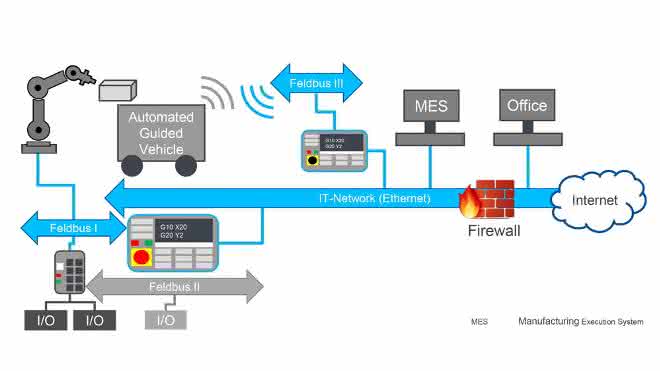
The internet has reached factories. Controls, drives, sensors and machines are networked with each other and constantly exchange data. Networking from the sensor to the cloud will continue to increase, as will the amount of data. Traditional IT services such as business management or logistics software are part of the network. However, the infrastructure for data exchange in many companies is still stubbornly resisting the networking trend. From the past, individual networks that are physically and technically separate from each other dominate. Each level of the so-called automation pyramid - from the control level to the field level - works with its own infrastructure and its own protocols.
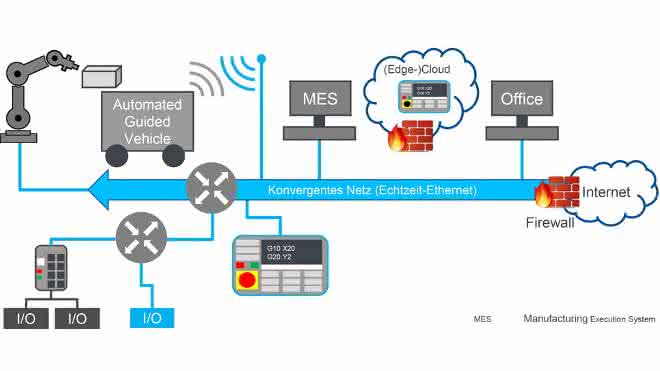
"These many different networks will merge," says Riedel. "The automation pyramid will gradually dissolve as a result." Instead of hierarchical communication structures in automation, the professor from the Institute for Control Engineering of Machine Tools and Manufacturing Units (ISW) at the University of Stuttgart expects flexible hierarchies in which cyber-physical systems exchange information with each other and with corporate IT and the cloud via a close-knit network.
Proliferation of standards
What stands in the way of this goal is the current proliferation of communication standards. Although the Ethernet standard (IEEE 802.3), which has been networking PCs for decades and is extremely fast and reliable, has been booming since the early 2000s. But in factories, there can be no question of a standard, because over the course of time, many providers have "bent" Ethernet to such an extent that there are now a dozen different variants that are not automatically compatible with each other. In addition, there are many other fieldbus standards such as Profibus, Modbus, CC-Link and others, which together still account for almost half of all installations.
The cause of this confusion is the desire of many suppliers of automation components to impose a proprietary standard on customers that will ensure good sales for many years to come. However, what has not worked on the public Internet will not be successful within the factory walls either. Users today are demanding general, open standards that allow a barrier-free flow of data in all areas and functions of a company. It is inevitable: the many networking standards will converge into one standard.
Another important requirement for communication in automation, especially at field level, is the ability to transfer data in real time. While clicking on a link in a web browser does not matter whether the page opens half a second earlier or later, in automation it is a matter of milliseconds, sometimes even microseconds. Ethernet-based networks have so far only been able to achieve this to a limited extent because Ethernet works with stochastic access procedures and large data packets, known as frames, and is therefore not real-time capable per se.
Real-time capability with TSN
One solution is the Time Sensitive Network, or TSN for short. This is a future standard based on a proposal from the Ethernet committee. Its great advantage is that it does not originate from the automation environment, but from the audio/video sector, and is therefore likely to meet with less rejection and competition from automation specialists. Concert halls have real-time Ethernet so that sound signals from different microphones are always played to the numerous loudspeakers without any delay differences. Even delays of a few milliseconds between audio channels would be noticeable as echoes.
Applied to automation, TSN as a solution based on convergent networks would bring many advantages. All participants in a TSN network are time-synchronized, i.e. they perform the right action at exactly the right time. TSN has different so-called traffic classes with different time windows that allow data to be prioritized according to bandwidth and time fidelity. Information that is important and cannot be delayed can be given a higher priority, and bandwidth and time windows are reserved for this. TSN will be a standardized extension of Ethernet and fully compatible with it. TSN is not yet available to buy in many products, but the first devices and demonstrators already exist.
OPC-UA gives data meaning
TSN ensures that data arrives where it is needed in good time. However, it does not contain any information about what this data means. This is ensured by a second standard: OPC-UA. This is a communication protocol for exchanging data between cyber-physical systems. OPC-UA is now accepted as a quasi-standard in communication for Industry 4.0. However, it is not real-time capable. However, the experts at the Stuttgart-based ISW are already working on this together with standardization committees. "Communication is no longer a unique selling point," says Oliver Riedel. "Anyone who tries to fight TSN or OPC-UA and continues to rely on proprietary solutions will probably not last long."
The topic of security, i.e. defense against hacker attacks, is also still under discussion. There are already good solutions for the safety aspect, i.e. the protection of employees. For example, workers must be able to rely on their machine stopping immediately when they press the red emergency button. Such commands have the highest priority at TSN. With the features described, TSN therefore has the potential to resolve the Babylonian confusion in industrial data communication.


You might also be interested in
Fraunhofer IPMS develops new 10G TSN endpoint
The demands on Ethernet networks in automotive, industrial and safety-critical applications are increasing rapidly. The Fraunhofer Institute for Photonic Microsystems IPMS is responding to this with a new 10G TSN endpoint IP core that enables...
 read more...
Ewald H. Kuk holds the keynote speech
On September 23 and 24, the international community from industry, research and development will once again meet in Stuttgart to discuss the latest developments in Time-Sensitive Networking (TSN). This year's keynote speech will be given by an...
read more...Basis for future-proof OT networks
Future-proof OT network solutions are the basis for advancing digitalization in industry. High-performance industrial Ethernet switches with a large number of ports, high data rates and extensive functions are required to ensure reliable and secure...
read more...EtherCAT all-rounder
In an interview with Andreas Mühlbauer, Thomas Rettig, Senior Management Control System and Communication Architecture at Beckhoff Automation, cites reliability, speed and compatibility as decisive factors for industrial communication.
read more...The tiger among processors
Since the move towards the Industrial Internet of Things (IIoT) and Industry 4.0 has picked up speed, processor boards and modules must be able to process exponentially growing amounts of data.
read more...One thing will win
Single Pair Ethernet is the technology that enables migration from various legacy networks to a universal physical layer. This is a further step towards making data available from the individual edge sensor through production to the desktop or...
read more...Faster start of series production with Computer-on-Module series and starter kits
TQ is presenting four versatile module series at this year's embedded world: TQMa243xL, TQMa64xxl, TQMa117xl and TQ110EB as well as a new, powerful SMARC starter kit in a practical form factor.
read more...One network for all applications
Reliable data communication with high data rates and deterministic time behavior is one of the prerequisites for production in accordance with the principles of Industry 4.0.
read more...Security of automation solutions
End-to-end safety in automation
Networking in industry and the associated Industrial Internet of Things (IIoT) are redefining the requirements for security - and therefore also for the automation solutions used.
read more...