
Circuit breaker
Energy data in networked systems
Communication and IoT-enabled protection devices such as the new open circuit breaker from Siemens provide a wide range of data beyond their actual tasks for comprehensive energy monitoring, condition monitoring and predictive maintenance management. The use of data in higher-level automation and IoT systems opens up particular potential.

In the last ten years alone, electricity prices have risen by an average of 19% in Europe and by as much as 27% in Germany (source: stromreport.de). For energy-intensive industrial companies in particular, but also for operators of buildings and infrastructure, the pressure to reduce consumption and thus cut costs is growing.
The requirements for minimizing electricity consumption have also been increasing from other sides for years: as part of the energy transition and the global climate protection agreement, government guidelines are demanding ever higher efficiency standards. In Germany, for example, the law on energy services and other energy efficiency measures (EDL-G) obliges companies above a certain size to carry out energy audits every four years.
Systematic energy management
One way to tackle this challenging situation is through operational energy management in accordance with the globally applicable ISO 50001 and 50003 standards. The starting point for successful optimization of energy consumption is a continuous process that continuously records energy consumption, develops various efficiency measures and implements a suitable, integrated concept - from management to field level. It is essential to make energy flows as transparent as possible. After all, concrete savings measures can only be derived if sufficient energy data is available and recorded at all relevant points.
Energy monitoring systems provide the technical basis for this. Such a system consists of measuring devices that record energy data and analysis software that can be used to visualize and evaluate this data. Malfunctions in technical systems can be identified at an early stage, failures can be prevented and the entire building operation can be made more energy-efficient.
Circuit-breakers: precise measuring devices
In addition to measuring devices, communication-capable protection and switching devices can also be used to record energy data. The new 3WA open circuit-breaker from Siemens shows what this looks like in practice. It combines protection and measuring functions in one device. The electronic tripping unit (ETU) is not only designed to record a wide range of data on energy, power quality and breaker states during normal operation. It also guarantees high measuring accuracy in accordance with the IEC 61557-12 measuring device standard across all current levels.
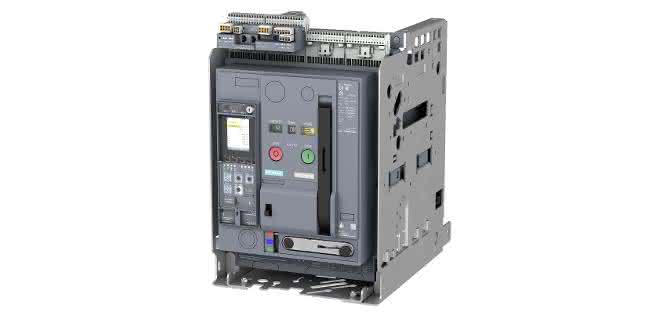
In addition, the requirements of IEC 50001 or the PMF level (Power Metering Function), as defined by IEC 60364-8-1 for compliance with ISO 50001, can be easily fulfilled with the 3WA: This allows the planner to select the required metering and additional functions based on predefined PMF types. The PMF type can also be adapted later via the application processor, for example in the event of changes in use.
Integration of measured values in the cloud
The data recorded by the circuit-breaker is usually transmitted to higher-level systems via standard protocols. This is now the case for around a fifth of the circuit-breakers installed worldwide. The 3WA open circuit-breaker is also connected to the network via the COM190 Profinet IO/Modbus TCP communication module. This supports Profinet for sophisticated industrial communication and Modbus TCP for energy monitoring tasks. Several communication protocols can also be used simultaneously for fast data transfer.
The new development goes one step further: the 3WA brings measured values from the electrical infrastructure directly into the IoT. All recorded data on energy, power quality and switch states can thus also be integrated into cloud-based energy management and medium-voltage systems. This opens up new possibilities. This is because the systematic use of IoT platforms offers characteristic advantages in electrical and building technology, even beyond cloud-based energy monitoring. The cost of an in-house IT infrastructure for technical building management can be significantly reduced. In addition, a very large volume of data can be stored and processed, which is available for extensive analyses regardless of location. The open IoT platform MindSphere from Siemens, for example, makes it possible to process, evaluate and compare large volumes of data from different devices and systems in buildings and infrastructures. The potential is enormous. Significantly reduced downtimes and further increased energy efficiency are just two examples.
Protected from cyberattacks
For IoT-enabled components such as the 3WA circuit-breaker, however, networking with the internet also means that the circuit-breaker must meet the same high cybersecurity standards as other networked systems in order to guarantee the operational safety of a company or building in the long term. This raises the central question of meeting adequate cybersecurity standards not only in the form of higher-level security concepts, but also directly at field level. This means that security functions integrated directly into the devices become the central building block for any end-to-end cybersecurity concept.
Various security features integrated into the open circuit-breaker therefore protect the switch against tampering attempts. For example, the COM190 Profinet IO/Modbus TCP module has parameter write and remote switching protection integrated into the hardware. This means that when write protection is activated, no parameters can be changed, while when remote switching protection is activated, switching on or off via one of the communication paths is prevented. Both functions are also always activated at the factory and must be switched off manually and therefore deliberately on the communication module itself. The 3WA is also protected against unauthorized access on the hardware side, for example by numerous locking and interlocking components.
Martin Moosburger, Vice President of Product Management Low Voltage Products, Siemens Smart Infrastructure, Business Unit Electrical Products


You might also be interested in
ESTIA aims to strengthen Europe's cloud
New tech alliance for EU sovereignty
Twelve companies, including Dassault Systèmes, are founding the European Sovereign Tech Industry Alliance (ESTIA). The initiative aims to strengthen Europe's technological independence and define requirements for sovereign cloud services. The start...
 read more...
Deutsche Telekom and Nvidia launch one of Europe's largest AI factories
With the Industrial AI Cloud in Munich, Deutsche Telekom and NVIDIA are creating one of the largest AI factories in Europe. Companies can train AI models, carry out simulations and access 10,000 GPUs.
read more...Leveraging data potential with AI and streaming
Huge data treasures are still lying dormant in many manufacturing companies. And yet it is high time that these treasures were unlocked. There is often a lack of resources and capacity to make data usable in real time. Streaming production data can...
read more...More awareness of noise
Dematic offers solutions that are tailored to different cloud environments and reduce environmental impact through reduced material consumption and improved energy efficiency.
read more...Generative AI in the automation environment
The mechanical engineering and automation industry is undergoing profound change. This transformation is being driven by more volatile global trade, geopolitical crises and increasing market pressure, which demands greater agility, technological...
read more...Rigid data structures have had their day
The traditional data center is no longer the center of data. A hybrid cloud storage approach enables manufacturing companies to both meet the current requirements of data-intensive processes and future-proof their infrastructure.
read more...Software as a service in three stages
CIM Database Cloud is a new out-of-the-box solution from Contact for end-to-end digital product development.
read more...How production can benefit from AI
Together with AI technology, IIoT networking makes it possible to better control machine parameters and optimize quality with predictive quality. Downtimes and set-up times can also be further minimized. Cloud platforms also make these technologies...
read more...More expertise for digital engineering
Altair, a computational science and artificial intelligence (AI) company, has acquired OmniV, a technology from Michigan, USA-based software company XLDyn.
read more...