
Artificial intelligence and HRC
Documentation with AI in aircraft production
Algorithms can support humans in quality assurance by using sensor data to assess quality. The subsequent documentation can be carried out with the help of blockchain-based technologies and thus create added value.
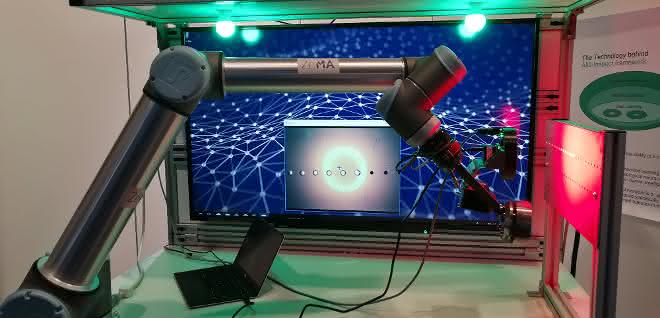
Aircraft production is known for its high safety standards and complex inspections. The majority of these inspections are still carried out manually. ZeMA believes that a semi-automated approach is most effective for optimization. In aircraft production, a semi-automated riveting process in aircraft section assembly can achieve an improvement by means of human-robot collaboration with subsequent AI-based inspection. The robot system is positioned within the aircraft section. The working range of the robot is extended by using a lifting unit so that it can position the relatively simple process tool, the anvil. The more complex tasks, such as inserting the rivet and operating the riveting hammer, are performed by the human operator.
By upgrading the robot tool with a force-torque sensor, it can monitor the riveting process in real time. In combination with other optical sensors such as a laser line sensor or a camera, the inspection tasks can also be automated using AI algorithms. The sensor data is fed through a trained machine learning model that classifies whether the scanned part is of good or poor quality. The result of the quality check is transmitted to the employee via mixed reality glasses. This enables the operator to react appropriately and carry out any necessary maintenance work.
Building on the partial automation of the riveting process and inspection described above, the signature process can be digitized at the same time. The use of a digital receipt book could thus make analog bookkeeping obsolete. The prerequisite for this is that the necessary data integrity is ensured. It would also be possible to make selected data accessible to other parties in a supply chain and to process and use it digitally.
To ensure data integrity, a blockchain-based technology called IOTA, which is based on distributed ledger technology or directed acyclic graphs (DAG), is used as a digital ledger. Directed acyclic graphs (DAGs) are an alternative technology to blockchain. The most obvious difference between DAGs and blockchains is that blockchains bundle transactions into cryptographically linked blocks and form a single chain, while DAGs use a graph in which a transaction is represented as a node in the graph.
A transaction in the IOTA network can be simplified as follows: Creating a transaction (recipient, sender, value and/or data message), encrypting the transaction, validating the transaction, adding the transaction or data to the graph. In this way, process and sensor data can be provided unalterably in private, privileged or public channels, depending on the interaction between supplier and OEM. At this point, DAG technology ensures data integrity and increases trust in the data, as it is stored unalterably.
As a general rule, raw data should not be published or made freely accessible to anyone. Therefore, a digital and unique fingerprint is created using a hash algorithm. In this way, data integrity and trust can also be realized beyond company boundaries.
In practical riveting applications, this could look like this: For each collaboratively joined rivet, process-specific data is collected, such as the force-torque data during the riveting process, an image of the rivet as well as the values from the laser line sensor scan to capture the dimensions of the rivet. As described above, this data is analyzed using artificial intelligence. The collected raw data is then stored in an internal company database. The derived hash values are stored immutably in their blockchain or graph using the IOTA protocol. If the raw data is now shared between suppliers, authorities or the OEM to validate production quality, the data integrity can be checked and verified using the hash values.
The solution presented includes three ideas for increasing production quality in aircraft production: Firstly, it improves ergonomics and efficiency in production through human-robot collaboration. Secondly, data is collected from various sensors during the riveting process for analysis using AI methods. The collected data is run through a supervised learning process to create the machine learning model. Subsequently, this model is used for quality analysis within the riveting process. Thirdly and finally, blockchain-based technologies can be used to increase data integrity and share safety-critical information between suppliers, authorities and the OEMs. Prof. R. Müller/Dr. M. Vette-Steinkamp/T.Masiak/as

Briefly explained: The MHI e.V.
The Wissenschaftliche Gesellschaft für Montage, Handhabung und Industrierobotik e.V. (MHI e.V.) is a network of renowned university professors - institute directors and chair holders - from German-speaking countries. The members conduct both fundamental and application-oriented research on a wide range of current topics in the fields of assembly, handling and industrial robotics. Further information on the society, its members and activities: http://www.wgmhi.de.
Briefly explained: ZeMA
The Center for Mechatronics and Automation Technology gGmbH (ZeMA) conducts application-oriented research and industry-related development in the fields of sensor and actuator technology, manufacturing and assembly processes and their automation. It offers a broad spectrum of research with the aim of industrialization and the transfer of research and development results into industry and onto the store floor. www.zema.deDiework originated in the Interreg-funded research project Robotix Academy (www.robotix.academy), a cross-border research cluster for industrial robotics and human-robot cooperation No. 002-4-09-001.


You might also be interested in
Predictive maintenance in retrofit
Predictive maintenance pays off. This is because early detection of impending failures means that systems can be serviced in a targeted manner before production downtime occurs. But how complex is it to integrate such a maintenance concept into an...
 read more...
Maintenance instead of replacement
The circular economy starts with the machinery
Sustainability in industry starts with machines, says our guest author from Deguma: How maintenance, modernization and the 5R strategy save resources, energy and CO₂.
read more...3D printing for unplanned requirements
The material fails and the machine suddenly stops? Then you need to take the right measures to be able to resume production quickly. Material failure in the form of faulty components or material wear in the frame are a risk for any production.
read more...High demands in terms of safety, application and robustness
Demanding work in the electrical trade and energy supply as well as smooth processes in production require innovative and customized measurement technology that scores points for safety, ease of use and resilience.
read more...Car meets e-bike: riding with lubrication-free polymer bearings
Studies show that the proportion of pedestrian and bicycle traffic is increasing in urban areas. With the JetBike, JetBike GmbH from Braunschweig presents a mixture of e-bike and car and relies on lubrication-free polymer bearings from Igus.
read more...Hydraulic hub for more efficient servicing
Bosch Rexroth presents a digital toolbox for service and maintenance. With a comprehensive range of digital services, the Hydraulic Hub simplifies and accelerates the service and maintenance of hydraulic products and increases machine availability.
read more...Arnold Umformtechnik expands after-sales...
Faster help with VR glasses
Arnold Umformtechnik is expanding the after-sales service for its machines to include digital remote services. The focus is on data security, simple operation and clear processes.
read more...147,000 euros per hour: high costs for German companies due to unplanned downtime
According to the "Value of Reliability" study, 67% of industrial companies in Germany experience unplanned downtime at least once a month. This costs the German economy 147,000 euros per hour. Nevertheless, reactive maintenance concepts are not...
read more...Maintenance starts with a maintenance planner
Legal requirements stipulate that machines and systems must be serviced regularly. The maintenance work serves to ensure occupational safety and economic efficiency.
read more...