
Igus and Harting
Partnership for reliable Ethernet transmission
Ensuring secure data transfer and reliable power supply in ever tighter installation spaces is a challenge that many engineers are currently facing. To meet this challenge, Igus has introduced a highly flexible Chainflex Ethernet cable for demanding movements. The robust cable with a long service life is the ideal partner for the new ix connector from Harting.
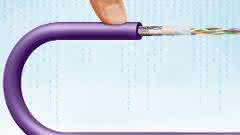
With the extremely flexible yet robust CFBUS.LB Ethernet bus cables, Igus provides the perfect complement to the Harting connector, which saves 70 percent space compared to the previous solution. This is a particular advantage in miniature housings, for example in camera systems, WLAN access points, routers or other digital components. Thanks to their special design, the Chainflex cables also require 50 percent less space than standard Ethernet cables.
Industry partner 4.0 in the tightest of spaces
"Low bending" is the buzzword for a particularly low bending radius for cables in energy chains. This is why Igus uses the abbreviation LB for the CFBUS.LB bus cable family, which is synonymous with the highest mechanical requirements. They are suitable for all common bus systems such as Ethernet CAT5, CAT5e, CAT6, Ethercat or Profinet. According to the company, the CF11 twisted pair data cable has the tightest bending radius currently available on the market.
Thanks to extreme bending radii of up to 6.8 x d, the high-end Chainflex cable can be used in the smallest installation spaces and for deep-freeze applications with temperatures down to -35 °C. The flexible cables demonstrate their strengths in terms of service life in continuous movement in pick-and-place machines, in the semiconductor sector or in highly dynamic packaging technology. This has been demonstrated by extensive test series. The CF11 data cable can therefore be optimally integrated into Harting's new ix Industrial (Type A) connector solution, which has just been presented at the Hanover Fair and is particularly suitable for compact data interfaces.


You might also be interested in
Basler acquires 76% of Indian image processor
Basler, supplier of image processing components for computer vision solutions, has acquired 76% of the Indian sales partner Alpha TechSys Automation.
 read more...
Process monitoring and fault detection
Cameras ensure quality during laser melting
Powder bed-based laser melting (PBF-LB/M) opens up new possibilities in additive manufacturing. Modern camera systems provide crucial process data to further increase quality and efficiency.
read more...Vision Sensor is three times faster than its predecessor
The 'CS-62' vision sensor from di-soric is around three times faster than its predecessor, the 'CS-60'. In combination with the 'nVision-i 25.1' software, it enables image processing solutions that were previously reserved for smart cameras.
read more...Thermal imaging cameras for quality control
Automated thermal imaging cameras are often suitable for quality control applications where temperature plays a role. However, while there are various solutions on the market for slow processes, it is challenging to select a camera that reliably...
read more...Easy entry into industrial VGA thermography
Reliable temperature measurement is a prerequisite for the success of many industrial processes. Berlin-based manufacturer Optris presents the Xi 640 infrared camera, a new member of its Compact Line, which enables non-contact temperature...
read more...Powder bed-based laser melting optimized
Aconity3D has set itself the goal of optimizing the stability of the manufacturing method of powder bed-based laser melting and thereby promoting its use in a wide range of industries. By using high-speed industrial cameras from SVS-Vistek, the...
read more...INDUSTRIAL Production Products of the year...
2nd place, category handling, assembly and production logistics: SICK
safeVisionary2 is the first 3D time-of-flight camera with Performance Level c safety certification. It enables safe three-dimensional environmental detection and won 2nd place in the competition for Product of the Year 2024 in the handling, assembly...
read more...Nomination Products of the Year 2024
SICK: Camera systems safeVisionary2
safeVisionary2 is the first 3D time-of-flight camera with Performance Level c safety certification. It enables safe three-dimensional environmental detection and has been nominated in the 2024 Product of the Year competition in the handling,...
read more...AI vision brings additional opportunities
The seamless integration of AI into the consumer sector has helped to improve our quality of life and make interactions with technology more efficient. In industry, AI vision with machine learning opens up new possibilities that are not covered by...
read more...