
Embedded vision assistance system
Avoid accidents with embedded vision
A Swedish research team has developed a fully integrated driver assistance system from an intelligent stereo camera and is now offering it to commercial users. It improves personal safety in the vicinity of mobile machinery and is based on the detection of high-visibility vests. With embedded image processing, it is compact and fail-safe.
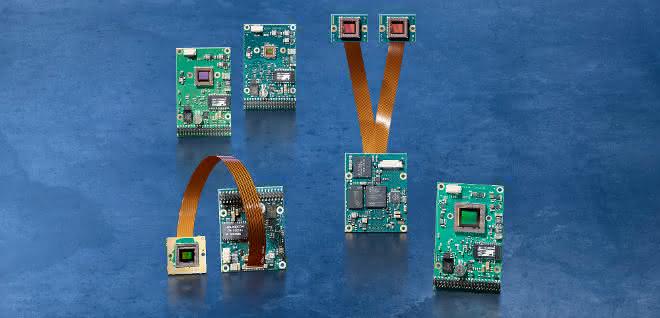
Where people and heavy machinery move in the same environment, accidents are unfortunately still part of everyday life. In mining, on construction sites, in logistics and elsewhere, vehicle drivers navigate areas that are difficult to see with machines that have very large blind spots. Companies are now increasingly looking for sensory aids to ensure occupational safety. Various solutions are in competition, based on radar, lidar, ultrasound, RFID or cameras. Retenua has presented a fully integrated system for mounting on vehicles that detects reflectors on high-visibility vests. It is based on an infrared camera and can trigger alarms and braking processes directly. Vision Components contributes the intelligent stereo camera. This embedded vision system with a powerful integrated processor captures the images and evaluates them itself. This means that no peripheral devices are required for image processing and the solution is extremely robust, both mechanically and functionally.
NIR 3D people detection
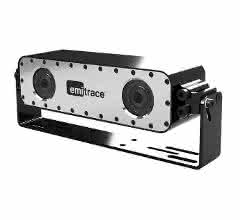
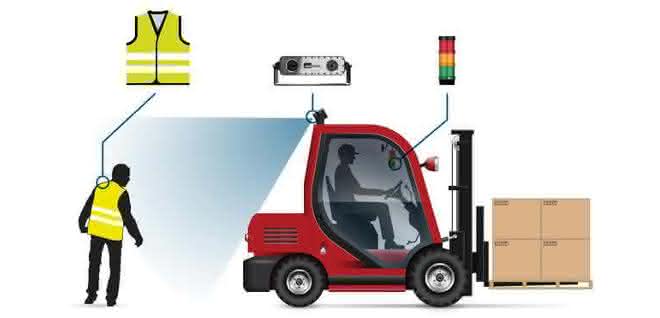
Retenua has patented a method for detecting retroreflectors - the reflective strips on high-visibility vests and protective clothing - and developed the Emitrace driver assistance system on this basis. This consists of a sensor and computer unit that is usually mounted at the rear of industrial vehicles. An optoacoustic signaling device is located in the driver's cab. No other devices are required. The integrated embedded vision system detects reflectors, calculates the 3D position and speed of people from the stereo images and triggers an alarm in the cab if there is a risk of an accident. It is even possible to link Emitrace directly into the vehicle control system so that it can automatically initiate braking.
The modules are extremely robust and can be used in a wide temperature range from -30 to 60 °C. The sensor unit has IP69K protection at the front and IP67 at the cable connection and is easy to clean. The viewing windows are made of hardened, scratch-resistant glass. The powerful NIR (near infrared) flash allows short exposure times, minimizing the influence of infrared radiation in the environment. The flash does not disturb people in the vicinity, but ensures stable detection performance in any lighting. Emitrace is suitable for indoor and outdoor use, day and night, and could become standard in mining applications in particular.
Demand-driven development
Rafael Mosberger and Henrik Andreasson conducted research at the University of Örebro in Sweden on detecting people with industrial vehicles. There they developed their new method for detecting retroreflectors with an infrared camera. The work was supported by both EU funding and industrial companies, which led the two scientists to found Retenua in 2015. The start-up provided several vehicle manufacturers with an early version of Emitrace as a developer kit. There was a lively exchange with their design departments in order to understand their needs and arrive at the current plug-and-play standard product with preset parameters.
Emitrace is designed for easy retrofitting on various mobile machines and for maintenance-free operation and has already been successfully tested in the field. Retenua works together with sales partners for installation and commissioning. These include forklift truck manufacturers, rental companies and service providers. Retenua's C++ vision library and the API provided allow flexible integration into different software environments. This means that raw data and image processing results can also be transferred to other systems for further processing or documentation.
Comparison with lidar, RFID and camera
Emitrace increases personal safety in the vicinity of heavy machinery. Lidar, radar and ultrasound, on the other hand, cannot reliably distinguish between people and objects. In industrial environments, which are characterized by narrow paths, they would constantly issue false alarms. Some products are based on RFID. This is a practical alternative to lidar, for example, and has the advantage that the transponders are detected even if they are obscured by obstacles. However, considerable costs can be incurred because staff and the vehicle fleet have to be equipped with transponders and readers.
With the exception of Emitrace, all existing camera-based products are trained to recognize people based on their silhouette. When walking and standing, this is easy to solve with algorithms. Other postures such as kneeling, sitting or lying down still overtax computing power. Reliable algorithms sometimes need several seconds to process a single image. It will be several years before this capability can also be implemented in real time. As Emitrace is trained exclusively on retroreflectors, body posture is no obstacle for the system.
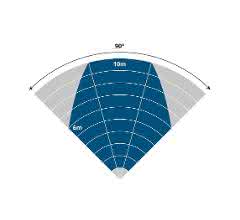
There are other special features: Previous camera solutions use the visible light spectrum and separate image processing computers. They are sensitive to sunlight and do not offer stable performance in the absence of light. However, people detection must also function reliably in the dark and under unfavorable lighting conditions. There are many poorly lit areas in mines in particular. The additional PC also increases installation and maintenance costs and takes up more space. Emitrace, on the other hand, combines sensor technology and data processing in a compact housing. The only additional requirement is that people in the work area must wear high-visibility clothing. The maximum ranges of the various products mentioned are in the 6 to 10 m range, for which Emitrace is also designed.
The embedded vision system
The fully integrated driver assistance system does not require any additional devices for data processing. The developers were specifically looking for embedded vision systems for real-time stereo image processing and ended up at Vision Components. "The vehicle industry prefers compact sensors that can be installed quickly and easily," says Rafael Mosberger, Managing Director of Retenua. The VC-Z series stereo camera meets all specifications: It is easy to integrate as a board camera with two remote sensor boards and offers a Xilinx Zynq SoC with a dual-core ARM processor that performs all image data processing.
A flash trigger and a 1 Gbit Ethernet interface ensure optimum connectivity. The camera with Linux operating system and the VCLib software library made the developers' work easier, confirms Mosberger: "This is a huge advantage for us because we were able to get started straight away. We use the functions in the supplied VCLinux and VCLib components to configure the sensors and read out the images. Our program is currently running entirely on the ARM processor. We are currently working with Vision Components to find out how we can speed up the algorithm by shifting computationally intensive steps to the FPGA." The FPGA is part of the Zynq SoC module, the core of the VC embedded cameras. This circuit enables higher processing speeds and can be freely programmed using a hardware description language.
Miriam Schreiber, Marketing & PR Manager, Vision Components / am


You might also be interested in
Helu makes its first trade fair appearance under a new brand name
Helu Kabel will be presenting itself as Helu for the first time at Hannover Messe 2026, showcasing system solutions, Heluchain cables and new industrial luminaires.
 read more...
Strategic realignment with brand relaunch
In future, Helukabel will trade as Helu
The Helukabel Group is parting with part of its name: in future, the company will only operate under the Helu brand. With this step, the specialist for electrical connection technology is underlining its strategic development from a classic cable...
read more...Modular plant construction for corrugated board
Insight into the production of corrugators at BHS Corrugated: Automated, modular and equipped with Helukabel components.
read more...Best quality for the steel
Conditions in the steel industry are harsh and inhospitable. The machines used must be able to withstand the demanding environmental conditions in order to deliver the best quality at all times.
read more...If the standard cable is not sufficient
Lapp offers cables for countless applications - but not for all of them. From time to time, the developers have to modify a standard cable or develop a special cable.
read more...Slight decline in sales, strong investments
The Lapp Group has not been spared from the weakening global economy. However, the company only recorded a slight loss in the past 2024 financial year.
read more...Electrical connection technology
Cables and wires for industrial automation
Heukabel offers system solutions for cable routing from a single source. The subsidiary EKD Systems specializes in tailor-made cable drag chains made of steel, stainless steel and plastic, which are used in moving machines and systems as well as in...
read more...Lapp relies on Ultramid from BASF
Mobile charging of electric vehicles
The automotive industry is currently undergoing the biggest transformation in its history. The boom in battery electric vehicles in particular is presenting the industry with major challenges. Lapp, as a supplier of cables and connection...
read more...Cable handling application
At this year's Motek, ArtiMinds Robotics is showcasing a robot-based automation solution for the sensor-assisted assembly of flexible cables in connector housings.
read more...