
Laser marking on stainless steel
Markings for harsh environments
The search for potential savings also extends to industrial marking in the process industry. Clear and permanent marking of all components saves time and money. Stainless steel is often used for high requirements.
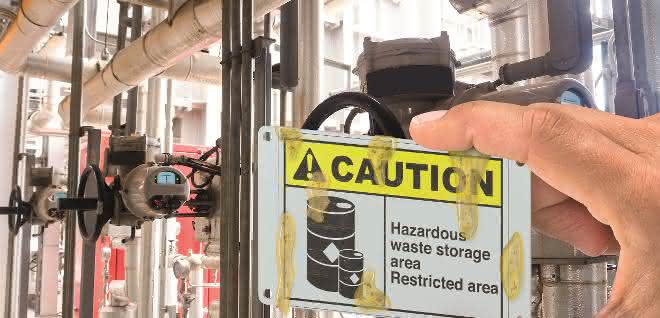
Markings are often subject to legal regulations. As a high-end solution, stainless steel materials are particularly worthy of mention here, as they stand out in terms of appearance, resistance and durability. In contrast to most plastics, metallic materials are also suitable for outdoor applications as they are resistant to UV radiation and weathering. Even aggressive chemicals and temperatures of up to 200 °C cannot harm stainless steel markings. As a result, this material is increasingly being used in industrial applications, for example as nameplates in the process or offshore industry. In order to be able to meet all customer requirements, Phoenix Contact uses plates made of V4A stainless steel grade 1.4404.
Create robust markingseconomically
One example from practice is the production of markings for clear identification in harsh environments. The markings must be resistant to mechanical and chemical stresses and also withstand all expected influences such as light, heat, cold and weather. Anodized aluminium, stainless steel and sometimes plastic are often used for this purpose.
Phoenix Contact has three different printer technologies in its range: thermal transfer printing, direct laser marking and UV LED printing. Thermal transfer printers - such as the Thermomark Card 2.0 and Thermomark Roll 2.0 series - enable high marking quality on a wide variety of plastics. However, this range is not suitable for marking metals. The areas of application for laser-marked material are diverse, from the offshore industry with its harsh environments and high demands on corrosion resistance to the process industry with its aggressive chemicals and classic mechanical engineering. For a wide range of applications, Phoenix Contact offers the Topmark Neo laser system with more than 600 marking materials - including aluminum and V4A stainless steel in addition to foils and plastics. The user selects from the marking modes "High Quality", "Standard" and "Draft", which differ in the ratio of marking time to contrast intensity. This is also referred to as engraving, as the laser beam creates an indentation on the signs. This type of marking is extremely robust against environmental influences.
In contrast, no material is removed during annealing marking; the surface of the stainless steel plate remains smooth and even. The energy input of the laser beam oxidizes the surface of the material with the surrounding atmospheric oxygen to create a high-contrast colour change. As hardly any dirt adheres to the smooth surface, this process is particularly suitable for the high hygiene standards of the food industry and medical technology.
Fast and environmentally friendly labeling with UV LED printing
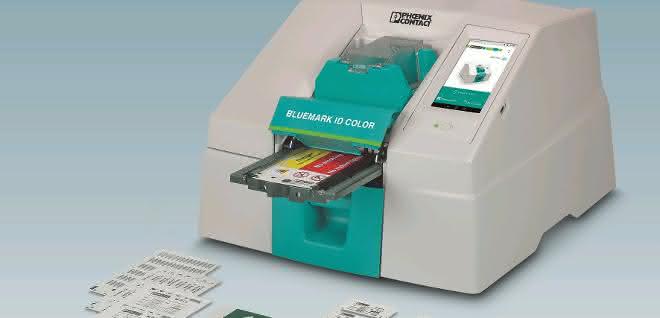
With the Bluemark ID printer family, Phoenix Contact offers an all-in-one solution for the entire industrial marking market. The environmentally friendly and emission-free UV LED printing process produces high-quality, ready-to-use marking solutions. Two printing systems are available for different applications: the monochrome printing system Bluemark ID and the color printing system Bluemark ID Color for CMYK multicolor printing. Both systems have numerous features that increase consistency and flexibility throughout the entire marking process. Over 1,300 marking solutions - made of metal as well as films and plastics - for terminal, conductor, cable, device and system marking offer users the right marking material for every application.
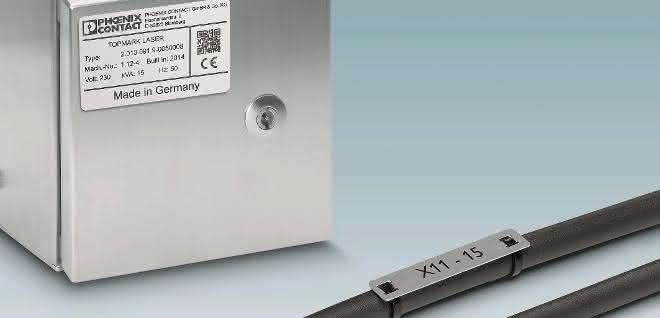
There are over 20 variants in the V4A material range alone. These include labels without adhesive for snapping into label holders, labels with adhesive that can also be mounted on textured surfaces, as well as labels for conductor and cable marking for cable tie mounting in square or round designs.
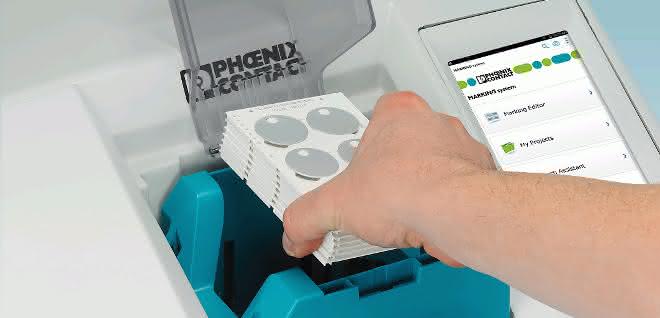
Aluminum and stainless steel plates are processed quickly and easily; no pre- or post-treatment is required. The stainless steel sign is simply removed from the packaging, inserted into a magazine provided for this purpose and fed into the printer. Once the printing process is complete, the metal sign is immediately ready for use. The Bluemark ID printing systems are even more flexible thanks to variable loading, which can be activated both in the "Project complete" marking software and directly on the printing system, depending on customer requirements. The front feed is useful for individual printing processes, with each magazine being fed in and output separately. Automated material feed can be used for larger jobs - up to 20 loaded magazines can be placed directly into the input magazine of the printing system, fed in and stacked. To further increase cost efficiency, the aluminum and V4A metal tags for the Bluemark ID printing systems can be printed on both sides. An incorrectly printed sign does not have to be disposed of immediately.
Consistency right from the start
Increasing complexity and high cost pressure in the industrial environment require efficiency improvements throughout the entire production chain - from planning to assembly. Software for all printing systems and end-to-end in-process solutions increase efficiency and reduce engineering and assembly costs. Today, complex projects in control cabinet and plant engineering are largely organized with the help of CAE (Computer Aided Engineering) software solutions. As part of the value chain, the planning and marking software Project complete automatically takes over all stored information on terminal points, wires, cables and markings at the click of a mouse, eliminating the need for manual data entry. This prevents errors caused by incorrect or redundant entries. Project complete provides all relevant labeling data as well as parts, order and assembly lists at the click of a mouse.
High-quality, permanently and clearly legible marking and labeling of components, cables or systems is a decisive quality feature in mechanical and plant engineering. In terms of appearance, resistance and durability, V4A stainless steel labels offer a high-end solution for industrial applications where the application is often prescribed by legal regulations. For standard applications, labeling materials made of foil or plastic are usually used, while metal is used for more demanding applications. In order to cover the entire application environment, Phoenix Contact offers an optimally coordinated overall package of software, marking systems and marking materials. Dipl.-Ing. Andreas Radeck, Product Marketing Marking Systems, Marking and Identification, Phoenix Contact


You might also be interested in
Helu makes its first trade fair appearance under a new brand name
Helu Kabel will be presenting itself as Helu for the first time at Hannover Messe 2026, showcasing system solutions, Heluchain cables and new industrial luminaires.
 read more...
Strategic realignment with brand relaunch
In future, Helukabel will trade as Helu
The Helukabel Group is parting with part of its name: in future, the company will only operate under the Helu brand. With this step, the specialist for electrical connection technology is underlining its strategic development from a classic cable...
read more...Modular plant construction for corrugated board
Insight into the production of corrugators at BHS Corrugated: Automated, modular and equipped with Helukabel components.
read more...Best quality for the steel
Conditions in the steel industry are harsh and inhospitable. The machines used must be able to withstand the demanding environmental conditions in order to deliver the best quality at all times.
read more...If the standard cable is not sufficient
Lapp offers cables for countless applications - but not for all of them. From time to time, the developers have to modify a standard cable or develop a special cable.
read more...Slight decline in sales, strong investments
The Lapp Group has not been spared from the weakening global economy. However, the company only recorded a slight loss in the past 2024 financial year.
read more...Electrical connection technology
Cables and wires for industrial automation
Heukabel offers system solutions for cable routing from a single source. The subsidiary EKD Systems specializes in tailor-made cable drag chains made of steel, stainless steel and plastic, which are used in moving machines and systems as well as in...
read more...Lapp relies on Ultramid from BASF
Mobile charging of electric vehicles
The automotive industry is currently undergoing the biggest transformation in its history. The boom in battery electric vehicles in particular is presenting the industry with major challenges. Lapp, as a supplier of cables and connection...
read more...Cable handling application
At this year's Motek, ArtiMinds Robotics is showcasing a robot-based automation solution for the sensor-assisted assembly of flexible cables in connector housings.
read more...