
Labeling
Printed in full color
With the CPX4 series, TSC Auto ID has developed a marking solution for economical "color printing on demand". The printers offer excellent print resolution and color quality as well as the fastest print speed in their class.
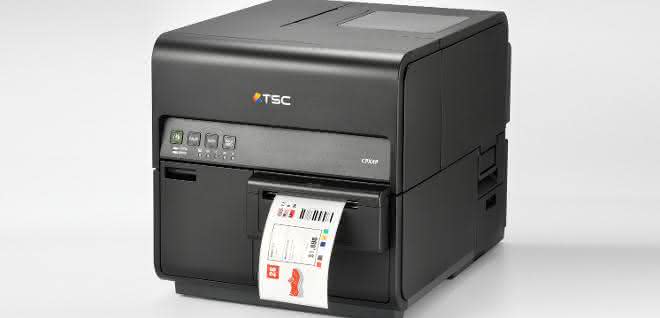
The two models CPX4D and CPX4P in the new series differ essentially in terms of the ink type. While the CPX4D uses so-called water-based dye ink for printing universally applicable blank labels, the CPX4P uses colored pigments suspended in the ink liquid.
A print resolution of 1,200 x 1,200 dpi enables precise printing of color images, barcodes and text on labels with a maximum width of 120 millimeters. The technology of the CPX4 series supports label rolls with an outer diameter of 7.9" (200 millimetres) and an inner diameter of 3" (76 millimetres). This reduces the time required for material changes and increases productivity in the labeling process. Sensor technology and media handling also enable the precise printing of miniature labels in the 25.4 x six millimeter format.
Thanks to TSC's line print head technology, the printers offer a high print speed of up to 300 millimetres per second - currently the top position in this category, explains the manufacturer. USB 2.0 Hi-speed and Ethernet are used for fast data transfer of large data volumes.
High-quality printer cartridges are also used. They offer an ink capacity of 240 milliliters each and ensure a high yield during the printing process. With the CPX4 series, printing costs can therefore be significantly reduced over the service life of the devices - an important aspect in terms of cost-effectiveness.
The model series is accompanied by the TSC service, which also includes the specially developed color management program for high-quality printing of vibrant, razor-sharp information and images. Users can also use the TSC cost calculator to calculate the cost of a print project per page and thus the expected ROI.
The series is equipped as standard with the Bartender Ultralite label software for easy layout of individual designs. Design changes can be made easily and variable data sets can be easily applied to the label. Users have the option of reacting spontaneously to changes in legislation and individual customer requirements or supporting individual marketing campaigns with specific labels - even from batch size 1. as


You might also be interested in
Conrad continues to grow
Conrad Electronic now generates 80% of its sales with business customers and has successfully developed from a traditional technology retailer into a B2B procurement platform. The company aims to become Europe's leading procurement platform for...
 read more...
AI finds its way into automotive customer service
In addition to computer solutions for vehicle diagnostics, Getac now also offers AI-based digital tools that support customer contact in service operations.
read more...SMC: "Preferred Supplier" from Bosch
The technology and service company Bosch has recognized SMC for the performance of its automation technology in factory and process automation and awarded it the status of "Preferred Supplier" in the material group "Standardized Pneumatic Devices".
read more...Combined ERP forces
The medium-sized ERP providers Step Ahead Software, Godesys and Informing merge to form the Step Ahead Group.
read more...Cybersecurity for asset-intensive companies
Forge Cybersecurity Platform, the new software platform from Honeywell, has been developed for the cybersecurity of asset-intensive companies and critical infrastructures. The platform is available in three versions.
read more...Automated machine tool as a success factor
Industry 4.0 is the hot topic of the moment. For small and medium-sized companies and contract manufacturers, it holds great potential for increasing production efficiency step by step. The focus here is on efficient and user-specific automation...
read more...Nemo hand vacuum lifts all materials
A new addition to the Eurotech portfolio is the battery-operated Nemo vacuum cleaner, which is suitable for handling almost all surfaces.
read more...Future-oriented cobot projects
Three pillars of successful cobot initiatives
What is important if cobot projects are to be future-oriented? Automation and robotics expert Omron has identified three aspects for human-machine collaboration.
read more...Short-stroke linear actuator instead of pneumatic cylinders
The new short-stroke linear actuator from Ketterer Antriebe and halstrup-walcher is characterized by high dynamics and a large stroke in a compact size. Thanks to the integrated electronics, the drive is easy to control compared to pneumatic...
read more...