
Ensenso XR
Camera calculates 3D point clouds itself
The Ensenso XR stereo camera from IDS can calculate 3D point clouds itself. It then sends the data via Ethernet or WLAN to a host PC for further processing.
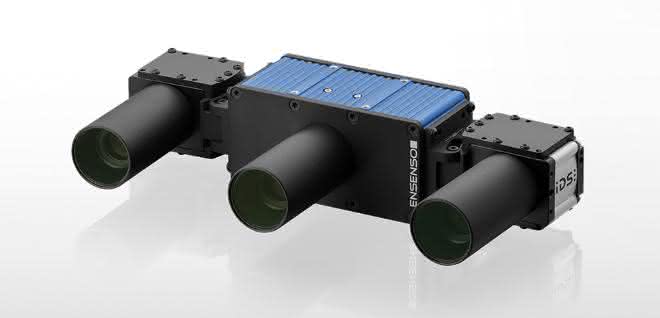
The Ensenso N and X series models use an industrial computer to calculate the 3D point clouds. As Ensenso XR cameras can take over the calculations themselves and forward them as a result, 3D data can be created twice as quickly in future - depending on the parameterization. Another advantage of the new camera series, according to the manufacturer, is that only one cable (for the power supply) needs to be connected to the camera, as the data is transmitted via WLAN. This is an advantage when used on robot arms, for example.
"Ensenso XR adopts the modular concept and precise detail capture of the Ensenso X series and opens up new scope thanks to the even faster capture of 3D point clouds, which will benefit many applications," says Dr. Martin Hennemann, Product Manager Ensenso at IDS. This applies, for example, to multi-camera systems where the load on bandwidth and PCs are critical factors for success, or bin picking applications that require the highest possible cycle rates.
The camera series was officially presented for the first time at Vision 2018 using a prototype. The model presented corresponds to the Ensenso-X series with a 1.3 MP sensor in terms of field of view and resolution. It can precisely capture entire pallets as well as small objects. In the case of a packed Euro pallet measuring 120 x 80 x 100 centimetres, the Z-accuracy is just under one millimetre at a camera distance of around two meters. Both variants with GigE uEye CP and robust GigE uEye FA industrial cameras (protection class IP65/67) with 1.6 MP and 5 MP sensors are planned for the Ensenso-XR series launch in spring 2019. as


You might also be interested in
Künstliche Intelligenz für Industriekameras
Auf der Vision zeigt IDS seine App-basierten Industriekameras IDS NXT. Die Industriekamera-Plattform wächst um die Familien IDS NXT rio & rome und bietet zusätzliche Sensoren und Kommunikations-Schnittstellen.
 read more...
Fokus einfach regeln
Nun stellt IDS Imaging Development Systems die Einplatinenkameras „uEye LE USB 3.1 Gen 1“ mit S-Mount oder CS-/C-Mount auch als Varianten zur Verwendung und Steuerung von Flüssiglinsen-Objektiven vor.
read more...KI-basierte Roboterzelle
Die Neocortex Artificial Intelligence (AI) Softwareplattform kombiniert Sensordaten und Maschinensteuerung, sorgt für eine optimale Wahrnehmung der Arbeitsumgebung, führt den Roboterarm und lenkt das Greifen und Ablegen der Objekte.
read more...Helu makes its first trade fair appearance under a new brand name
Helu Kabel will be presenting itself as Helu for the first time at Hannover Messe 2026, showcasing system solutions, Heluchain cables and new industrial luminaires.
read more...Strategic realignment with brand relaunch
In future, Helukabel will trade as Helu
The Helukabel Group is parting with part of its name: in future, the company will only operate under the Helu brand. With this step, the specialist for electrical connection technology is underlining its strategic development from a classic cable...
read more...Modular plant construction for corrugated board
Insight into the production of corrugators at BHS Corrugated: Automated, modular and equipped with Helukabel components.
read more...Best quality for the steel
Conditions in the steel industry are harsh and inhospitable. The machines used must be able to withstand the demanding environmental conditions in order to deliver the best quality at all times.
read more...If the standard cable is not sufficient
Lapp offers cables for countless applications - but not for all of them. From time to time, the developers have to modify a standard cable or develop a special cable.
read more...Slight decline in sales, strong investments
The Lapp Group has not been spared from the weakening global economy. However, the company only recorded a slight loss in the past 2024 financial year.
read more...