
Servo solution for fluid applications
Valves out, electric motors in
Kollmorgen has developed a prepared drive solution for hydraulic applications for the S700 series of servo controllers. The new technology is designed to improve the energy efficiency of applications that require the high force density of hydraulics. Two further advantages are control accuracy and service life.
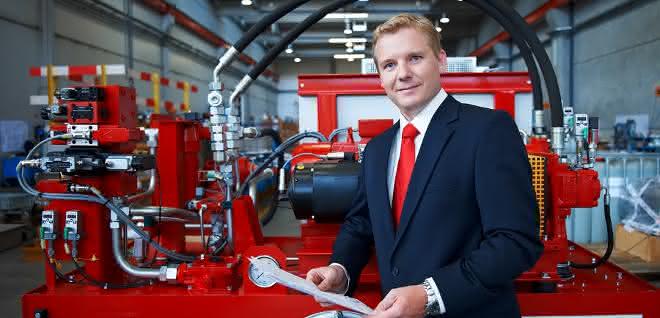
The pressure or volume flow control of hydraulic applications is usually realized with the help of variable displacement pumps. In standard solutions, comparatively primitive asynchronous motors are used to drive the variable displacement pumps. A controller is connected to this, whose task is to maintain set values. This classic set-up is controlled via pressure sensors and the control of pressures and flow rates in rather coarse - and therefore imprecise - control ranges. Two further disadvantages are energy efficiency and noise emissions, as asynchronous machines generate a lot of reactive power and more noise than synchronous motors.
Kollmorgen's solution, on the other hand, ensures the varying pressure and volume flow requirements in hydraulic applications via the speed of the synchronous servomotor - i.e. not via valves. The two parameters are controlled by the S700 servo controller in conjunction with the synchronous servo motor and a fixed displacement pump. It delivers the same volume with every revolution. Consequently, the reference variable of the control is reduced to the pure speed.
Independent pressure control in the servo inverter
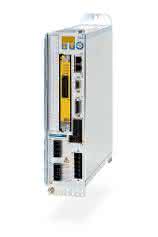
The structure of this servo drive solution, which is designed for hydraulic applications, means that control is handled autonomously by the intelligent S700 servo inverter. The controller, which is connected via fieldbus or analog signal, only specifies the pressure and volume values, which are then precisely maintained by the controller via the speed. "With the sampling frequency of 16 kHz, we achieve a fast and precise control behavior of the speeds and thus perfect pressure and flow values," explains Kollmorgen development engineer Georg Jaskowski. The software within Kollmorgen's S700 servo controllers also paves the way for efficiency compensation as a result of higher pump speeds. "The same applies to the linear interpolations with the effect of effectively compensating for vibrations and pulsations and thus intercepting them," says Georg Jaskowski. Another advantage in practical use is that target pressures and target volumes can be stored as recipes in the drive controller via profiles or ramps and made available to the controller for immediate retrieval.
The Austrian company Hainzl uses the briefly outlined advantages for the engineering of complete hydraulic solutions for small to medium power requirements - for tasks ranging from plastics processing to handling technology. According to Peter Schrenk, Head of Fluid Technology at Hainzl, servo inverter-controlled hydraulics can fully exploit their advantages in the 1 to 20 kW range. Beyond this, central systems still have their justification.
Additional costs of the servo pump pay off
In the experience of the fluid specialists from Linz, the additional costs of a servo pump quickly pay for themselves compared to conventional technology. "We have fewer actuators in the system and thus reduce complexity," says Peter Schrenk. In terms of ergonomics at the workplace, this technology also scores points with its quieter drives and emission values below 75 dB. "Noise is increasingly a health and safety issue in manufacturing companies."
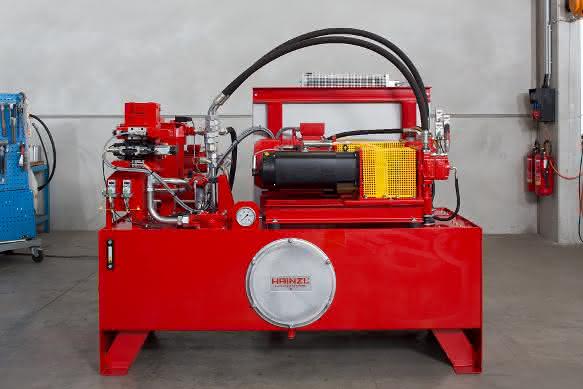
The main advantages of the so-called servo inverter-controlled hydraulics, however, lie above all in the wide range of possible applications, without having to compromise on whether the hydraulic supply is provided from a central unit in a process area. "We make the high power density of hydraulics more easily available," says Schrenk. Cables are easier to lay than hydraulic pressure lines. Furthermore, the compact units work with significantly less hydraulic oil and are only in an active operating state when the connected process actually requires the hydraulic power. In contrast, central systems must always maintain the operating pressure - especially when hydraulic axes work in a time-delayed manner in production processes. According to the company, the servo inverter-controlled hydraulics are ready for operation from a standing start thanks to the highly dynamic servo motor from Kollmorgen's AKM series.
This design improves energy efficiency in the long term, as losses in standby mode no longer play a role. This is accompanied by a longer service life of the hydraulic medium, as the oil is subjected to less mechanical stress and therefore does not age as quickly. This should result in lower costs for operating materials and higher availability due to longer maintenance intervals. The longer service life of the fluid as a result of the targeted use of hydraulics also ensures that the ambient temperature does not rise excessively - this as a result of an overall reduction in power loss. And where less "waste heat" is generated, OEMs and machine operators also have to worry less about how to control or reduce the rising temperatures in their processes. On the motor side, Kollmorgen also makes a valuable contribution to reducing heat input, as the AKM servomotors generate low thermal power losses due to their high efficiency. In addition, the synchronous servomotors operate without external fans.
No braking power in the hydraulics
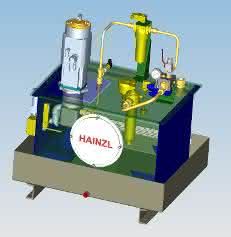
The negative influence of heat on service life and energy efficiency also has an effect outside of partial load and standby mode - specifically when braking forces are acting on the hydraulics. Hainzl uses Kollmorgen technology, for example, to perform handling tasks as part of intralogistics processes. This involves lifting and lowering heavy steel parts. With centralized hydraulics, the kinetic energy generated during lowering can only be absorbed via the oil in the form of heat. This has the consequences described above - including additional cooling measures, which further reduce the overall efficiency of a machine (keyword OEE). "The electrohydraulic system developed together with Kollmorgen makes it possible to allow the braking energy to act directly on the motor," explains the Head of Fluid Technology at Hainzl. This enables the Austrians to feed back the braking energy elegantly and, above all, energy-efficiently, especially in constantly recurring lowering sequences.
Conclusion
With the prepared servo pump drive solution, Kollmorgen has developed a new function for electrohydrostatic actuators (EHA) based on the S700 servo controller series. The software-based application can be easily adapted to the special features of the application during engineering by parameterization. This creates the basis for utilizing the advantages of the EHA without having to consider possible restrictions of existing central hydraulics. Kollmorgen supports this approach with a modular and, above all, open drive solution that can be easily integrated into the existing automation network.


You might also be interested in
Helu makes its first trade fair appearance under a new brand name
Helu Kabel will be presenting itself as Helu for the first time at Hannover Messe 2026, showcasing system solutions, Heluchain cables and new industrial luminaires.
 read more...
Strategic realignment with brand relaunch
In future, Helukabel will trade as Helu
The Helukabel Group is parting with part of its name: in future, the company will only operate under the Helu brand. With this step, the specialist for electrical connection technology is underlining its strategic development from a classic cable...
read more...Modular plant construction for corrugated board
Insight into the production of corrugators at BHS Corrugated: Automated, modular and equipped with Helukabel components.
read more...Best quality for the steel
Conditions in the steel industry are harsh and inhospitable. The machines used must be able to withstand the demanding environmental conditions in order to deliver the best quality at all times.
read more...If the standard cable is not sufficient
Lapp offers cables for countless applications - but not for all of them. From time to time, the developers have to modify a standard cable or develop a special cable.
read more...Slight decline in sales, strong investments
The Lapp Group has not been spared from the weakening global economy. However, the company only recorded a slight loss in the past 2024 financial year.
read more...Electrical connection technology
Cables and wires for industrial automation
Heukabel offers system solutions for cable routing from a single source. The subsidiary EKD Systems specializes in tailor-made cable drag chains made of steel, stainless steel and plastic, which are used in moving machines and systems as well as in...
read more...Lapp relies on Ultramid from BASF
Mobile charging of electric vehicles
The automotive industry is currently undergoing the biggest transformation in its history. The boom in battery electric vehicles in particular is presenting the industry with major challenges. Lapp, as a supplier of cables and connection...
read more...Cable handling application
At this year's Motek, ArtiMinds Robotics is showcasing a robot-based automation solution for the sensor-assisted assembly of flexible cables in connector housings.
read more...