
Compressed air distribution systems
No need to deflate
Compressed air generation and distribution costs energy, and that is expensive. This is why companies should not cut corners when installing new and expanding existing systems and distribution, but should rely on modern, well-planned systems.
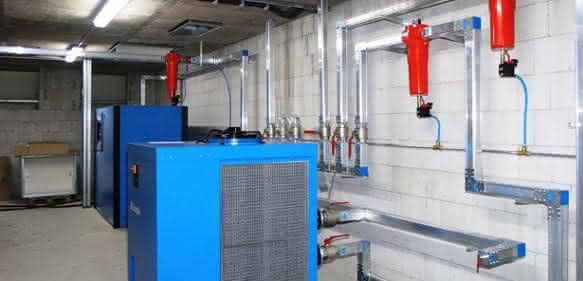
Various factors play an important role when deciding on a compressed air distribution network. The production pressure is the first parameter that influences consumption and performance. Under no circumstances should the air be produced at a high pressure and then reduced to the consumption pressure in order to compensate for leaks or pressure drops in the network. Each additional bar means a 9 percent increase in output and therefore additional energy costs.
In an average system, the generation pressure is around 7 bar. The network is designed in such a way that this pressure is distributed as evenly and efficiently as possible. An increase from 8 to 10 bar leads to a 15 percent increase in energy costs for compressed air generation. A larger diameter is therefore usually more economical than changing the working pressure.
Maximum flow rate and expansion reserves
The diameter of the main ring must be designed according to the maximum simultaneous extraction at all consumption points. It is also possible to expand production by adding or replacing units with a higher capacity in the compressor room. It is normally difficult to make changes to the main manifold during operation. Once a choice has been made, the system will function for the entire service life of the network. The use of modern modular systems facilitates and accelerates any changes to the secondary network. This reduces the costs for modifications and modernizations.
Pressure losses are caused by the friction of the medium as it flows through the pipe. They are closely related to the speed of the compressed air and the roughness of the pipe. The network diameter should therefore be designed in such a way that the velocity of the fluid in the main lines is as low as possible. The guideline values are 6 m/s or less. A lower velocity results in lower electricity consumption for the production and distribution of compressed air. Modern system planning assumes a maximum pressure drop of 3 percent of the inlet pressure.
Materials and products
A low weight facilitates and speeds up installation, while corrosion- and oxidation-free materials guarantee high-quality compressed air in the long term. The type of connections used to join the pipes is also important. Systems with machined connections made of durable material with high-quality seals offer perfect tightness.
The system layout and diameter of the pipes are based on the position of the tapping points. A closed ring configuration is ideal. Despite a higher initial investment, this offers an even distribution of pressure and a lower pressure drop with the same flow rate in the long term. Modular systems that allow cost-effective modifications, possibly even under pressure, also enable the network to be adapted to an expansion of production.
Correct installation prevents compressed air losses, malfunctions or breakages. Any higher installation costs will pay off in the long term through lower operating, maintenance and repair costs.
Calculation programs for the compressed air sector enable a quick evaluation of different configurations and create reports with the key data. am


You might also be interested in
Predictive maintenance in retrofit
Predictive maintenance pays off. This is because early detection of impending failures means that systems can be serviced in a targeted manner before production downtime occurs. But how complex is it to integrate such a maintenance concept into an...
 read more...
Maintenance instead of replacement
The circular economy starts with the machinery
Sustainability in industry starts with machines, says our guest author from Deguma: How maintenance, modernization and the 5R strategy save resources, energy and CO₂.
read more...3D printing for unplanned requirements
The material fails and the machine suddenly stops? Then you need to take the right measures to be able to resume production quickly. Material failure in the form of faulty components or material wear in the frame are a risk for any production.
read more...High demands in terms of safety, application and robustness
Demanding work in the electrical trade and energy supply as well as smooth processes in production require innovative and customized measurement technology that scores points for safety, ease of use and resilience.
read more...Car meets e-bike: riding with lubrication-free polymer bearings
Studies show that the proportion of pedestrian and bicycle traffic is increasing in urban areas. With the JetBike, JetBike GmbH from Braunschweig presents a mixture of e-bike and car and relies on lubrication-free polymer bearings from Igus.
read more...Hydraulic hub for more efficient servicing
Bosch Rexroth presents a digital toolbox for service and maintenance. With a comprehensive range of digital services, the Hydraulic Hub simplifies and accelerates the service and maintenance of hydraulic products and increases machine availability.
read more...Arnold Umformtechnik expands after-sales...
Faster help with VR glasses
Arnold Umformtechnik is expanding the after-sales service for its machines to include digital remote services. The focus is on data security, simple operation and clear processes.
read more...147,000 euros per hour: high costs for German companies due to unplanned downtime
According to the "Value of Reliability" study, 67% of industrial companies in Germany experience unplanned downtime at least once a month. This costs the German economy 147,000 euros per hour. Nevertheless, reactive maintenance concepts are not...
read more...Maintenance starts with a maintenance planner
Legal requirements stipulate that machines and systems must be serviced regularly. The maintenance work serves to ensure occupational safety and economic efficiency.
read more...