
Compressed air measuring devices
Cala laser research center uses technology from Beko
When a new think tank and research center is created for medical science, vision becomes reality. This is also the case on the Garching research campus near Munich, where the laser research center Centre for Advanced Laser Applications, Cala for short, has been planned, built and set up since 2008. It is due to go into operation in 2018. In its technical room, compressed air measurement systems from Beko Technologies ensure seamless monitoring.

Biomedical imaging, tumor therapy and risk-free screening: at the new research center, physicists, physicians and biologists from Ludwig-Maximilians-Universität (LMU) and the Technical University of Munich (TUM) will investigate the potential of light for the early detection and treatment of serious diseases such as cancer. Only if research and possible therapies are carried out in a cost-effective way can as many cancer patients as possible benefit from them later on. Compressed air, and in particular its absolute purity, plays an important role in the use of intense laser light. It is therefore essential for the researchers to continuously monitor the compressed air quality - a sensitive process, but one that has been simplified and designed with the necessary reliability through the use of an online measuring system.

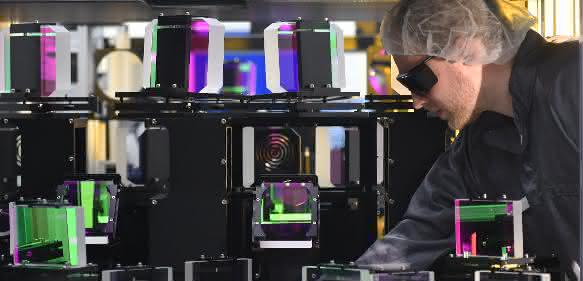
The Munich researchers generate laser light using state-of-the-art laser systems. The laser beam is directed fifty meters through the beamline - a pipe system in an ultra-high vacuum that runs under the floor slabs of the research center: from the light source to the various applications and test laboratories in the building. Only the cleanest, purest compressed air may be used to ventilate the beamline. Compressed air-operated gate valves separate the sections of the beamline and the experimental chambers from each other. "The smallest impurities in the compressed air can cause the deflecting mirrors to fog up and thus have a significant impact on the quality of the entire system," says Prof. Jörg Schreiber from LMU Munich. According to the Professor of Experimental Physics, residues of oil or moisture would make the laser light more diffuse and solid particles would damage the deflecting mirrors. The particularly clean compressed air is also used to clean the deflection mirrors with the aid of a plasma gun.

In order to permanently monitor the quality of the compressed air and to be able to react immediately in the event of contamination, the Cala project managers decided to use the Metpoint OCV measuring device from Beko Technologies. The measuring process from the Neuss-based compressed air specialist is TÜV-certified in accordance with the requirements of ISO 8573-1, class 1-4, and therefore offers the highest possible level of reliability when recording and analyzing compressed air quality data. The measuring device enables analyses down to thousandths of a milligram per cubic meter of residual oil vapour. During operation, the online system monitors the compressed air around the clock. Sampling and time-consuming laboratory evaluations are no longer necessary.
Automated control of the compressed air valves
The measuring device automates the handling of compressed air measurement and control. It also simplifies the control of connected systems. This reduces the risk of contamination of the entire laser system as well as the time and effort required, especially with such a highly complex technology and branched laser infrastructure as in Cala. In addition to the sophisticated technology, a comprehensive cooling water and ventilation system, whose pipes run through the entire building complex, ensures safe and reliable operation.
The beamline, also known as the "laser highway", runs under the floor panels in a raised floor about one meter high. In the event of contamination by oil, the compressed air lines and beamline would have to be cleaned. The measuring device, on the other hand, enables higher-level control of the gate valves and compressed air valves. The technology triggers an alarm as soon as the recorded data exceeds an individually adjustable limit value. The compressed air main valve is closed and contamination of the entire laser system is prevented.
"Compressed air plays an important role in the functionality and smooth operation of the laser center," says Prof. Schreiber. "Therefore, the seamless measurement and control of its quality is central to process reliability, and the measuring device is an indispensable indicator." This sets the technical course for successful research at the Laser Center. ee


You might also be interested in
Plagiarius 2024 negative prize
On January 26, 2024, the Plagiarius campaign awarded its dreaded "Plagiarius" negative prize for the 48th time to manufacturers and retailers of particularly brazen counterfeits and fakes.
 read more...
Ivalua honors winners of the Generative AI...
AI-supported "add-ons" for buyers within 48 hours
Ivalua, provider of cloud-based spend management solutions, announced the winners and innovations of the first Generative AI Innovation Cup. The competition took place in December 2023. It was open to all Ivalua partners and employees - more than...
read more...Efaflex celebrates 50 years of high-speed...
The emphasis is on "fast"
Since day one, Efaflex has wanted to use new technologies as early as possible and drive progress in the industry. This year, the family business is celebrating its 50th anniversary under the motto "Fast Forward".
read more...Security of supply even during power outages
In the winter of 2022, Germany was worried about energy shortages. The drugstore retailer dm did not paint any horror scenarios, but nevertheless saw the possibility of controlled, temporary, regional power cuts (brownouts).
read more...Safety technology in mechanical engineering
Modules with new functions
Euchner's product highlights at EMO 2023 include the communication-capable solenoid interlocks.
read more...Transforming the paper industry towards climate neutrality
Together with partners from industry and research, Voith is developing a project for the optimization of energy and material flows in paper production. The aim of the research project is to develop a digital framework that enables effective process...
read more...Up to 95 percent less flue gas thanks to direct extraction
The requirements for occupational safety measures and safety technology are also constantly increasing in welding technology. The Technical Rules for Hazardous Substances (TRGS) stipulate that welding fumes and harmful substances must be extracted...
read more...Competitive advantages with large machines
Whether 3D-printed components for machines and systems, prototypes or aids for design: additive manufacturing is almost indispensable for modern companies in mechanical and plant engineering and automation if they want to play in the premier league.
read more...Transport technology from the modular system
Many transport tasks can be realized with the help of linear technology. Pre-configured solutions are available to simplify the interaction between the linear unit, motor, gearbox and controller. This minimizes the effort required for research and...
read more...