
Assembly automation
Without programming for automation
At Motek, Fraunhofer IPA will be using robot applications to present new technologies that increase the degree of automation in assembly and thus leverage economic and qualitative potential.
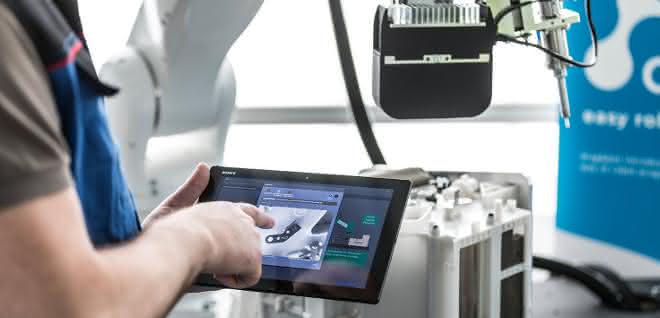
Medium-sized companies have rarely exploited the potential offered by the use of robots. One of the reasons: Programming is comparatively complex and external experts are often required to set up a robot. Martin Naumann, Group Leader at the Fraunhofer Institute for Manufacturing Engineering and Automation IPA, believes that this is no longer appropriate in an age of intuitively operated smartphones and tablets.
Software reduces programming effort
Together with his colleagues, the Fraunhofer IPA researcher has developed the Drag&bot software, which reduces programming effort to a minimum. Drag&bot provides ready-made program modules that can be quickly and intuitively combined into complex robot applications via a graphical user interface. In addition, operating and input aids simplify the parameterization of the modules. "This means that expert knowledge is no longer required to reprogram robots from different manufacturers," emphasizes Naumann. Visitors to the stand at Motek can program an application with Drag&bot.
The Pitasc software solution for force-controlled assembly processes will also be on show. It makes it possible to automate processes that were previously carried out manually, such as the assembly of control cabinets, in an economically viable way. The software is innovative because once the task has been modeled, it can be transferred to new workpiece variants, other robot types and robots from other manufacturers. It is also structured like a modular system: it contains ready-to-use and reusable program modules that system integrators can put together individually and use directly when setting up a robot system. Pitasc is also integrated into Drag&bot.
Analysis via app
If a company would like to automate assembly processes to a greater extent, for example, Fraunhofer IPA offers the automation potential analysis, which provides companies with sound decision-making knowledge about all their assembly workstations and lines in production and suitable automation options. This allows "quick wins" to be systematically identified and concepts to be created and implemented on this basis.
This analysis is now being carried out for the first time with the help of an app, which Ramez Awad, also a group leader at the IPA, will be presenting at the trade fair. "This not only allows us to further accelerate the analysis, but also provides us with a database that allows us to compare a newly planned solution with one that has already been implemented, for example," explains Awad. as
Hall 7, Stand 7102


You might also be interested in
Android tablets from the ET6x series
For demanding applications
Zebra Technologies has developed the robust Android tablets of the ET6x series for use in warehouses, production, field service and public safety.
 read more...
Interview with Gabriele Zocchi
A single software for AR and VR
Augmented and virtual reality differ in the degree of virtualization, but can now work with one and the same software - and in multi-user applications. Gabriele Zocchi, Technical Product Owner at Holo-Light, explains how it works.
read more...Robust computer solutions and an autonomous robot dog
Getac, provider of computer solutions, is once again presenting innovative technologies for industrial applications at this year's Hannover Messe. Getac has several robust new products in its luggage. Visitors to the Getac stand in Hall 15, Stand...
read more...Process control with traceability
RS Components has added a new 300 W manual soldering platform to its range with the WXsmart from Weller. The soldering station uses TLS encryption and two-factor authentication to protect against cyber attacks and data skimming.
read more...Highly automated into the future
The classic production line is a discontinued model. Increasingly complex and fully digitalized value chains require a well thought-out and flexible approach to automation.
read more...Process control with traceability through soldering tips with microchips
RS has added a new 300 W manual soldering platform to its range with the WXsmart from Weller. The station combines all soldering applications in a single device and comes with a new range of intelligent soldering tips. In this way, the WXsmart...
read more...Determine position in real time
Vehicle tracking through precise real-time localization: At the Mercedes-Benz Türk bus factory in Hoşdere, time-consuming searches and long search routes on the 36-hectare site are a thing of the past.
read more...Fit for Zone 1/21
The Tab-Ex 03 tablet from the Pepperl+Fuchs brand ECOM Instruments is now the third generation of Samsung devices in variants for industrial use in harsh environments. From November 2022, the Tab-Ex 03 will be available in the DZ1 variant for use in...
read more...Increasing productivity in industrial manufacturing
Transparent production planning and control for the digital factory - 5thIndustry presents the real-time app 5i.Progress. The latest development from the software experts enables intuitive order management for employees in production.
read more...